Sealed Subwoofer Box Calculator
Match a draft box to a sealed target volume, then check Qtc, F3, external size, and displacement before you cut.
📦 Sealed Presets
🔧 Sealed Setup
📈 Reference Tables
Driver volume guide
| Driver | Sealed net | Vented net | Disp. |
|---|---|---|---|
| 8 in class | 0.45-0.90 | 0.75-1.25 | 0.03 ft3 |
| 10 in class | 0.75-1.40 | 1.10-1.80 | 0.05 ft3 |
| 12 in class | 1.00-2.00 | 1.80-3.50 | 0.08 ft3 |
| 15 in class | 1.80-3.50 | 3.00-5.80 | 0.13 ft3 |
| 18 in class | 2.80-5.00 | 5.00-9.00 | 0.20 ft3 |
Alignment guide
| Alignment | Tune | Volume band | Use |
|---|---|---|---|
| Sealed | N/A | 0.45-2.00 | Tight bass |
| Daily vented | 33-35 Hz | 1.10-3.50 | Balanced |
| Low-tune | 28-32 Hz | 1.80-5.80 | Deeper low end |
| SPL vented | 36-40 Hz | 2.50-9.00 | Upper-bass hit |
Material guide
| Material | Thick. | Density | Note |
|---|---|---|---|
| 15 mm MDF | 15 mm | 740 kg/m3 | Light MDF |
| 19 mm MDF | 19 mm | 760 kg/m3 | Common build |
| 12 mm birch ply | 12 mm | 620 kg/m3 | Thin shell |
| 18 mm birch ply | 18 mm | 650 kg/m3 | Strong all-round |
| 18 mm Baltic birch | 18 mm | 680 kg/m3 | Premium panel |
| 19 mm marine ply | 19 mm | 660 kg/m3 | Moisture ready |
| 12 mm HDF | 12 mm | 880 kg/m3 | Very stiff |
| 15 mm composite | 15 mm | 720 kg/m3 | Stable board |
Sealed guidance
| Driver | Area | Tune | Note |
|---|---|---|---|
| 8 in class | 12-16 in2 | 34-38 Hz | Small cabin |
| 10 in class | 16-22 in2 | 32-36 Hz | Tight daily |
| 12 in class | 22-30 in2 | 30-34 Hz | Most builds |
| 15 in class | 32-42 in2 | 28-32 Hz | Large trunk |
| 18 in class | 44-60 in2 | 26-30 Hz | Big output |
💡 Build Tips
When you design a sealed subwoofer box, you must calculate the volume of the sealed enclosure. The internal volume of a sealed enclosure will determine the performance of the subwoofers when in use. A sealed subwoofer box are an enclosure that is completely airtight.
The sealed enclosure provides a specific type of sounds from the subwoofer. If the sealed enclosure is too small for the subwoofer, the subwoofer will experience too much back pressure. However, if the sealed enclosure is more large for the subwoofer, the subwoofer will lose it’s ability to play low frequences.
How to Design a Sealed Subwoofer Box
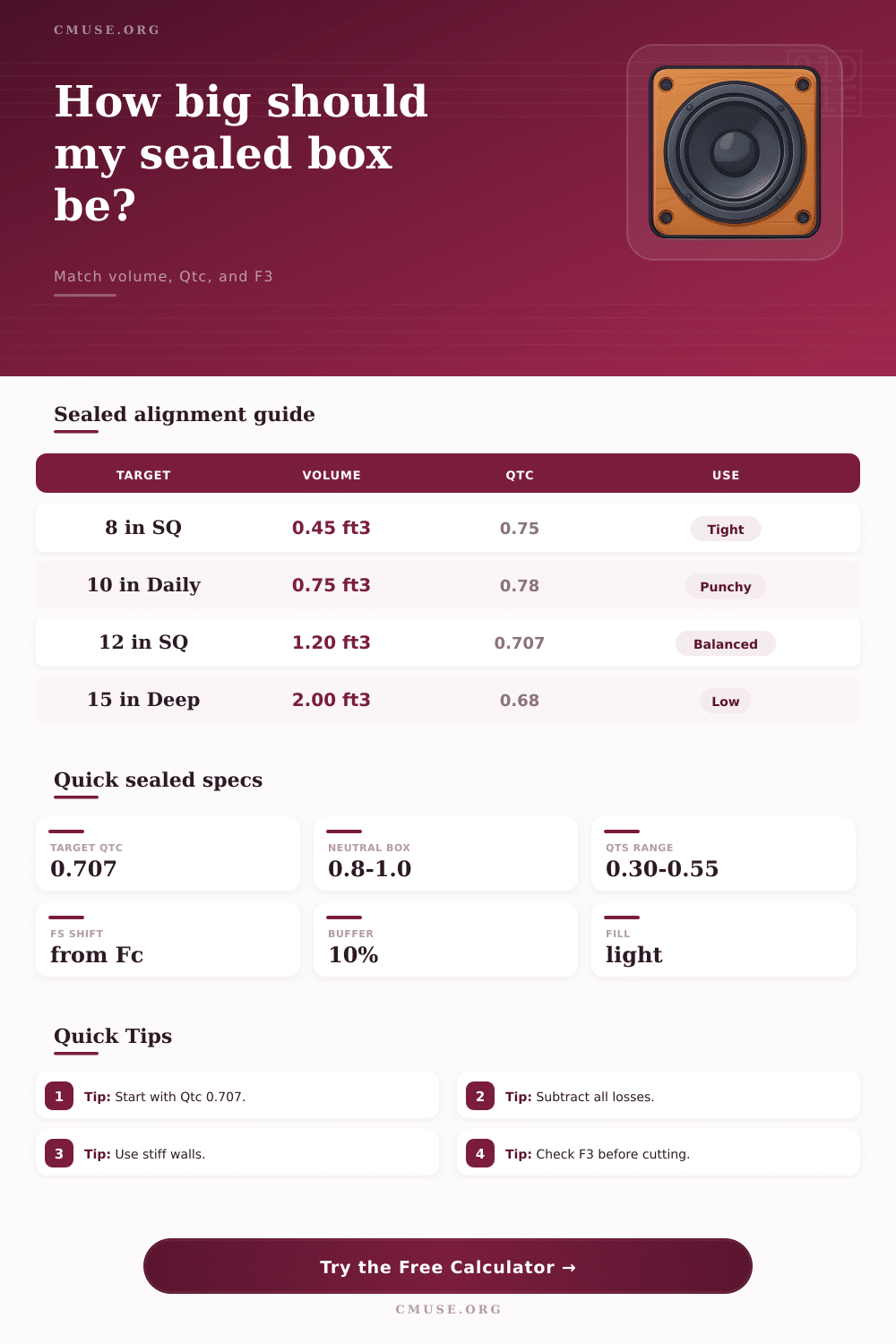
To design a sealed enclosure that produce the best sound from the subwoofer, you must understand the concept of Qtc. The Qtc of a subwoofer measures the system resonance of the subwoofers and it’s enclosure. The ideal Qtc for a subwoofer is 0.707.
This measurement will allow the subwoofer to play most frequencies even. When the Qtc is lower than 0.7, the sound from the subwoofer will be loose and boomy. However, if the Qtc is higher than 0.8, the sound will be tight and punchy with the subwoofer lacking in low frequency.
Many sound designer aim for a Qtc between 0.75 and 0.78 as this will allow the subwoofer to produce the best balance of sound impact and accuracy. When you calculate the dimension of a sealed subwoofer box, you must distinguish between gross and net volume. Gross volume is the total volume of the sealed enclosure.
However, net volume is the amount of airs within the enclosure once you subtract the space taken up by the enclosure’s components. You must subtract the displacement of the subwoofer driver from the gross volume. Additionally, if the enclosure feature internal bracing, you must also subtract the volume that the bracing take up from the gross volume.
If you dont take these measurements, the calculated net volume will be lower than the target net volume for the subwoofers. As a result, the calculated Qtc will be higher than the target Qtc for the subwoofer. The materials used to construct the sealed subwoofer box will impact the performance of the subwoofer.
Use stiff material like 18mm birch plywood or MDF to construct the sealed enclosure. If the wall of the enclosure flex, the enclosure will absorb energy from the subwoofer. Additionally, flexing wall will change the Qtc of the enclosure.
Another factor to consider when constructing the enclosure is ensuring that all joins between the materials are airtight. Use silicone or strong adhesive to join the enclosure as this will prevent the volume from changing and the subwoofer from performing incorrect. Polyfill can also be used to adjust the performance of a sealed subwoofer box.
Polyfill is a fibrous material that can be placed in the enclosure. Polyfill will make the volume of the enclosure act as if it were larger. Using polyfill will increase the volume of the enclosure by approximately 20%.
However, dont use too many polyfill as it will make the bass sound mushy. Finally, you must consider the external dimensions of the subwoofer enclosure. The thickness of the wood for the enclosure will impact the external dimensions of the enclosure.
For instance, if you use 19mm MDF for the construction of the subwoofer enclosure, you must add 19mm to each side of the internal dimension of the enclosure. Once you have calculated each external dimension of the enclosure, you can determine the final dimensions of the enclosure. To make this calculation, use a calculation tool.
This tool will tell you the final dimensions of the subwoofer enclosure so that it will both fit in the vehicle and meet the target Qtc of the subwoofer. You should of checked these dimensions twice to make sure they are actualy correct.