Schroeder Diffuser Calculator
Calculate QRD prime sequence wells, maximum depth, design frequency, scattering range, and panel layout for studio diffusion.
🎼Diffuser Presets
🎚QRD Design Inputs
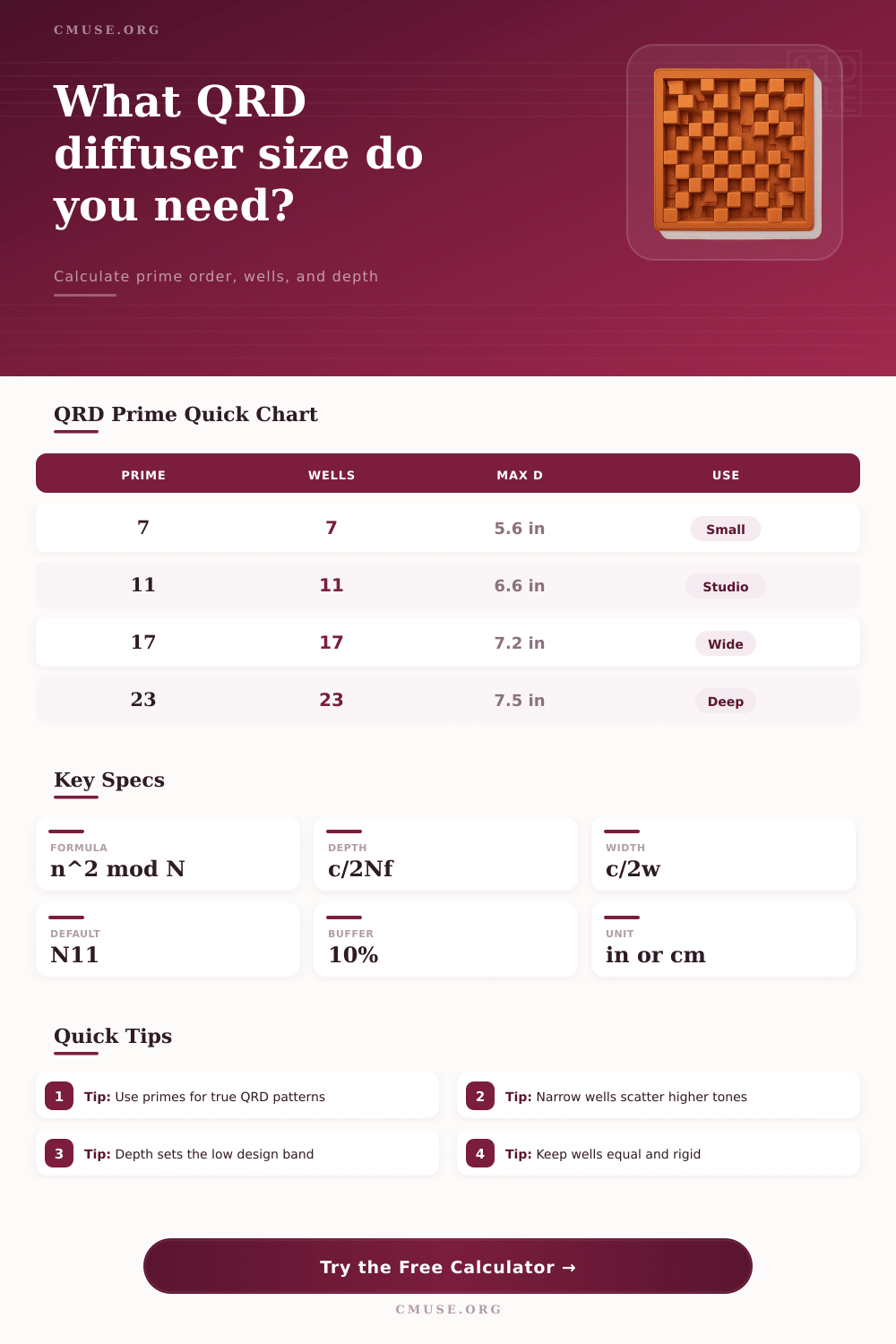
Depths use the one-dimensional QRD rule d(n) = residue × c / (2Nf0), where residue = n² mod N and N is prime.
Schroeder Diffuser Results
📏Calculated Spec Grid
🔢Well Depth Breakdown
📊QRD Prime Reference
| Prime N | Residue depths | Typical panel use | Design note |
|---|---|---|---|
| 5 | 3 unique depths | Narrow cloud or small insert | Compact pattern, limited spatial spread |
| 7 | 4 unique depths | Practice room, booth rear wall | Useful when wall width is tight |
| 11 | 6 unique depths | Home studio rear or side wall | Common balance of width and depth |
| 13 | 7 unique depths | Control room rear wall | Smoother scattering than small primes |
| 17 | 9 unique depths | Listening room or wide studio | Good coverage with moderate depth |
| 23 | 12 unique depths | Large live room or theater | Deep pattern with broad lateral spread |
🎧Well Width and Upper Range
| Well width | Metric width | Approx upper limit | Best fit |
|---|---|---|---|
| 1.0 in | 2.5 cm | 6,780 Hz | Bright rooms, high-frequency scattering |
| 1.5 in | 3.8 cm | 4,520 Hz | Balanced speech and music rooms |
| 2.0 in | 5.1 cm | 3,390 Hz | Home studio rear-wall diffuser |
| 3.0 in | 7.6 cm | 2,260 Hz | Deep live room or theater panels |
| 4.0 in | 10.2 cm | 1,695 Hz | Large-format low-mid diffusion |
🏛Common QRD Project Sizes
| Project | Prime and wells | Usual f0 | Panel target |
|---|---|---|---|
| Vocal booth rear | N7, 14 wells | 900 to 1200 Hz | Shallow scatter behind mic zone |
| Home studio rear wall | N11, 22 wells | 650 to 800 Hz | Two panels behind mix position |
| Control room rear wall | N13, 26 wells | 550 to 700 Hz | Wide horizontal diffusion |
| Hi-fi listening wall | N17, 34 wells | 500 to 650 Hz | Broad image support |
| Live room feature wall | N23, 46 wells | 420 to 550 Hz | Deep, spacious reflections |
📐Depth Formula Examples
| Design case | Formula focus | Example result | Meaning |
|---|---|---|---|
| N11 at 700 Hz | 10c / 22f0 | 7.1 in max | Deepest residue is 10 |
| N13 at 600 Hz | 12c / 26f0 | 8.7 in max | Lower f0 needs deeper wells |
| N17 at 550 Hz | 16c / 34f0 | 12.1 in max | Large prime broadens pattern |
| N7 at 1000 Hz | 6c / 14f0 | 5.8 in max | Compact high-band diffuser |
💡Diffuser Calculation Tips
Acoustic diffusion are a way to scatter sound waves in such a way that the sound does not pile up in the corner of the room (where sound reflects) and it does not flatten against the walls. Using acoustic diffusion makes sound travel more even throughout the room and makes the room feel larger than it actualy is. Schroeder diffusers is one type of acoustic diffusion tool.
Schroeder diffusers use quadratic residue sequences to scatter the sound waves. People use Schroeder diffusers because they provide scattering of the sound waves without turning the entire room into a dead box of sound absorbing material. A quadratic residue diffuser works by creating a surface with a series of wells of vary depths.
How Schroeder Diffusers Work
The depths of the wells follow a mathematical pattern based off a prime number, and that mathematical sequence is a repeating sequence. The sound waves that hit the quadratic residue diffuser will reflect off of each well at different times and at different angles due to the different depths of the wells. The result of the sound waves reflecting at different times and angles is that the sound scatter across a range of frequencies rather than creating a single reflection of the sound waves.
The prime number sequence that is created for the quadratic residue diffuser must be respected in order for the diffuser to effectively scatter the sound waves, so you can use calculators to ensure that the sequence are correct. The variables that must be understood in creating a quadratic residue diffuser are varied. The prime order of the quadratic residue diffuser will determine both the number of wells within each sequence of the diffuser, and the number of different depth that are used within the quadratic residue diffuser.
Higher primes will lead to a greater number of depths within the quadratic residue diffuser, and a higher prime will create a quadratic residue diffuser that scatters sound waves more smooth. Additionally, higher primes will require the quadratic residue diffuser panels to be wider and deeper in order to efficiently reflect sound waves with lower frequencies. The width of the wells will determine the upper end of the frequency range of sound waves that will be reflected by the quadratic residue diffuser.
Narrower wells will reflect higher frequencies. Finally, the depth of the wells will determine the low frequency performance of the quadratic residue diffuser; shallow wells will not reflect sound waves with low frequency. The temperature in which the quadratic residue diffuser will be built is a factor in the calculations.
The speed of sound changes with the changing air temperatures, which impact the wavelength of the sound waves. However, changing the temperature will not ruin the design of the quadratic residue diffuser; it will only change the frequency at which it begin to work. Additionally, you will have to incorporate a buffer into the calculations for the amount of materials required to build the quadratic residue diffuser.
Not only will the panels of materials be of a certain size, there will be error in the cutting of the panels. Therefore, allowing for a buffer in the calculation for the area that must be covered by the quadratic residue diffuser will ensure that there is enough material to create all of the divider required to build the quadratic residue diffuser. One of the mistakes that many people make when attempting to build a quadratic residue diffuser is to believe that the maximum depth of the wells is the only important measurement for the sound diffuser.
If the wells are too wide within the panel, the quadratic residue diffuser will not effectively scatter sound waves at the high frequencies. Additionally, if the quadratic residue diffuser panel is shallow, the sound waves will not efficiently scatter at the low frequencies. Therefore, it is important to first determine the frequency range of sound that need to be scattered in the specific area in which the quadratic residue diffuser is to be built.
After determining the frequencies, you can use the math to calculate the size of the panel required to reflect that range of frequencies. Many people mistakenly believe that creating a series of small quadratic residue diffuser panels and placing them side-by-side will work in the same way as a single large quadratic residue diffuser panel. However, if the goal is to obtain the full benefit of sound scattering by the quadratic residue diffuser, you should not stack the panels.
Both the total number of wells that are created by the quadratic residue diffuser, as well as the total number of panels that are created, is important variables in the construction of a quadratic residue diffuser. Each of these variables can have an impact upon the sound that is scattered by the quadratic residue diffuser. The variables in the real world are often not the same as those calculated by the mathematics of quadratic residue diffusers.
The presence of furnitures in the room, doors, and the curvature of the ceilings all play a role in how the sound travels within the built environment. While the calculation of the quadratic residue diffuser is not useless in this scenario, it is simply a starting point in the building of the sound scattering panel; adjustments must be made according to how the room sound once the quadratic residue diffuser is built. Running the number for a quadratic residue diffuser before actually building it is beneficial to the building process.
By running the numbers for the quadratic residue diffuser, it is possible to understand the relationship between the depth of the wells within the panels, the width of the wells, and the frequencies of the sound waves that will be reflected. Once you understand the relationship between these three variables, it is easier to make decision about the construction of the quadratic residue diffuser. It is possible to understand why a specific prime number is required for a quadratic residue diffuser of a certain size, and why adding one panel will have a more greater impact upon the sound scattering properties of the quadratic residue diffuser than increasing the depth of each of the wells within the panels.
Understanding the relationship between these variables ensures that the quadratic residue diffuser that is constructed is an actual acoustic tool for sound scattering, rather than a decorative tool for buildings and structure.