Scale Practice Cycle Calculator
Build a complete key, mode, octave, tempo, articulation, and repetition plan for one practice cycle.
🎹Scale Practice Presets
🎼Cycle Inputs
Practice Cycle Results
📊Current Scale Spec Grid
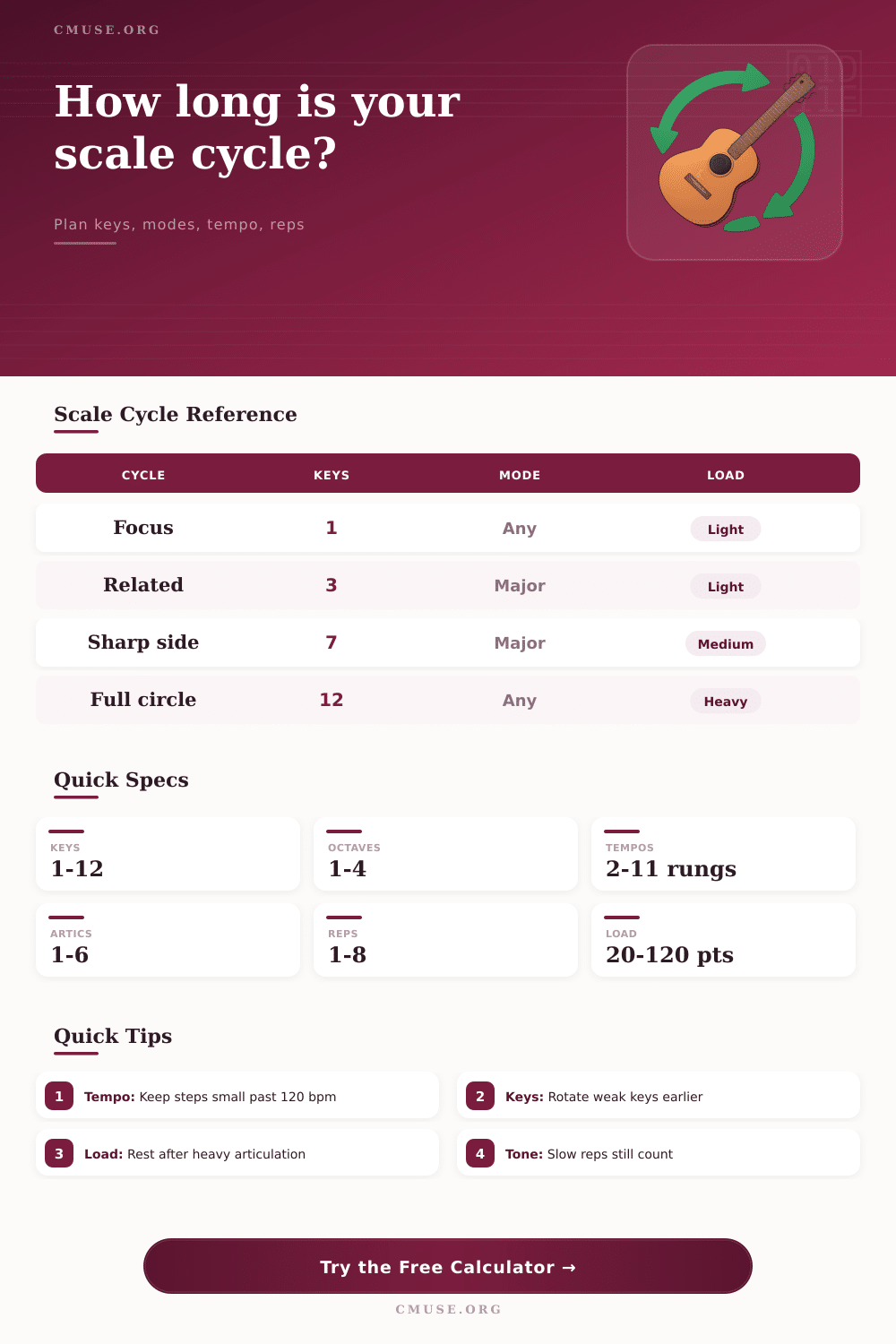
📘Key Cycle Reference
| Cycle type | Keys counted | Common use | Practice load |
|---|---|---|---|
| 1 focus key | 1 key | Repair weak fingering, intonation, or voicing | Light |
| 3 related keys | Tonic, dominant, relative minor | Short lesson assignment or audition polish | Light to medium |
| 7 sharp-side or flat-side keys | C plus one side of the circle | Reading fluency and key-signature balance | Medium |
| 12-key circle | All chromatic tonics | Complete major, minor, modal, or jazz routine | Heavy |
🎶Scale And Mode Specs
| Scale focus | Notes per octave | Extra attention | Best cycle use |
|---|---|---|---|
| Major scale | 8 including octave | Even fingering and tone center | Daily baseline |
| Harmonic minor | 8 including octave | Raised seventh leap control | Intonation and keyboard geography |
| Dorian or Mixolydian | 8 including octave | Modal color without drifting major | Jazz, folk, improvisation |
| Blues scale | 7 including octave | Blue-note placement and feel | Improvisation vocabulary |
| Chromatic scale | 13 including octave | Finger substitution and airflow | Agility and smooth connection |
⏱Tempo Ladder Planning Table
| Tempo zone | Suggested step | Repeat idea | When to stop |
|---|---|---|---|
| 40-72 bpm | 8-12 bpm | 1-2 clean passes | When fingering is stable |
| 72-108 bpm | 5-8 bpm | 2 clean passes | When tone remains centered |
| 108-144 bpm | 4-6 bpm | 2-3 clean passes | When tension rises |
| 144+ bpm | 4 bpm | Short bursts only | At first accuracy drop |
🎯Instrument Load Multipliers
| Instrument group | Load factor | Cycle risk | Planning note |
|---|---|---|---|
| Piano, guitar, bass | 0.95-1.05 | Hand fatigue | Watch repeated stretch patterns |
| Violin, cello | 1.10-1.18 | Shifts and bow changes | Keep tone before speed |
| Flute, saxophone, trumpet | 1.12-1.28 | Breath and embouchure | Add reset time for long ladders |
| Voice | 1.20 | Range and registration | Prefer smaller key groups |
💡Practice Cycle Tips
Most players see scales as just a warm-up before getting to important part: the music. This approach reduces technical practice to rote learning rather than purposeful skill building.
Once you input your desired objectives and instrument, the math has been done for you (by the calculator above) and you don’t need to guess if you’re practicing usefully or merely busily. It provides real guidance towards specific results based off your goals.
How to Use the Practice Calculator
You can choose variety by deciding what number of keys you want to cycle. That will make entire practice session different than before. Picking one key as the focus will be hard on your mind (high) but easy on your body (light). Running through all 12 keys in order (around the circle of fifths) mean it’s heavy on both body and mind. The chart below shows this clearly: the low seven sharp/flat side keys provides a balance between reading easily and tiring out your fingers or embouchure. Do you want a deep dive into something or a broad sweep across keyboard?
Most players lose their accuracy in tempo management. You can set a start speed and a goal, and then tool creates a ladder of intermediate steps between those two points. It assumes smaller steps preserves form, whereas bigger jumps invite tension. Around the time the tempo gets up into the 120 bpm range, the calculator advise keeping the step size narrow (four or five bpm). That’s the part people get wrong; they think you push harder for speed, when actualy you remove friction for speed. Your fingers aren’t fighting for position anymore at 130 bpm, so slowing back down to 125 isn’t failure, it’s data. The algorithm know about this and raises the repeat pressure as you target higher accuracy levels such as 98 percent clean notes.
To really multiply cycle size fast, consider articulation patterns, which add another layer of coordination on top of rhythm and pitch. Legato (playing smooth) is basic work but then add slurs, or groups of accents, and now you’re forcing your brain to track finger independence yet keep tone. It is no surprise that difficulty level increases when you select jazz swing or mixed classical packs. That’s double-practice in the same period! It might seem like there are too many notes to pass, but recall that focus over volume always wins, even if number of reps goes down.
The system also flags when your study cycle is longer than your available practice time, which serve as a helpful reality check for those of us planning 30-minute sessions. Load multipliers deserve special consideration from wind and string players whose instruments imposes physical limitations on them that are not present when playing the piano. Bow control on cello is more prone to degradation then finger stamina on the piano; breath support on the saxophone can deteriorate faster too. To account for this, the calculator increase the factors applied to those categories because it warns you that heavy cycles may be hurting your tone rather than improving your speed. To avoid that, it’s best to finish a lighter cycle with a good sound than to attempt a heavier one with strained technique. You should of focused on tone first.
Voice students should stay in smaller key groups because registration breaks is hard to fix in one session and offer no room for error. The key here is to be consistent rather than intense. By planning your practice into a cycle, you can target all those weak points without burning out your nervous system. Adjusting your rest ratio to allow for some recovery time will keep your hearing sharp and your muscles relaxed.
There’s no guess work involved in your day-to-day practice routine with this method, when you know the numbers, you simply do them. Scales no longer becomes an exercise in just going through the motions, but instead build a solid foundation upon which all other playing rests.