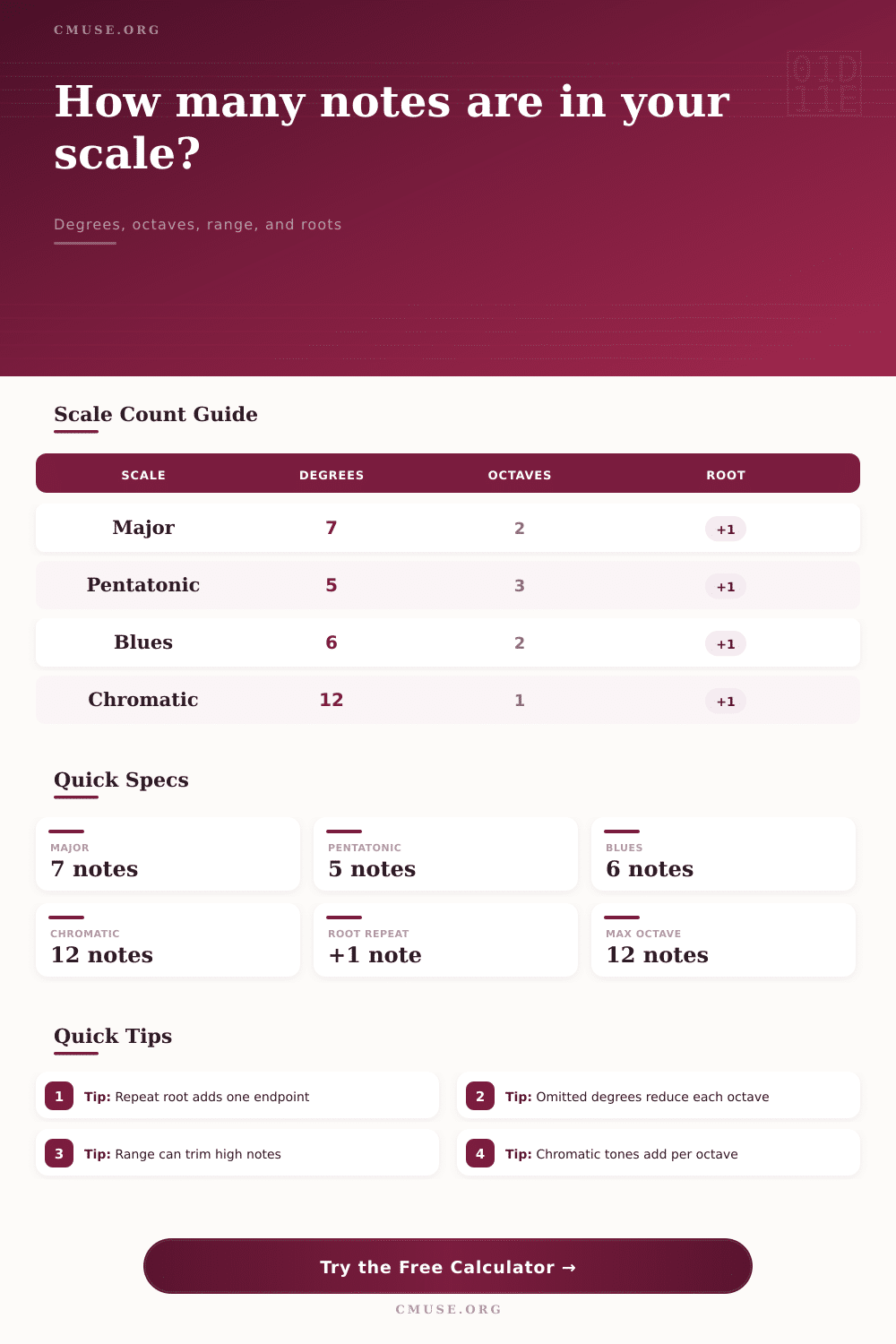
Scale Note Count Calculator
Count scale degrees across octaves with repeated roots, omitted tones, chromatic notes, and practical instrument range limits.
🎹Real Scale Presets
🎼Scale Inputs
Scale Count Results
📌Selected Scale Spec Grid
📊Scale Family Reference
| Scale family | Degrees per octave | Interval pattern | Counting use |
|---|---|---|---|
| Major | 7 | 1 2 3 4 5 6 7 | Standard lesson, exam, and warm-up counts |
| Natural minor | 7 | 1 2 b3 4 5 b6 b7 | Minor patterns without raised sixth or seventh |
| Major pentatonic | 5 | 1 2 3 5 6 | Short five-note patterns and open voicings |
| Minor pentatonic | 5 | 1 b3 4 5 b7 | Guitar boxes, bass fills, and vocal riffs |
| Blues | 6 | 1 b3 4 b5 5 b7 | Hexatonic blues studies with the blue note included |
| Chromatic | 12 | All semitones | Finger drills, enclosure studies, and full-note inventories |
🎻Instrument Range Examples
| Instrument or voice | Typical low | Typical high | Counting note |
|---|---|---|---|
| Piano | A0 | C8 | Most scale spans fit unless the root starts near an edge |
| Guitar standard tuning | E2 | E6 | Two-octave fingerings can lose notes below the sixth string |
| Violin | G3 | A7 | Three-octave scales often require position shifts |
| Flute | C4 | D7 | Whole-tone and chromatic studies fit well in mid range |
| Electric bass | E1 | G4 | One- and two-octave counts depend heavily on starting root |
| Alto voice | F3 | F5 | Omitted degrees help test singable reductions |
🔢Counting Rules Table
| Counting choice | Formula effect | Example | Result change |
|---|---|---|---|
| Repeated top root | Add one endpoint after the final octave | C major C4 to C6 | 14 becomes 15 |
| Omitted degree | Subtract that degree once per octave | Major without 4 and 7 | 7 becomes 5 per octave |
| Chromatic addition | Add entered passing tones per octave | One blue note in pentatonic | 5 becomes 6 per octave |
| Instrument range | Count only generated notes between low and high | Guitar E2 to E6 | Edge notes may be removed |
| Unique pitch classes | Ignore octave duplication | Two-octave major scale | Still 7 unique classes |
📝Common Practice Counts
| Practice pattern | Degrees used | Octave span | Written note count |
|---|---|---|---|
| One-octave major with final root | 7 | 1 | 8 notes |
| Two-octave major with final root | 7 | 2 | 15 notes |
| Three-octave violin major scale | 7 | 3 | 22 notes |
| Two-octave minor pentatonic | 5 | 2 | 11 notes |
| One-octave chromatic scale | 12 | 1 | 13 notes |
| Two-octave whole-tone scale | 6 | 2 | 13 notes |
💡Scale Counting Tips
For example, when learning scales, music student are commonly taught to play them upwards and then repeat downwards. Perfectly understandable, but have you considered how many different finger movements it takes? If you count the repeated note on the bottom of the scale too (which makes sense), then a two-octave major scale has fifteen individual notes to master. In contrast, there is perhaps just eleven notes if it is a pentatonic run over the same interval.
Practicing the timing of difficult sections or building stamina can matter much more to a beginner than you might think. Simply inputting your chosen octave range and scale type into the calculator above will do calculations for you. No guessing required!
How to Count Notes in Your Scales
This all hinges on the idea that a ‘scale’ is much more than a series of pitches. It’s a series of actions. There are seven degrees to a major scale and this may seem straight forward except when you begin to stack up these octaves over each other. To finish the cycle most players include another note at the end of the scale. It returns to the initial pitch class but in a higher range. This creates a single endpoint to overall number.
For example, imagine you are learning scales for an exam where you have to play three-octave scales. Knowing this endpoint rule lets you predict exactly how long you will be playing in terms of measures or beats. You could change the inputs to reflect the effect of leaving out degrees in the scale. What is the impact on the density of the pattern?
Pentatonic scales has been a staple of guitarists’ and bass players’ repertoires. These scales feature just five notes per octave so are more easly visualized on the fretboard. However, this also alters rhythmic feel as you travel from string to string. Although a minor pentatonic scale may look easy to visualize playing it across two octaves requires accurate finger coordination.
You can enter the missing degrees yourself and use this facility to create your own patterns that ‘skip’ certain intervals. This enables you to model complex moddern riffing ideas found in modern rock or complex jazz lines where there’s no need to conform to strict diatonic rules. It also opens up addition of chromatic passing tones that don’t alter the harmonic framework.
Interestingly, scale counting can also be affected by the instrument’s range. When a violinist begins with a G3 and moves up three octaves there are going to be some physical considerations they did not face if they were a pianist playing equivalent notes on C4 of the piano. There are fields within the calculator where you can enter your low and high note so that it filters out notes beyond what you play. This can be especially valuable for wind players or vocalists whose physical restrictions is very clear.
If the number of notes drops significantly after you enter the range into the calculator, it suggests the pattern you’ve selected is too much for your embouchure or voice. It might suggest moving the root note down or perhaps only trying an octave rather than the full two-octave range.
The other option is to view the data in terms of unique pitch classes. This means ignoring repeated octaves and simply looking at which notes occur in one pass around the circle. A chromatic scale always has twelve notes, no matter how many octaves you include because every semitone is accounted for. By comparison, when playing a major scale, the answer is always going to remain seven unique groups whether it is stretched over five or more octaves. So, the difference between unique pitches and the notes actualy being played lets us think about what’s being played harmonically (or vocally) instead of purely physically.
Jazz musicians frequently use chromatic enclosures or blue notes to add color to standard scales. They also make the texture denser, which demands greater breath control or finger work. You can set the number of extra notes added at each cycle and it will then accurately show what is required technically. Adding a flat fifth gives the blues scale its unique signature sound but this alters where your hands need to be on the guitar or which fingers plays the notes on the piano. Even slight changes in note density can result in large impacts on clarity and tempo.
In conclusion, knowing exactly how many notes are in your scale lets you plan your practice time more precisely. This is useful when preparing for a recital and learning the fingerings by heart. It is also helpful when creating practice routines that can be used every day. There is no guesswork involved as there are clear answers to help you make those decisions.
The reference tables on the page provide immediate comparisons of scales from one family to another across instrument ranges. This gives context to what feels easier or more difficult. No more guesstimating whether a three-octave run will fit into your metronome settings, or if you need to alter the pattern so it fits comfortabley inside your voice.
Learning to count notes is only part of learning them. After you have an accurate understanding of how many pitches to play, you can begin working towards correct articulation, spacing and musicality. Your mind will no longer need to worry about reaching the end of your fingers. You can transform those ideas into real things for practice.
Begin with playing a simple major scale and experience the basics of counting for yourself. As your playing improves, try adding extensions and omissions. Remember, regardless of how complex the math might be, the music should feel smooth.