Scale Interval Pattern Calculator
Convert W/H step patterns into semitone formulas, root-note scale spelling, degree offsets, and octave-wrapped note lists.
🎹Real Scale Presets
🎼Pattern Inputs
Use tokens such as W, H, W+H, 3, or comma-separated semitone steps. The total is tested against the 12-semitone octave.
Scale Pattern Results
| Degree | Note / Offset | Cumulative Semitones | Arriving Step |
|---|---|---|---|
| 1 | C4 | 0 | Root |
📊Selected Pattern Spec Grid
📘Step Token Reference
| Token | Meaning | Semitones | Common Use |
|---|---|---|---|
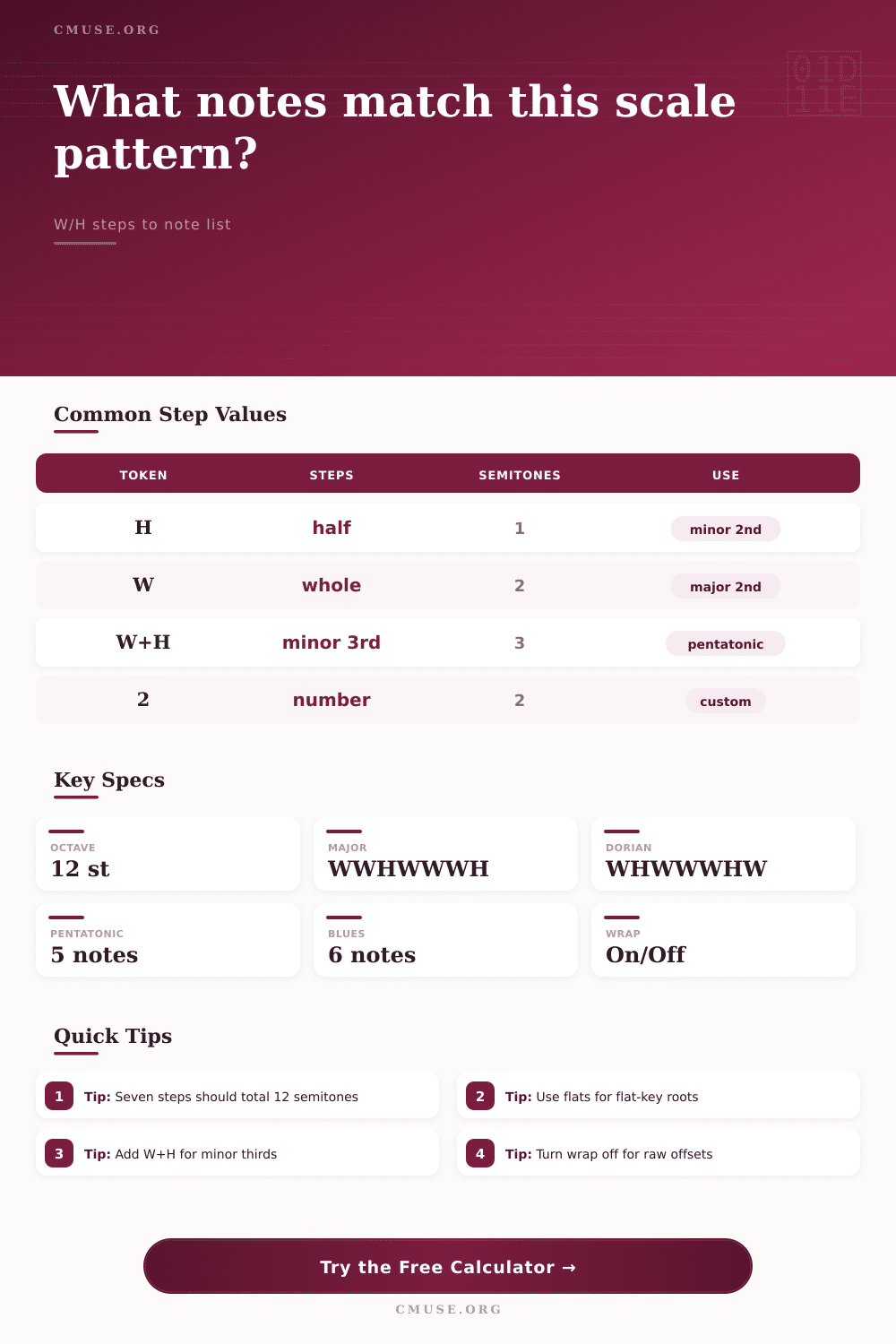
| H | Half step | 1 | Chromatic move, minor 2nd |
| W | Whole step | 2 | Major-scale neighbor step |
| W+H | Whole plus half | 3 | Minor third gap in pentatonic and blues scales |
| 3, 4, 5 | Direct semitone step | Exact number | Custom, synthetic, or non-diatonic formulas |
🎵Scale Family Patterns
| Scale | W/H Pattern | Semitone Formula | Family Signal |
|---|---|---|---|
| Ionian / major | W W H W W W H | 2-2-1-2-2-2-1 | Stable major center |
| Dorian | W H W W W H W | 2-1-2-2-2-1-2 | Minor with raised 6 |
| Phrygian | H W W W H W W | 1-2-2-2-1-2-2 | Minor with flat 2 |
| Lydian | W W W H W W H | 2-2-2-1-2-2-1 | Major with raised 4 |
| Mixolydian | W W H W W H W | 2-2-1-2-2-1-2 | Major with flat 7 |
| Aeolian / natural minor | W H W W H W W | 2-1-2-2-1-2-2 | Natural minor center |
⚙Preset Comparison Table
| Preset | Root | Displayed Scale | Why Use It |
|---|---|---|---|
| C Ionian major | C4 | C D E F G A B C | Clean baseline for W W H W W W H |
| D Dorian mode | D4 | D E F G A B C D | Shows the rotated major pattern from a minor tonic |
| A minor pentatonic | A4 | A C D E G A | Uses W+H gaps instead of seven adjacent degrees |
| C blues scale | C4 | C Eb F Gb G Bb C | Shows the added chromatic blue-note step |
💡Scale Pattern Tips
Perhaps you’ve felt like music theory is a secret language. You look at chord charts with string after string of Ws and Hs and think to yourself: what’s this hidden code? Well, there is no such thing. But the system appear intimidating unless you break it into physical actions on the keyboard or fretboard.
At its base, the entire system relies on distance. More specifically, it’s about measuring the distance from one note to another. Once you get past seeing letters and begin thinking in terms of steps, the entire system become mechanical instead of mystical. It’s just a matter of how far I have to jump.
How Music Scales Work
After you enter your root note and pattern, the calculator above do the rest of the work for you. You don’t have to waste mental energy figuring out how many semitones there is to be counted each time you wish to check the mode. These strange letters and numbers (W and H) gets converted into real pitch names that you can instantly hear and play without confusion.
This matters because it’s one thing to know intervals of a mode, but another to actualy hear how they sound starting on G versus starting on F. By making you choose a root, a preferred accidental spelling, and number of steps, the calculator removes any guesswork and tells you precisely which notes goes where.
The stumbling block for most newbies is thinking that every scale should have seven notes. Not so! Five are enough for pentatonic scales (penta means five). Six are used for blues scale. All twelve notes in an octave are used for chromatic scales. These shapes can be freely defined using the pattern input field. Presets include standard modes such as Aeolian or Ionian, so you don’t have to do the hard work of typing in whole steps and half-steps. Alternatively, you can do it yourself by typing in whole steps and half steps manually.
It opens up the geometric structure of music. Any musical scale is nothing more than a recurring shape in architecture. Alter where it starts, and you alter its character but not building blocks.
More time needs to be spent on accidentals. Knowing a note is three semitones up from the root isn’t enough. You also must understand if this means C natural or B sharp if you want to write something down for others to play. The switchable spelling preference allow you to choose which way the calculator should of spell a note according to conventional key signatures instead of simply by raw frequency alone. This helps keep your written music clear and avoids embarrassing double sharps when what you are playing should be in a simple key. Conventions matter, and notes should be written in a logical manner with respect to scale they appear in, even if the actual pitch is exactly the same as another note with the same sound.
Another option that shows the nature of pattern continuation on an instrument is called octave wrapping. If this option is selected, tool will limit the display of notes to just one register (octave) and allow you to more easily follow scale form as a complete circle. Unchecking this box gives you actual rising offsets without octave wrapping. This lets you see what happens from interval to interval and what the cumulative stacking effect are on the intervals. This view can shed some light on why some intervals sound wider or narrower than others if they are played consecutively.
It also displays something about mathematics of the system behind twelve-tone equal temperament, namely, there are precisely twelve semitones per octave. In other words, every diatonic scale need to add up to exactly 12 to reach initial pitch class again (back to the start). This works best if you don’t try and remember all potential combinations of these intervals. Simply know that a half-step is next-to each other whereas a whole step are two frets apart (or two white keys with no intervening black key). You can then build any scale family up or knock it down using these basic building blocks.
For common ones this is laid out in the reference table on the page, but more often than not, exploring your own unique patterns works best. Change the sequence of whole and half steps to create a brighter major sound different than darker minor or even exotic symmetrical sounds. It’s all about tension and movement in music. And these intervals shows this movement clearly. They point out where the friction points are and the areas of stability.
Seeing these intervals visually helps you move beyond rote learning into true comprehension of the construction of scales. It allows you to begin to see the links from one mode to another and realise they’re all variants of the same thing. When you glance across a scale chart again don’t simply read what’s there. Look at gaps between the notes. That’s where the music exists.