Scale Degree From Tonic Calculator
Enter a tonic, key spelling, mode, and note to identify the scale degree, movable-do solfege, semitone offset, chromatic alteration, and modal function.
Reverse degree model: the note letter identifies its written scale degree from the tonic, while the pitch class shows whether that degree is diatonic, raised, lowered, or outside the selected mode.
Calculation Breakdown
| Degree | Scale Note | Offset | Solfege And Function |
|---|
The current scale table updates from the tonic, octave, spelling bias, and mode above.
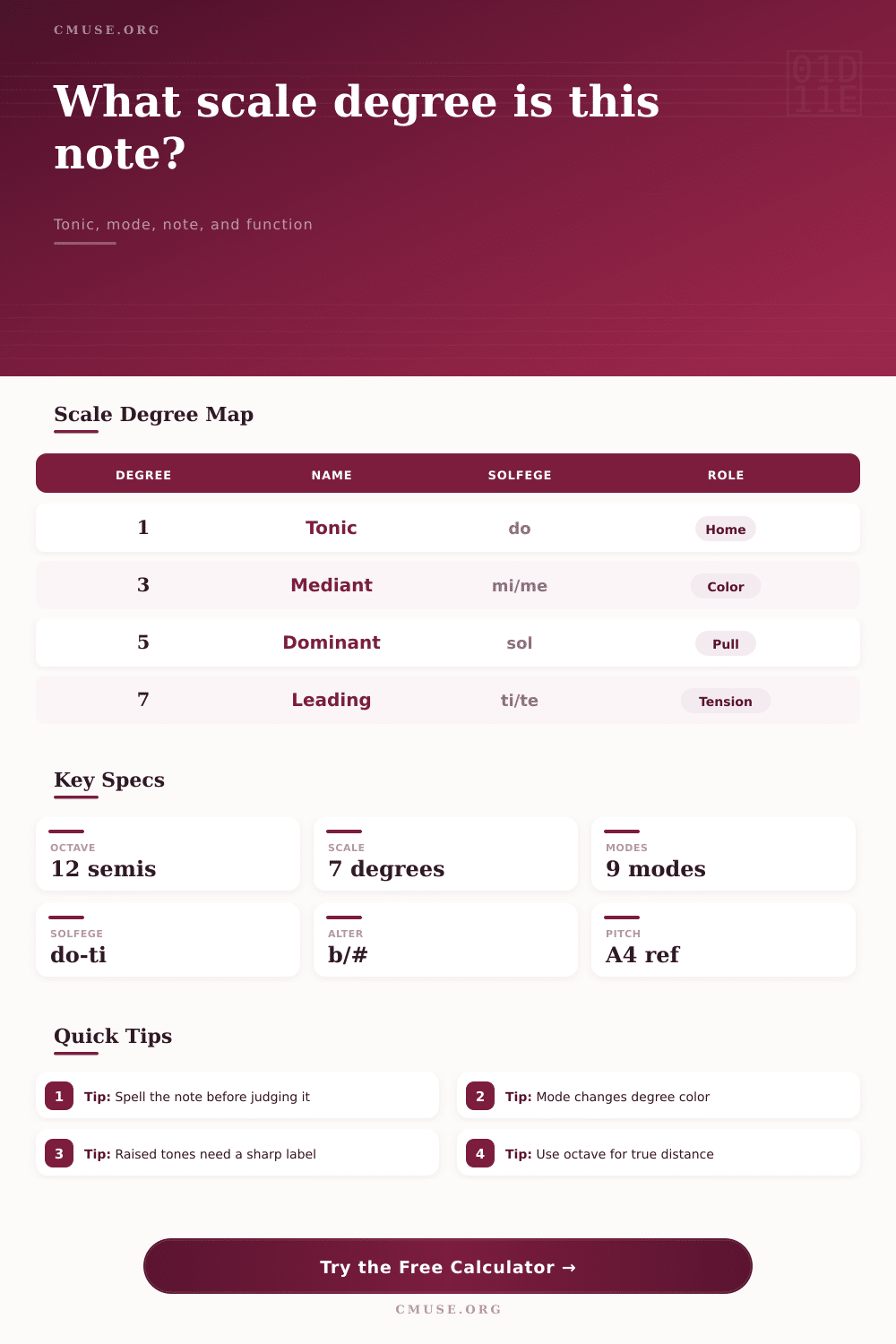
Rest point, home base, and final resolution.
Motion tone that often prepares 5 or returns to 1.
Defines major, minor, and modal color quickly.
Predominant lift, with sharp 4 giving Lydian color.
Strong cadence pressure unless flattened in Locrian.
Color and pivot tone; raised 6 brightens minor modes.
Raised 7 pulls to tonic; flat 7 relaxes the cadence.
Choose a note to see its modal role.
| Mode / Scale | Semitone Pattern | Altered Degrees | Typical Color |
|---|---|---|---|
| Major / Ionian | 0-2-4-5-7-9-11 | Natural 3, 6, 7 | Bright tonic stability |
| Natural minor / Aeolian | 0-2-3-5-7-8-10 | b3, b6, b7 | Flexible minor color |
| Harmonic minor | 0-2-3-5-7-8-11 | b3, b6, natural 7 | Minor with leading tone |
| Melodic minor | 0-2-3-5-7-9-11 | b3, natural 6, 7 | Ascending minor lift |
| Dorian | 0-2-3-5-7-9-10 | b3, b7 | Minor with raised 6 |
| Phrygian | 0-1-3-5-7-8-10 | b2, b3, b6, b7 | Dark flat-second pull |
| Lydian | 0-2-4-6-7-9-11 | #4 | Open raised-fourth color |
| Mixolydian | 0-2-4-5-7-9-10 | b7 | Dominant without leading tone |
| Locrian | 0-1-3-5-6-8-10 | b2, b3, b5, b6, b7 | Unstable diminished fifth |
| Written Degree | Diatonic Solfege | Lowered Form | Raised Form |
|---|---|---|---|
| 1 tonic | do | lowered do | di |
| 2 supertonic | re | ra | ri |
| 3 mediant | mi or me | me / lowered 3 | raised 3 |
| 4 subdominant | fa | lowered fa | fi |
| 5 dominant | sol | se | si |
| 6 submediant | la or le | le | raised 6 |
| 7 leading/subtonic | ti or te | te | raised 7 |
| Result | Meaning | Example From C | Use In Analysis |
|---|---|---|---|
| Diatonic | Pitch matches the selected mode degree | E in C major = 3 | Label by degree name and function. |
| Raised | Same written degree, higher pitch class | F# in C major = #4 | Keep the degree number and mark the alteration. |
| Lowered | Same written degree, lower pitch class | Eb in C major = b3 | Useful for mixture, blues, and borrowed color. |
| Nearest | Pitch-class reading ignores spelling | Gb from C can be b5 | Use when audio pitch matters more than notation. |
What happens is that with tonic stability, your brain locks onto root note. Other notes feel as though they are orbiting around this center. But music hardly ever remains in one place, does it? Home leaves and returns.
To understand what is happening, a note must be placed somewhere relative to that anchor. Is it an answer or a question? The calculator above do the maths for you. Enter your key and mode and it doesn’t ask you to guess at conversions or coefficients.
Understanding the Role of Each Note
Pitch is only part of what a scale degree are: It is also a function. The note C in a key of A minor are not the same as the note C in a key of C major. It’s home in C major. It’s the mediant in A minor. So it provides color rather than a sense of ending. Enter your tonic and target note into the tool to find out its musical role.
Beyond physical frequency, you are entering the mental world of role. That’s why most musicians gets this wrong; they’ve relied on their ears for training and not theory.
The color comes from the mode choice What is the color? The mode choice is where the real color is found. Switching from Natural Minor to Dorian alters the sixth degree by a semitone. That tiny alteration turns a sad-sounding minor scale into something more positive. The color calculator respond with an update in the semitone offset and the solfege. What it illustrates is movement from le to la. In doing so, it alters the emotional colour. With the tool illustrating the change for you, there’s no need to remember all of these modal permutations.
The spelling counts. Or should I say it does? In theory, there’s no difference between G flat and F sharp. It’s an example of two notes that are spelled differently but sound the same. When those pitches appear in the context of a key they become distinct. If you have an F sharp within a key of C major then it is a raised fourth. This gives the sound a Lydian feel. If instead, you have a G flat in the same key it is a diminished fifth. What is that? Well, it adds both tension and dissapears. That’s important if you’re writing music for traditional instruments or reading from sheet music. The tool recognise this with its spelled reading mode, forcing you to look at the notation first, not simply study the pitch.
On a fast memory aid the solfege output gives you this: hearing sol links back to dominant function. It is the fifth degree that must be resolved. Then hearing ti indicates the leading tone. It is the note that needs the tonic. It’s no accident that these syllables work. It’s a language created to express the weight of harmony. The calculator syllable represent an act of translation that transforms raw data into musical intuition. It is a start on understanding the function behind the frequency.
You will also notice the semitone offset. That’s the raw distance from the tonic. It is the raw distance, stripped of any modal context and presented to you with physical reality. Four semitones make a major third. Three make a minor third. Transposition uses this metric. Instruments that are not tuned to the standard also benefits from it. Abstract theory meets measurable reality.
The problem arises when we forget to consider the context of the note; for example, if a note sounds ‘strong’ then perhaps it’s a dominant note. Or perhaps not? Maybe in Locrian mode that identical pitch class is now acting as a flat five. Now we have an unstable note that lacks direction or drive. The reference table on the page illustrate this well. It highlights the modes and how the altered degrees change the color of each mode. It serves to remind us that a note is only as stable as the scale around it.
Understanding relationships is what analyzing scale degrees is all about. It is not for academic note labeling but to know why a melody sounds the way it does. Knowing when a phrase is in the subdominant means you know it’s not finished. Why? Because there is a sense of tension and that is what music storytelling is all about.
When you analyse, or compose, make a map of your notes. What’s the tonic? What’s the degree? What’s the function? If you can see the architecture behind the sound, then you will hear it differently. It’s not just a bunch of random pitches but rather a carefully designed piece of work. Where does this tune sit in relation to home? Sometimes you may find that coming back is the most interesting part of the trip.
You should of seen how much better it sounds.