SBIR Frequency Calculator
Estimate speaker boundary interference response from front, side, rear, and listening wall distances, then compare nulls, boundary gain, placement options, and treatment depth.
Room And Placement Presets
SBIR Inputs
Calculation Breakdown
Boundary Null Table
| Boundary | Distance | Path Difference | 1st Null | 3rd Null | Risk |
|---|
Null Harmonic Series
| Boundary | n1 | n2 | n3 | n4 | n5 |
|---|
Treatment Thickness Table
| Target | 1/4 Wave Depth | 1/8 Wave Depth | Your Total Depth | Use |
|---|
SBIR Placement Grid
Boundary Gain Reference
| Placement | Expected Gain | SBIR Tradeoff | Best Use |
|---|---|---|---|
| Free standing | 0 to +2 dB | Lower first null, less bass lift | Large rooms with measurement freedom |
| Near front wall | +2 to +4 dB | Higher front-wall null, easier to treat | Most nearfield studios |
| Front plus side wall | +4 to +6 dB | More overlapping reflection paths | Asymmetric or narrow rooms |
| Corner | +6 to +9 dB | Strong modal and SBIR interaction | Subs after EQ and measurement |
| Flush / soffit | +3 to +6 dB | Front-wall SBIR mostly removed | Purpose-built control rooms |
Did you ever mix something that’s tight sounding on your phone but muddier in your studio? It’s not always the speakers. Often its the room, which is creating what we call speaker boundary interference response. The sound wave come from drivers and strike a wall. From there they bounce back toward your ears canceling certain frequencies. The frequencies return a little bit out of phase with themselves. What you hear is an uneven or hollow bass response.
Now you have a tough time mixing because you think the mix needs more bottom, so you turn up the EQ. Then when you listen on another system, the mix sound boomy. You just made up for the room null rather than the mix issue. The math is simple: If the path length difference is half a wavelength, there’s a big dip in the frequency response.
Fixing Bass Problems With Speaker Placement
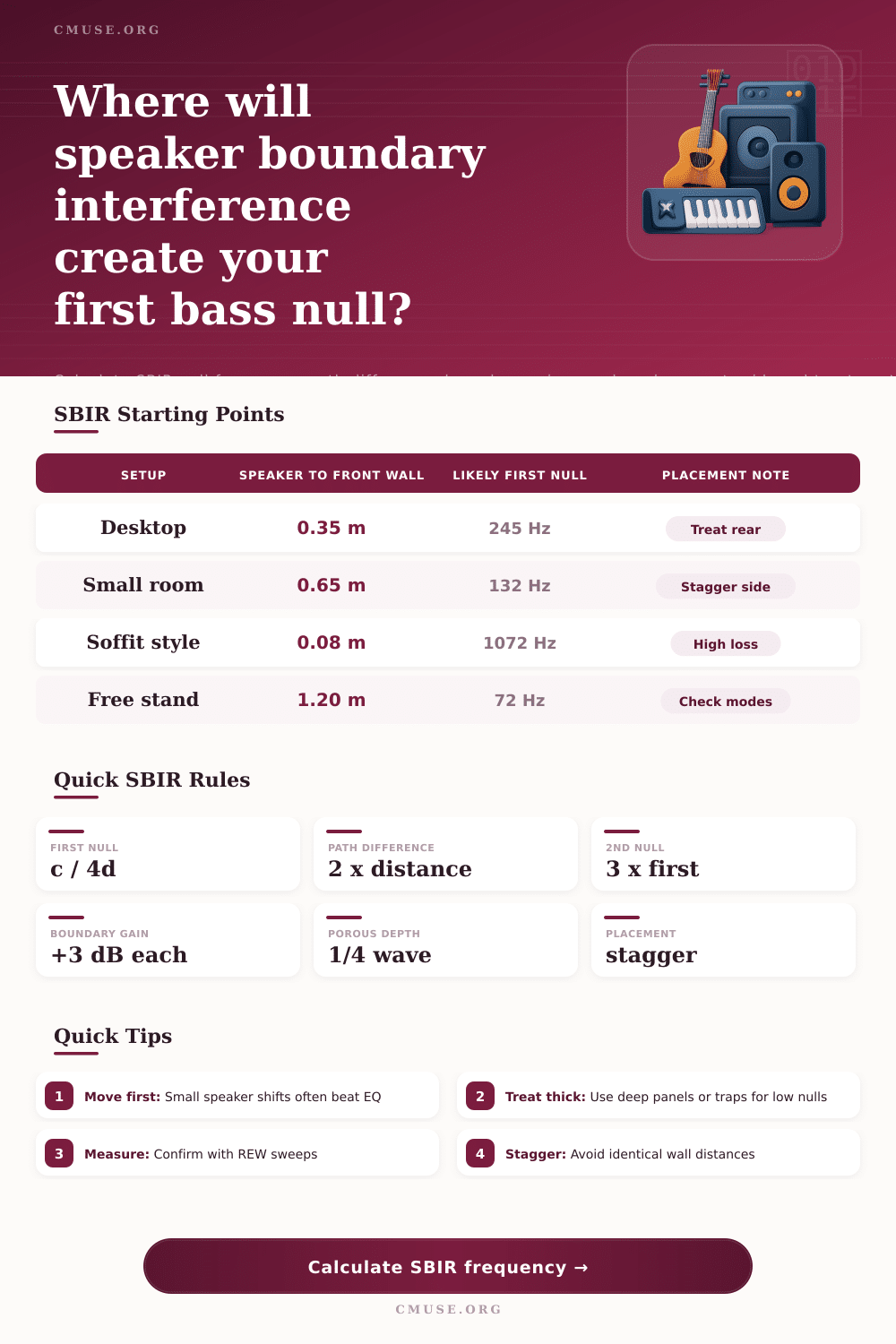
How do you understand what that means? Well, it’s complicated. At room temperature, the speed of sound is about 343 meters per second. Divide the speed of sound (in meters/second) by four times the distance to next wall and you have the frequency where you’ll notice a serious drop off in the sound.
Slide the speaker back six inches and location of first bass null moves up or down by dozens of hertz. It is a pretty small physical adjustment with a significant acoustical result. The calculator above do the math for you. It converts distance into precise frequencies. See exactly what notes you’re cutting out of your sound.
The distance from your listening position to front wall is what most folks talk about. And they should because in most nearfields, that’s typically going to be the dominant boundary. But don’t neglect the rear wall behind you and the side walls. Side reflections also produce nulls of their own. When your speakers is positioned closer to the sides than the front, those lateral reflections will smear up your mid-bass response.
Staggering your speakers (a simple geometric trick) spreads those cancellations out instead of stacking them on top of one another. It often buys you more clarity different than acoustic foam. On the flipside we have boundary gain. By putting your speakers near boundaries such as walls you can increase the sound level of bass. Low frequencies is reflected back off the wall in a constructive way. In other words, it sounds louder down there.
And here’s the price: The nearer you approach the boundary the higher and steeper the first null becomes. For example, a speaker sitting flush on a front wall may provide excess boom down at eighty hertz or lower. But it probably would of produce a nasty cancellation spike just above that note. It’s one or the other… Either more low end or a smoother transition into midrange. Acoustics is always a matter of tradeoff.
Absorption can be used as treatment in these nulls but it can be confusing. To treat for a particular frequency, the treatment needs to be about one-quarter of the wavelength deep. A good rule of thumb is that thickness of absorber should be about one-fourth the wavelength. So if your initial null occurs at one-hundred twenty hertz, then you are going to require thicker treatments (more than regular two inch studio foam). Thin panels will not address these problem frequency. They simply appear nice on the wall.
The tool give you a reference point for how far into the room you would have to go to physically dampen the reflection. This is an option other than changing the source. First, it is all about geometry to fix speaker boundary interference response. Don’t think you can EQ your way out of a deep null without impacting phase coherence and headroom. Move either the listening position or the speakers. That will shift cancellations away from being on top of each other on musical notes.
Measure it. Adjust a bit. Listen. When the physical layout is dialed in, then other problems are more easily addressed. Use subtle equalization and careful treatment. But begin with distance; that’s where it all starts. Actualy, its better to start there.