Practice Hours to Learn Saxophone Calculator
Estimate saxophone learning time from embouchure stability, breath support, reed response, tone control, fingerings, articulation, and jazz or classical goals.
Calculation Breakdown
| Practice Block | Weekly Time | Main Sax Skill | What It Stabilizes |
|---|
Highest pitch, sharp intonation sensitivity
Common starter, balanced air demand
More air, larger voicing target
Heavy air load, bigger finger spread
| Learning Goal | Typical Focused Hours | Sax-Specific Gate | Primary Risk If Rushed |
|---|---|---|---|
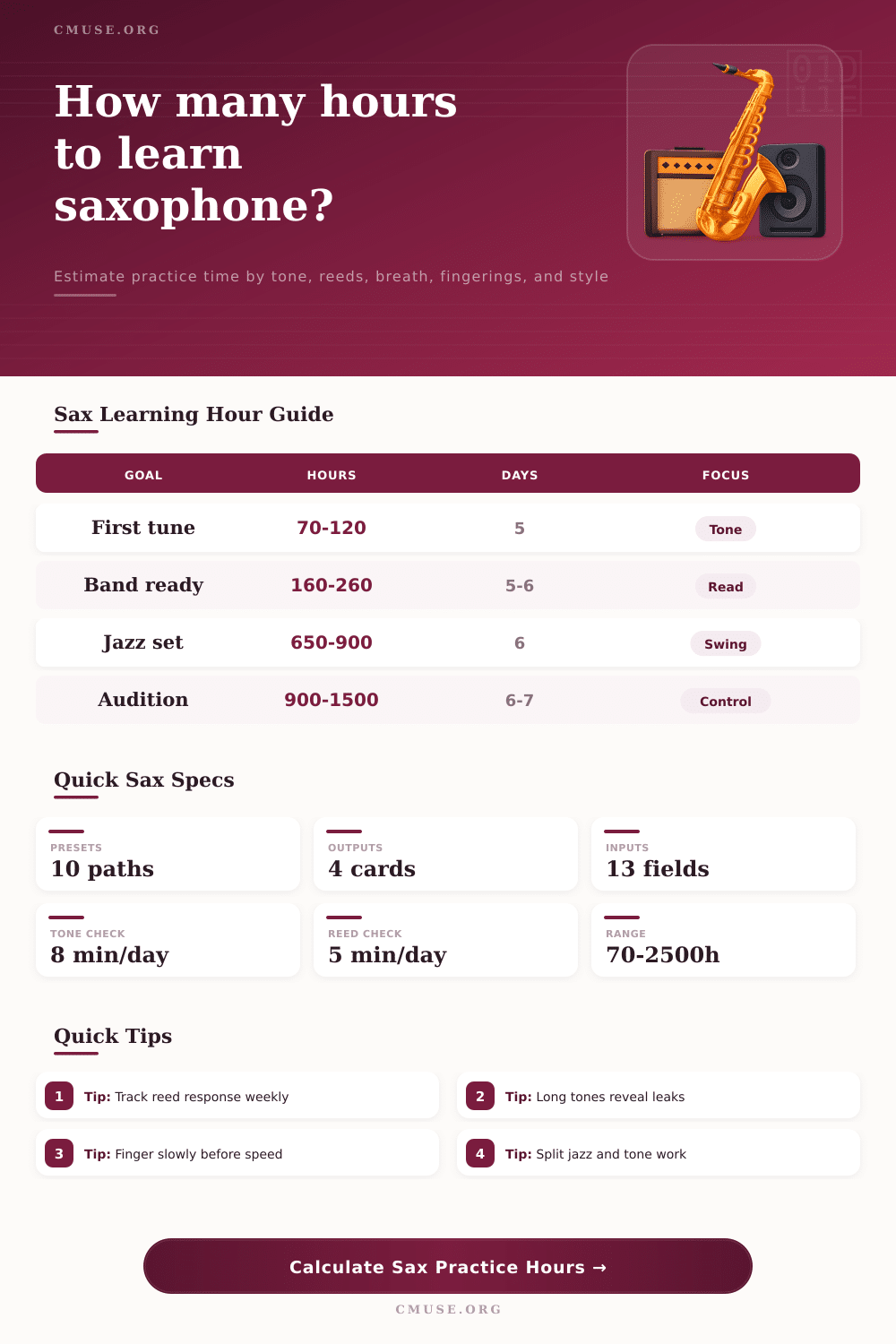
| First clear tune | 70–120 hours | Seal, air start, octave break | Biting the reed and unstable pitch |
| Ensemble ready | 160–260 hours | Fingerings, reading, section blend | Weak low notes and late entrances |
| Solid beginner tone | 240–420 hours | Long tones, articulation, reed matching | Thin tone that changes by register |
| Jazz combo ready | 650–900 hours | Swing articulation, blues language, guide tones | Scale runs without phrasing |
| Classical audition ready | 900–1500 hours | Tuning, even tone, clean starts, altissimo prep | Uncontrolled attacks and uneven vibrato |
| Sax Type | Common Starting Reed | Learning Load | Why It Changes Hours |
|---|---|---|---|
| Soprano sax | 2.0–2.5 | High | Pitch center is narrow, so embouchure and voicing errors show quickly. |
| Alto sax | 2.0–2.5 | Medium | Balanced air resistance and hand position make it the fastest starter path. |
| Tenor sax | 2.0–2.5 | Medium+ | Requires more air column control and a larger voicing target than alto. |
| Baritone sax | 2.0–3.0 | High | Air volume, horn weight, and low-note response add endurance work. |
| Sax Skill | Calculator Weight | Practice Evidence | Useful Check |
|---|---|---|---|
| Embouchure stability | 22% | Steady pitch, fewer squeaks, relaxed jaw | Hold middle G for 12–20 seconds without wobble. |
| Tone control | 22% | Matched registers, usable dynamics, centered sound | Play low D to palm D with similar tone color. |
| Breath support | 18% | Full phrase length, stable starts, no collapsing ends | Crescendo a long tone without biting. |
| Fingering fluency | 18% | Clean octave key moves, side keys, low notes | Move through chromatic notes at a slow metronome. |
| Articulation accuracy | 15% | Clean tongued starts, slurs, accents, swing feel | Alternate legato and tongued eighth notes evenly. |
| Reed consistency | 5% | Predictable response across several reeds | Compare three reeds before judging your tone. |
| Track | Extra Hour Driver | Typical Add-On | Practice Emphasis |
|---|---|---|---|
| General sax | Reading, tone, fingerings | Base estimate | Long tones, scales, simple repertoire, clean attacks. |
| Classical sax | Intonation and even articulation | 5%–12% | Slow tone matching, tuning drones, articulation clarity. |
| Jazz sax | Swing feel, vocabulary, transposition, ears | 8%–18% | Blues, guide tones, call-and-response, rhythmic phrasing. |
| Both tracks | Two tone concepts and two articulation systems | 14%–28% | Separate sound models so one style does not blur the other. |
| Scenario | Weekly Time | Best Fit | Expected Feel |
|---|---|---|---|
| 20 minutes, 4 days | 1.3 hours | First notes or maintenance | Good habit builder, slow calendar progress. |
| 35 minutes, 5 days | 2.9 hours | Beginner to ensemble ready | Enough contact for embouchure and reading growth. |
| 60 minutes, 6 days | 6.0 hours | Jazz combo or audition prep | Can split tone, technique, repertoire, and improv. |
| 90 minutes, 6 days | 9.0 hours | Serious classical or jazz track | Needs rest breaks to avoid jaw tension and reed fatigue. |
This is something all budding sax players come to realize sooner or later: It doesn’t matter how much money you have spent on that shiny new horn; if your embouchure is out of control and you blow into some bargain basement reed then it’s going to sound like you are trying to play a very annoyed goose.
Vague intentions don’t equate to a few focused minutes of practice. To put it simply, most student fail because they practice for time instead of practicing for outcomes. They’ll sit down for an hour, spend twenty minutes trying to assemble the horn or scrolling through social media while the horn sits on their knee. Focus on isolating specific mechanical failure points and deliberatey repeat until real progress occurs.
How to Get Better at Playing Saxophone
Now that you know what’s missing (plug them into the calculator above), you don’t have to guess. How many weeks will it take to reach a firm low Bb? Just plug in honest numbers about your strengths (or lack thereof) on things like tone control, breath support, and embouchure stability, and it does the work for you.
Those thing add up quickly. If you’ve got a weak lip seal then each time you practice it strengthens it as a habit, until one day it’s muscle memory. That’s the mistake people make. Tone isn’t something you just find. Tone is something you develop with long tones played at a volume that feels uncomfortable.
This tool weights those thing heavily because they are the foundation for everything else. If you can’t hold a solid note without wavering in pitch, you won’t be able to improvise well.
Let’s think about the differences in playing tenor versus alto saxophones. The alto sax is a popular beginner instrument because it is smaller, making hand positions easier and air resistance less intense. In contrast, baritone sax takes some getting used to. It require a lot of air and more control over your lungs. It is also heavy.
So if you’re transferring from clarinet, you’ll probably have greater finger dexterity but your embouchure will need to let go somewhat. Clarinettists tend to bite down on their reed to create a sound, but saxophones respond better to a soft covering of the mouthpiece and an even breath supply.
The calculator takes existing experience into account when calculating the estimated time. The returner may find they only lose 100 or so hours before regaining lost stamina whilst the complete novice could easily double that figure trying to focus their tonal centre without squeaking!
Another issue with the classical approach is that classical instruction doesn’t always include jazz playing. When you read music you aren’t just reading notes but internalizing rhythm placement and vocabulary. This means you must make decisions spontaneously and train your ears. All of this add a lot of time to the learning curve.
Embouchures also change with jazz articulation versus classical legato. Prepare for a longer ride if you intend to be proficient at both styles. Because these two playing methods use opposing techniques, splitting your practice time can slow down your progress unless you dedicate certain days to one or the other.
Consistency trumps intensity. Thirty minutes a day will go further then cramming four hours on Saturday. This will cause you to tense up your jaw and exhaust your reeds. Doing so defeats purpose of developing muscle memory.
While it may be tempting to invest in a luxurios mouthpiece brand first, stick with what works for now. If your reeds is chirping, or won’t respond, you’re not going to hear yourself correctly. It’s easy to blame your lips, but a warped or dry reed might actualy be the problem.
Having a few matched reeds in a pile gives you confidence. You can go back and forth without worrying about response, allowing you to concentrate instead on developing good habits. Keep track of which reeds sound best each week and toss those you find less consistent. This little exercise will keep bad habit out of your mouth.
So in conclusion, becoming a good saxophonist has very little to do with talent and much more to do with perseverance through the frustrations. The time will pass slowly. There’ll be weeks when it feels as if you’re going backwards and then suddenly a phrase come out easily. Have faith in the slow progress. Maintain a gentle lip position, rapid breath, and specific objectives. Then when you eventually get that first clean tune under your belt you should of known that every second of effort paid off.