Rubato Deviation Percent Calculator
Compare a notated tempo with actual phrase timing to quantify expressive stretch, compression, and tempo elasticity across a chosen beat span.
🎼Real Rubato Presets
⏱Timing Inputs
Rubato Result
📊Rubato Spec Grid
🎹Phrase Type Reference
| Phrase type | Typical deviation | Common direction | Reading note |
|---|---|---|---|
| Cadence arrival | 6% to 18% | Stretch | Often expands into harmonic resolution or a final note. |
| Pickup or upbeat | 2% to 9% | Compress | May lean forward before a downbeat or lyric entry. |
| Melodic high point | 4% to 12% | Stretch | Peak notes often receive slightly more time than the surrounding pulse. |
| Recitative speech rhythm | 10% to 28% | Mixed | Speech contour can outrank strict pulse in short spans. |
| Transition passage | 3% to 10% | Either | Movement between ideas can push forward or relax. |
| Cadenza or fermata span | 18% to 45% | Stretch | Use phrase intent rather than barline regularity as the comparison. |
🎻Performer Style Benchmarks
| Style | Usual range | Best span | Interpretation cue |
|---|---|---|---|
| Historically restrained | 0% to 6% | 4 to 16 beats | Favor local articulation over broad tempo drift. |
| Classical balanced | 2% to 8% | 4 to 12 beats | Rubato should preserve phrase proportion and ensemble clarity. |
| Romantic elastic | 6% to 18% | 2 to 16 beats | Cadences and melodic peaks can widen noticeably. |
| Impressionist floating | 5% to 15% | 4 to 20 beats | Elasticity may be spread across color changes. |
| Jazz ballad flexible | 4% to 16% | 1 to 8 beats | Pickup timing and behind-the-beat placement matter. |
| Vocal breath-led | 5% to 20% | 2 to 12 beats | Breath, diction, and consonants affect the stopwatch reading. |
| Contemporary precise | 0% to 5% | 8 to 32 beats | Small deviations can be deliberate when texture is sparse. |
🔢Deviation Classification Table
| Deviation | Timing character | Tempo effect | Use with care when |
|---|---|---|---|
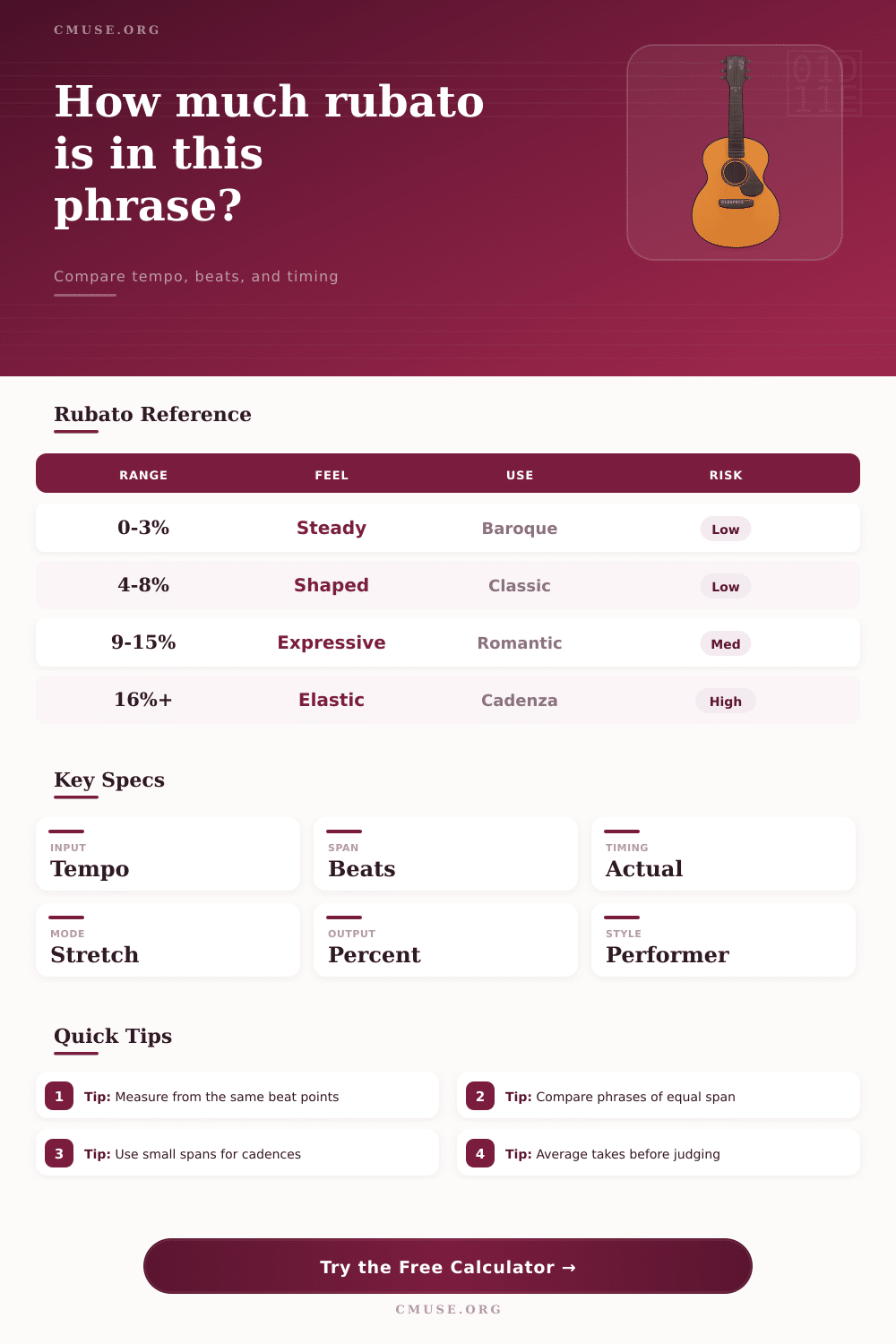
| 0% to 3% | Nearly steady | Tempo remains clearly projected | The line needs audible breath or cadence. |
| 4% to 8% | Controlled rubato | Small tempo shift across the phrase | Ensemble entrances follow immediately. |
| 9% to 15% | Expressive rubato | Listeners hear elastic time | The harmonic rhythm is already dense. |
| 16% to 25% | Strong expansion | Phrase tempo changes substantially | The pulse must resume without ambiguity. |
| 26% and above | Free or cadenza-like | Notation is a loose reference | The passage is not meant to sound free. |
📝Measured Scenario Examples
| Scenario | Notation | Actual timing | Approximate deviation |
|---|---|---|---|
| Chopin-style cadence | 8 beats at 72 BPM | 7.35 seconds | 10% stretch |
| Mozart aria breath | 4 beats at 84 BPM | 3.05 seconds | 7% stretch |
| String quartet arrival | 6 beats at 66 BPM | 5.85 seconds | 7% stretch |
| Jazz ballad pickup | 2 beats at 58 BPM | 1.86 seconds | 10% compress |
| Baroque arioso line | 12 beats at 76 BPM | 9.7 seconds | 2% stretch |
💡Timing Tips
Tempo flexibility, known as rubato, is considered by most musicians to be a necessary element of emotional expression, although equally conceded as something hard to teach or comment on. People often use phrases like “letting the phrase breathe” or “playing with freedom” to describe it, but these descriptions are too vague to help you understand. One person’s naturaly flowing rendition may sound sloppy to another. Conversations about tempo flexibility is missing a simple way to measure exactly how much time is added or subtracted compared to written instruction.
That’s where this calculator steps in to convert the span of beats (and seconds) into an unambiguous deviation percentage. It takes the subjectivity out of saying that someone has played too freely, or too tightly, or with shape. It bases its central calculation on relationship between the indicated tempo and the time it actualy takes you to play a section of music. It asks for the number of beats in that phrase. It also asks for the number of beats per minute as noted and the actual amount of time it took in real life, measured using a stopwatch or another piece of recording software.
How to Measure Music Timing
From there, it calculates the difference between expected time and the real time. This will give you an exact percentage of how far away from the metronome click you was playing. If this is equal to zero then your performance perfectly adhered to what’s on the page. Any positive figure show how much you stretched and took longer then the written note. Negative values represent compressing the music into a shorter space than the notation implies.
This accuracy can help distinguish the artistically intended from the accidentally wobbly tempo. Remember that context matters when interpreting these findings. What may be a disastrous stretch for a dance rhythm could be perfectly fine for a romantic cadence. To help set your expectations, the calculator contains settings for a range of musical types.
In general terms, we can think about baroque music as requiring a degree of control over change with variations typically not exceeding a five percent stretch. This maintains the clarity of pulse while keeping structural integrity. By contrast, the romantic period often uses far more generous swells to highlight a melodic climax or emphasise harmonic tensions. Knowing these parameters means you cannot apply one rule to every piece you perform. You are forced instead to think about what the composer intended along with your instinctive feel for how you wish to perform it.
Another problem arises when people begin their timing either too early or too late within the music. Then they stop too soon or stay too long after the last note, that data will be suspect. To keep things consistent the tool requires you to specify a beat span for the time-span. Then always measure between definite parts of the notation such as strong beats or the end of a bar. Then each piece of analysis can be considered as an equal amount of music.
As a bonus it flags up exactly where the ‘stretch’ or ‘compression’ is taking place. Perhaps it’s towards the tail-end of the phrase? Maybe it’s during a flurried passage of rapid running notes? Knowing where the deviation is actually happening on a small scale enables you to improve your technical command, not merely accept a general feeling.
Tempo management becomes even more complex when considering ensemble playing. If several voices or instruments is to be heard in unison, then each player’s rubato needs to be coordinated or soon descends into chaos. The reference tables from the calculator point towards checking for coordination over shorter spans. So, while it may well be fine to have broad elasticity over a whole phrase, the entry points should of been matched more tightly.
Having an idea of what percentage of deviation you’re making allows you to better communicate with fellow player. You don’t need to say hurry up or slow down, but rather talk about changes to timing based off measurable data. It’s objective language that often results in quicker and more accurate rehearsals as everybody knows where they are aiming.
Finally, numbers don’t take the place of art, they simply serve it. A calculator like the one shown above will do the math for you if you enter your measurements, but you make all the artistic decisions. A totally even zero percent can sound coldly mechanical. A wildly off-the-wall twenty percent deviation can sound indulgent and unfocused. You are aiming to find that sweet spot where time serves the music’s story.
You need enough time to communicate feeling without letting go of the structural anchor that keeps the piece together. Doing this exercise with this kind of tool develops your own inner sense of proportion. It conditions your ear to pick up on tiny changes in timing before they become glaring mistakes. It takes something as abstract as breath and flow and makes it into real technical choices.
The ability to manage tempo flexibility come through experience. You need to listen carefully to other people’s work, examine their performances, and use a metronome in non-obvious ways. This information shows how you approach playing. And this shows you habits you may never have realized you had. Maybe you always lag on the cadences no matter the genre or force those pickup notes at a furious pace. If you know what you do you can then address it with intent.
From there you get more license in the music. You have more liberty to shape the pulse. You can shape the pulse rather than battle against it. That is where the power of playing music lies. In the interplay between form and expression. A passage of notes becomes a livig conversation with the listener.