Room Reverb Calculator
Estimate RT60, total absorption, and treatment coverage for speech rooms, studios, rehearsal spaces, and live rooms.
🎧 Room Presets
🔧 Geometry and Use
💪 Surface Mix
🔧 Treatment Plan
📊 Acoustic Spec Grid
📑 Reference Tables
| Room use | RT60 target | Feel | Best for |
|---|---|---|---|
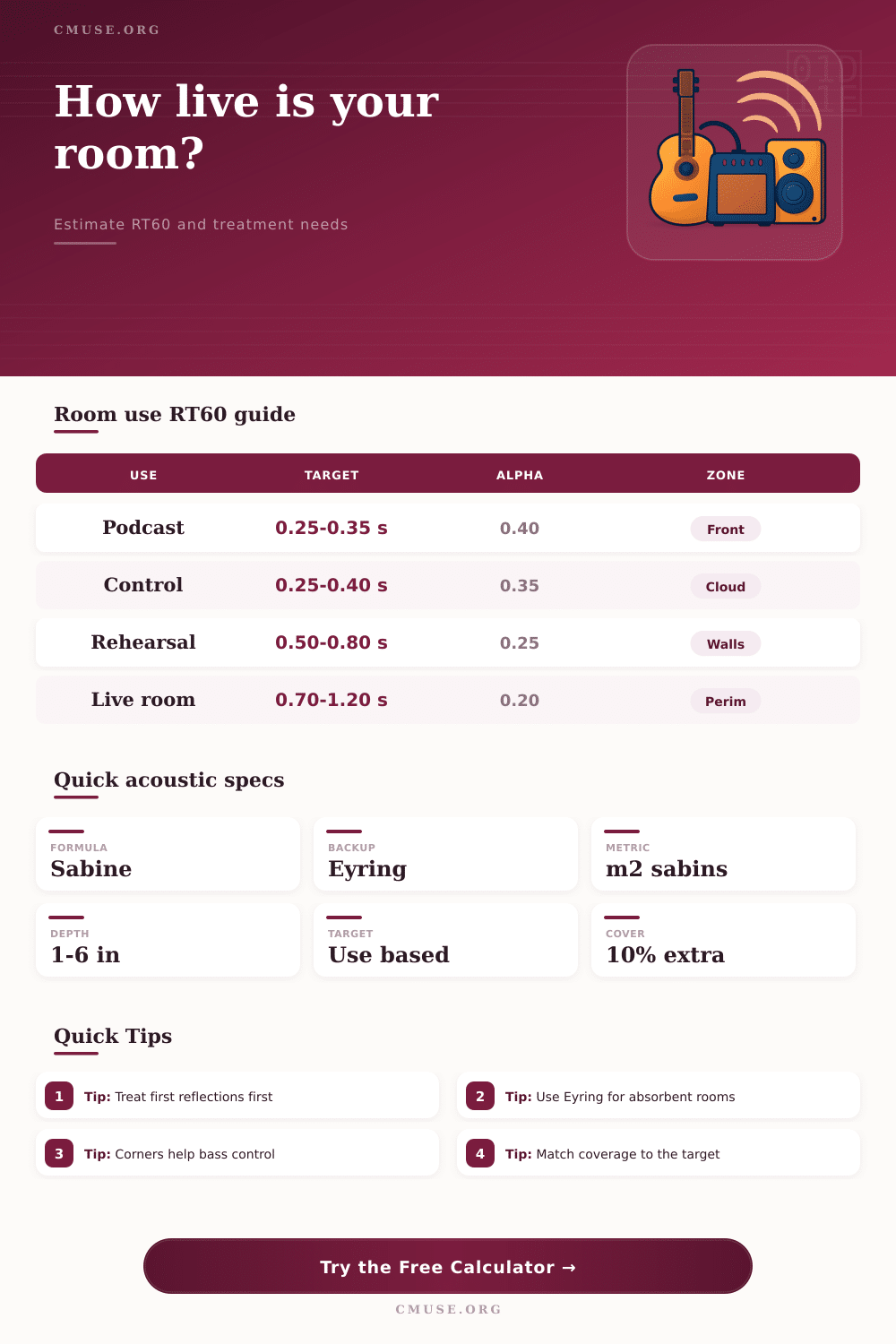
| Podcast booth | 0.25-0.35 s | Tight | Speech |
| Control room | 0.25-0.40 s | Focused | Mixing |
| Rehearsal room | 0.50-0.80 s | Natural | Band work |
| Live room | 0.70-1.20 s | Open | Tracking |
| Finish | NRC-ish | Midband alpha | Use |
|---|---|---|---|
| Painted drywall | 0.05 | 0.05 | Reflective shell |
| Carpet on underlay | 0.30 | 0.30 | Speech floors |
| Heavy curtain | 0.55 | 0.55 | Soft wall |
| Acoustic tile | 0.60 | 0.60 | Ceiling control |
| Depth | Alpha lift | Low-end shift | Best use |
|---|---|---|---|
| 1 in | Light | Small | Flutter fix |
| 2 in | Moderate | Medium | Voices |
| 4 in | High | Strong | Control rooms |
| 6 in | Very high | Deep | Corner traps |
| RT60 band | Room feel | Speech | Music |
|---|---|---|---|
| < 0.30 s | Very dry | Clear | Close mic |
| 0.30-0.45 s | Tight | Good | Mix rooms |
| 0.45-0.75 s | Controlled | Okay | Rehearsal |
| 0.75+ s | Live | Soft | Room sound |
Reverberation time, measured in decibels, is the length that it takes for a sound to fade 60 decibel after the sound source stop. Reverberation time are important for sound mixing and mastering because it determine how clear or echoed a rooms sound will be. If the reverberation time is too high, the sound within that space can become mud and hard to capture clearly.
However, if the reverberation time is too low, the sound within that space will sound unnatrually dead. In order to find the proper reverberation time for a specific room, it is important to consider how one should of used that space. Different space require different amounts of reverberation time.
Reverberation Time and How to Control It
For example, podcast booth require a low reverberation time of between 0.25 and 0.35 seconds to ensure that the words in a podcast are as crisp and clear as possible. In contrast, live music tracking room require a higher reverberation time of between 0.70 and 1.20 seconds to allow the instrument to sound natural to listener. Control room require a specific amount of reverberation time to allow engineer to properly listen to the audio being create in that room.
A reverberation time of 0.35 seconds is often used in control rooms so that detail in the audio are made clear to engineer. The material used in a room have the potential to impact the reverberation time within that space. For instance, painted drywall is a hard surface that will reflect most of the sound that hit that surface, and has an absorption coefficient of approximately 0.05.
If you add carpet to the floor, it will increase the absorption of the mid-range frequency of sound within the space, as carpet have an absorption coefficient of approximately 0.30. Additionally, one can add acoustic tile to the ceiling to increase the absorption of sound that would typically bounce off the ceiling, as the acoustic tiles has an absorption coefficient of 0.60. The people within the room also play a role in the reverberation time of a space.
Each person in the room will absorb some of the sound due to the clothing and standing position of those individual. Thus, each person that is added to a space will increase the total amount of absorption of sound within that space. Acoustic treatment can be used to control the reverberation time of a room.
It is not necessary to cover every surface of a room with acoustic treatment, as covering every surface with acoustic treatment may make the rooms sound too dead. Acoustic panel should be targeted to cover the first reflections in the room. These panel should be placed on the side wall or the ceiling of the room, and should cover 18 to 25 percent of the total surface area of the room.
The panel that are used for a control room have an absorption coefficient of 0.90, and are effective at absorbing low-mid frequency without the need to remove high frequency from the room. Bass trap might also be necessary to be placed in the corner of the room to even out sound reflection, as they are targeted towards correcting bass buildup within the room that might not be accounted for by the standard formula for calculating reverberation time. Two different formula can be used to calculate the reverberation time of a specific treatment for sound.
The first is the Sabine formula, which assume that sound is evenly distributed throughout a room. This formula is used in rooms with high level of activity and low sound absorption. The second is the Eyring formula, which account for sound scattering in areas with high sound absorption.
This formula is used in space with high absorption of sound. The Eyring formula will provide a much shorter time than the Sabine formula if the room has high sound absorption property. The size and shape of a treatment area can impact the reverberation time of that treatment area.
For example, a large treatment area will have a longer reverberation time due to the relationship between the volume of the area and the sound that reflect off of the walls. A tall ceiling will require more sound absorption to even out the reverberation time of the space. The perimeter length of the treatment area will also impact reverberation time, as reverberation time is related to the area of the wall in the room.
In small vocal pod of less than 10 square meter in area, the sound will even out very quickly. In a much larger live room of 50 square meter, sound will become muddy very quickly unless there is some form of diffusion treatment implement into the room. In order to test the reverberation time of a treatment area, pink noise can be played within that area, or one can clap their hand within that area.
By listening to the decay band of the sound that is played within the area, one can determine if the reverberation time is set to the correct time. If the reverberation time is less than 0.3 second, it will feel very dry to those that is in the area. If the reverberation time is more than 0.75 second, it will feel more like a live room.
Mathematical tool can be used to input the dimension of the treatment area, the size of the treatment area’s surface, and the type of material used in the area. These tool will calculate the reverberation time of the area and the amount of acoustic treatment that is needed to alter that time.