Room Ratio Bolt Area Calculator
Check studio length, width, and height against practical Bolt-area room ratios, floor area, and low-frequency axial mode spacing.
🎧 Room Presets
📏 Room Inputs
📊 Bolt Area Spec Grid
📋 Reference Tables
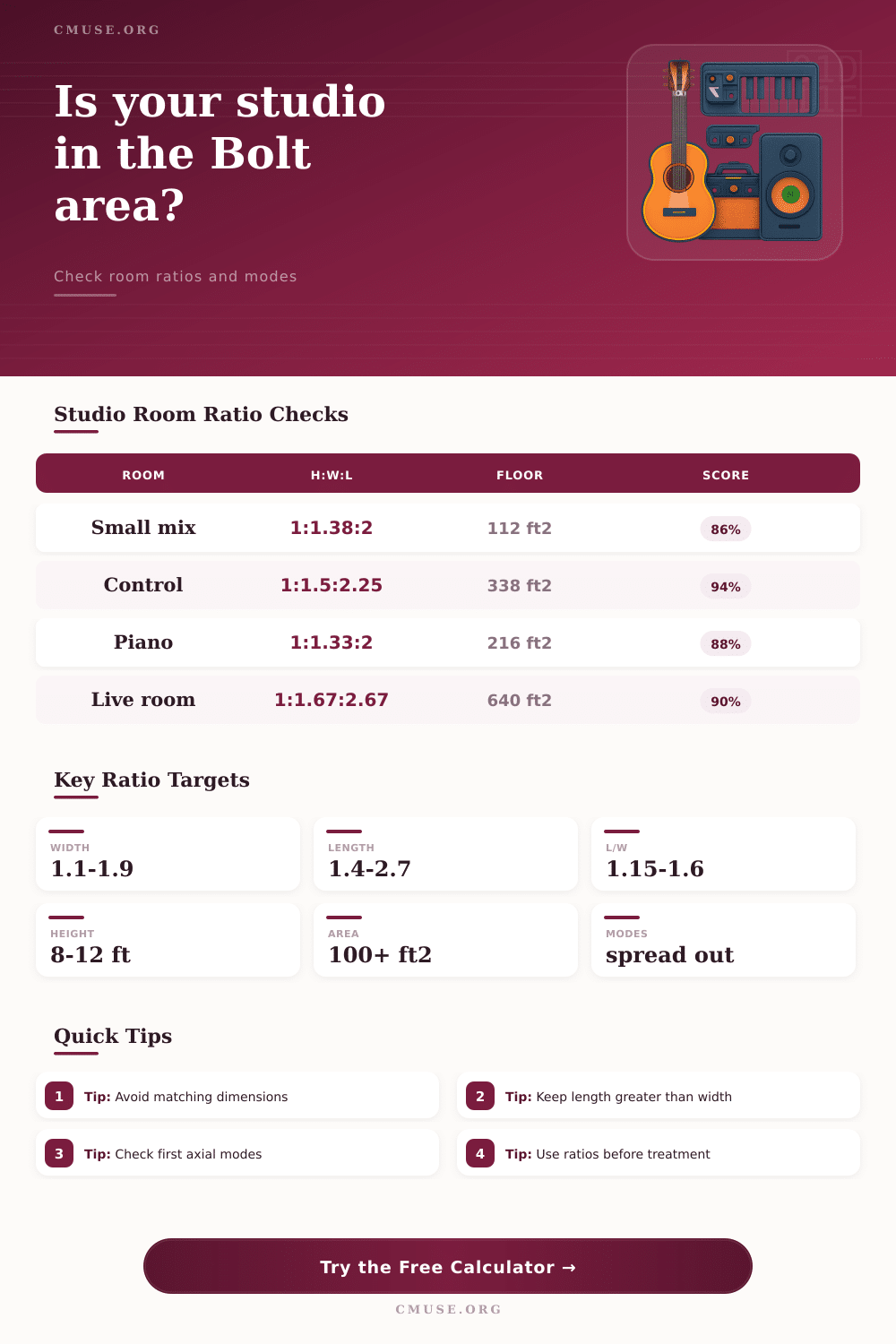
| Room Type | Typical Dimensions | Normalized Ratio | Use Case |
|---|---|---|---|
| Small Mix Room | 10 x 14 x 8 ft / 3.05 x 4.27 x 2.44 m | 1:1.25:1.75 | Production, editing, compact mixing |
| Control Room | 15 x 22.5 x 10 ft / 4.57 x 6.86 x 3.05 m | 1:1.50:2.25 | Tracking control and mix decisions |
| Piano Room | 12 x 18 x 9 ft / 3.66 x 5.49 x 2.74 m | 1:1.33:2.00 | Natural instrument recording |
| Live Room | 20 x 32 x 12 ft / 6.10 x 9.75 x 3.66 m | 1:1.67:2.67 | Drums, ensemble, room microphones |
| Ratio Check | Preferred Range | Warning Pattern | Why It Matters |
|---|---|---|---|
| Width / Height | 1.10 to 1.90 | Near 1.00 or 2.00 | Reduces stacked vertical and side-wall modes |
| Length / Height | 1.40 to 2.70 | Near width ratio | Keeps front-back modes from clustering |
| Length / Width | 1.15 to 1.60 | Square or very long rooms | Balances stereo depth against modal spacing |
| First Axial Modes | Separated by 5 Hz or more | Two modes within 3 Hz | Helps identify early bass buildup risk |
| Shell Type | Low-Frequency Behavior | Planning Note | Score Adjustment |
|---|---|---|---|
| Light Stud / Flexible | Some bass leakage and flex | Useful for small practice rooms | Softens penalty slightly |
| Standard Drywall | Moderate boundary stiffness | Common baseline for studios | Neutral adjustment |
| Double Wall / Isolated | Stronger modal containment | Needs better proportions | Stricter modal penalty |
| Concrete / Basement | Very stiff boundaries | Watch clustered bass modes | Strongest modal penalty |
| Comparison | Better Ratio Example | Problem Example | Result |
|---|---|---|---|
| Small Studio | 8 x 11 x 15 ft | 8 x 8 x 12 ft | Better width and height separation |
| Mix Room | 10 x 15 x 22.5 ft | 10 x 20 x 20 ft | Less duplicate length-width behavior |
| Live Room | 12 x 20 x 32 ft | 12 x 24 x 24 ft | More useful axial mode spread |
| Vocal Booth | 7 x 5 x 8 ft | 6 x 6 x 8 ft | Avoids square floor dimensions |
When you find yourself hearing uneven bass in a studio, it is often due to the room itself. The dimensions of the room, specifically its width, length, and height can impact the sound that is create within that room. Planning the relationship between those three dimension can even further ensure that the sound within the room is even.
The calculator available on this page can help you to test your dimensions against targets, each of which are based upon measurements that have worked within other rooms. The targets for each of the dimensions are established based upon the impact that the dimensions has upon the resonant frequencies of the room. Resonant frequencies can become problematic if two dimension within the room are similar to one another in size.
Use the Room Calculator to Fix Uneven Bass
In these cases, the resonant frequencies of those two dimensions can interfere with one another, creating a peak in the sound that cannot be treated with acoustic treatment. If one dimension is much larger than the other dimensions of the room, the modes of the sound within the room will be long and narrow in relation to the other dimensions, which will likewise impact the sound of the room. Both of these problematic ratio can be selected with the calculator, which normalizes the dimensions to the height of the ceiling, and scores each of the dimensions with the targets established by these issues.
The calculator also estimate the first three axial modes of the rooms, as well as the speed of sound within the rooms. The axial modes will change based upon the speed of sound, the speed of sound changing based upon the temperature of the air within the room. Thus, a mode established at 42 Hz will have a different relationship within the room than a mode at 51 Hz, even if the area of the floor of those rooms are the same.
Many engineers believe that a large room is the best option. However, if a large room has poor dimensions, it may produce worse sound than a small room with good dimensions. The calculator takes into account the size of the rooms, weighting the area of the floor of the room to the purpose for which the room will be used.
A mixing room, for instance, will require more floor area than a vocal booth. Additionally, however, the mixing room will require the modes within the room to be closer together because that is where the engineer will be making decision about the master mix. Therefore, a floorplan may score highly for a practice room, but may score lower for mastering.
Thus, the calculator makes an adjustment that accounts for the purpose of the room. The way in which the room itself is constructed can impact each of the acoustic problems of that room. A room with a double wall will provide good isolation of the area within the walls.
A double wall will allow more of the bass energy to remain within the walls. Thus, the problems created by the modes will be more audible within a double wall than in a lighter stud wall. A lighter stud wall will allow for the escape of some of that bass energy from the walls.
Therefore, a penalty or credit can be applied to a design based off this selection. The temperature within the room will affect the speed of sound within the room. The speed of sound changes with the change in air density, and air density changes with the change in the temperature of the air.
What may sound good within the winter in the room may have another set of acoustic problems in the summer with the change in temperature of the HVAC system. Thus, you can select the temperature within the room with the calculator to determine the impact upon the axial modes. This selection is important for treating the room appropriately for the changing seasons.
The tables included at the bottom of the calculator are for comparison with other rooms and are not established as prescriptive tables to apply to each of the dimensions of any given room. Each of these tables include examples of the sizes that have been established for different types of rooms in the past. The problems that are established in each of the tables include the tendency for rooms to have square floors, length and width dimensions that are similar to one another, and axial modes that are within a few hertz of each other.
These problems indicate the type of floor plan that is establishing each of these problems. Each of these calculations should of been performed prior to purchasing any acoustic treatment. Each of the acoustic panels and bass traps will help to even out the reflections in the treatment.
The treatments will not, however, help with the problem created in the spacing of each of the modes. Thus, if any of the dimensions within a room are even close to being similar in size, the peak created by those dimensions will always be audible. By performing this calculation prior to purchasing acoustic treatment, an engineer can at least determine whether basic acoustic treatment will be required for the room, or if the room itself will need to be changed.
There are other factors within the room that can be considered that the calculator will not account for. For instance, the position of the HVAC system, windows, doors, and beams will limit the treatment that can be performed within the room. Thus, although the calculator can help to determine the best layout for acoustic treatment, many engineers will use the calculator to determine several different layouts for treatment, and then visit the best two rooms with a tape measure to determine if they will work within that real world environment.
The intention behind the calculator is not to create a room that scores highly upon each of the calculations within the program. The intention is to create a room where each of the resonances are even enough so that the acoustic treatment can finish the job. In a properly laid out room, each of the axial modes will be even enough so that mixing can occur within that area.
Thus, the intention of performing each of the ratio calculations is ensuring that the shape of the treatment does not interfere with an engineer’s ability to accurately mix music.