AMROC Room Mode Calculator
Estimate axial, tangential, and oblique room modes, plus Schroeder frequency and modal spacing.
🎧 Presets
📏 Room Inputs
📊 Acoustic Reference
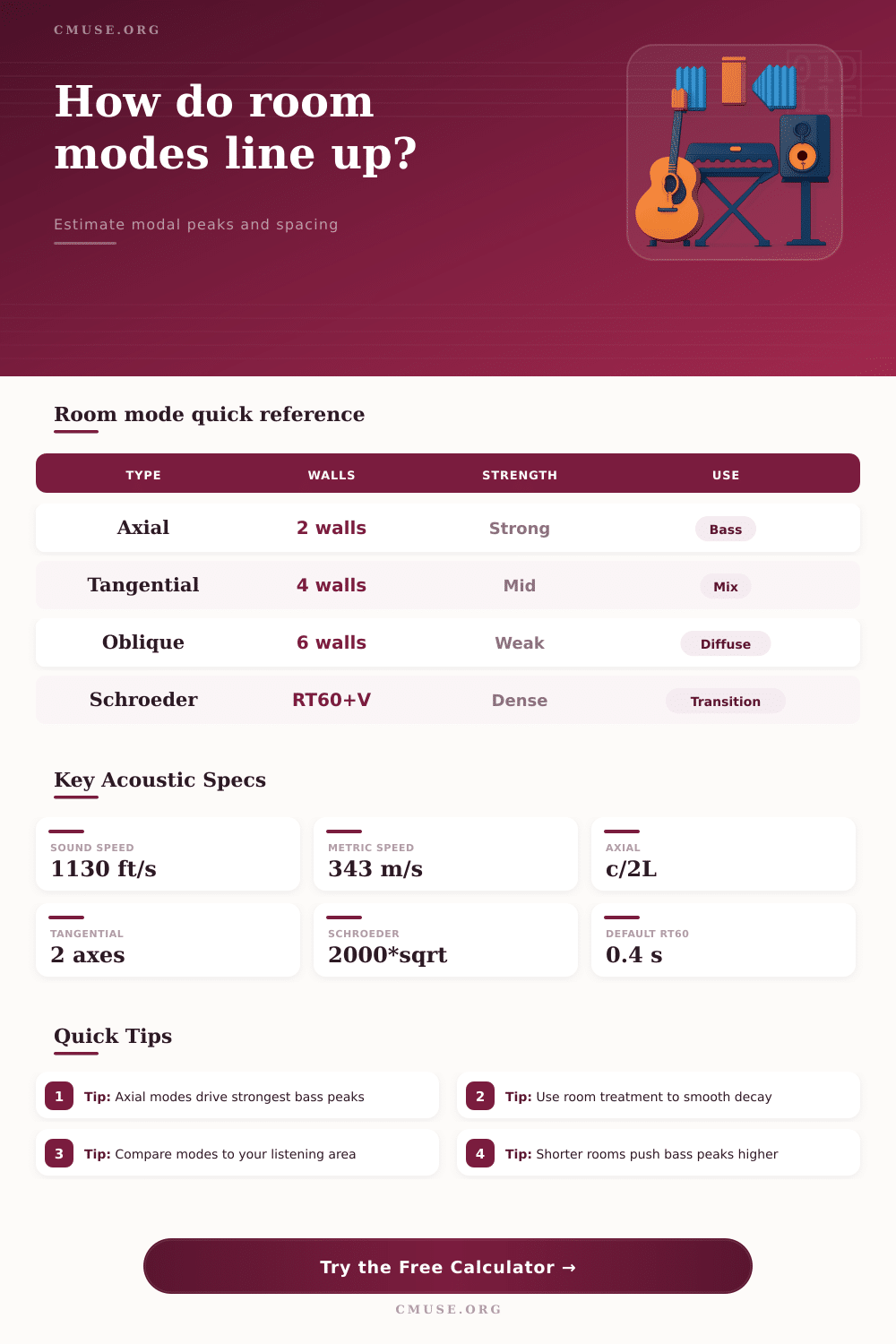
| Mode | Formula | Count | Character |
|---|---|---|---|
| Axial | c/2L | 1 axis | Strongest |
| Tangential | 2 axes | 4 walls | Mid strength |
| Oblique | 3 axes | 6 walls | Weakest |
| Schroeder | 2000*sqrt | RT60/V | Dense field |
| Preset | L x W x H | RT60 | Use |
|---|---|---|---|
| Small Bedroom | 12 x 10 x 8 ft | 0.45 s | First check |
| Control Room | 14 x 11 x 8 ft | 0.35 s | Mixing |
| Mix Room | 18 x 14 x 9 ft | 0.40 s | Broadband |
| Live Room | 24 x 18 x 10 ft | 0.60 s | Natural decay |
Sound that bounces in room generate what you call room modes, these are resonances in set frequencies that depend directly on the size of your room When sound waves hit limits as walls floor and ceiling they bounce back and form zones of high and low acoustic pressure scattered through the space. Most rooms have their main resonances between 20 Hz and 200 Hz where every frequency relates to one or several dimensions of the room or their parts.
Here what happens: sound waves travel between two opposite surfaces… For example between left and right wall or between floor and ceiling; and here are born the room modes. Think about room mode as a “bump” in the answer of the room in various frequencies.
Room Modes: Why Bass Booms or Disappears
Those bumps come from the shape of the room and how its dimensions do that the waves bounce one against the other. When that happens some frequencies boom and last forever without disappearing.
In rooms appear three kinds of modes: axial, tangential and oblique. Axial modes are the easiest to understand because they involve only two surfaces. They are also simple to count.
Here is the basic formula: f = c / (2 * d). Here c is the sound speed in meters each second, f the wanted frequency in Hz and d the distance between those opposite surfaces. Axial modes commonly are the biggest headache in home studios because rooms usually have parallel walls and they most strongly affect your sound.
Those three kinds of modes create havoc in different ways… Peaks, nulls and uneven decay everything twists your audio and makes it sound wrong. You can have a peak in 250 Hz in one corner and a null in the same frequency somewhere else in the room.
In lower frequencies the wavelengths surpass the room itself so room modes entirely dominate.
Rectangular room shape works best also because modes are easily count. There is the Bonello criterion that says that rooms require increasing number of modes each third octave for best acoustics. Also the materials of the walls matter, lightweight plasterboard does not reflect low frequencies nearly as well as solid concrete.
Room mode calculators show where the bass energy piles up in various modal frequencies and where it lacks. Lay the speaker in one corner and the microphone in another to find the best position for balance those modes. You can trace them by means of gear or simply listening carefully.
Let sine-waves run through the room so that your ears find which frequency dips and which peaks. With EQ of the whole system you can lower too loud frequencies. Bass traps require to be thick enough to address the particular mode that causes the problem.
Naturally EQ only reduces energy in problem frequencies and you target only those room resonant modes that genuinely matter.