Room Mode Calculator
Map axial, tangential, and oblique resonances, estimate Schroeder frequency, and test whether your listening seat lands in a trap-heavy zone.
🎧 Room Presets
🔧 Room Setup
Mode snapshot
First modes below the selected ceiling, sorted by frequency.
| # | Freq | Family | Indices |
|---|---|---|---|
| Run the calculator to see modal data. | |||
📈 Reference Tables
| Guide | Ratio | Use | Note |
|---|---|---|---|
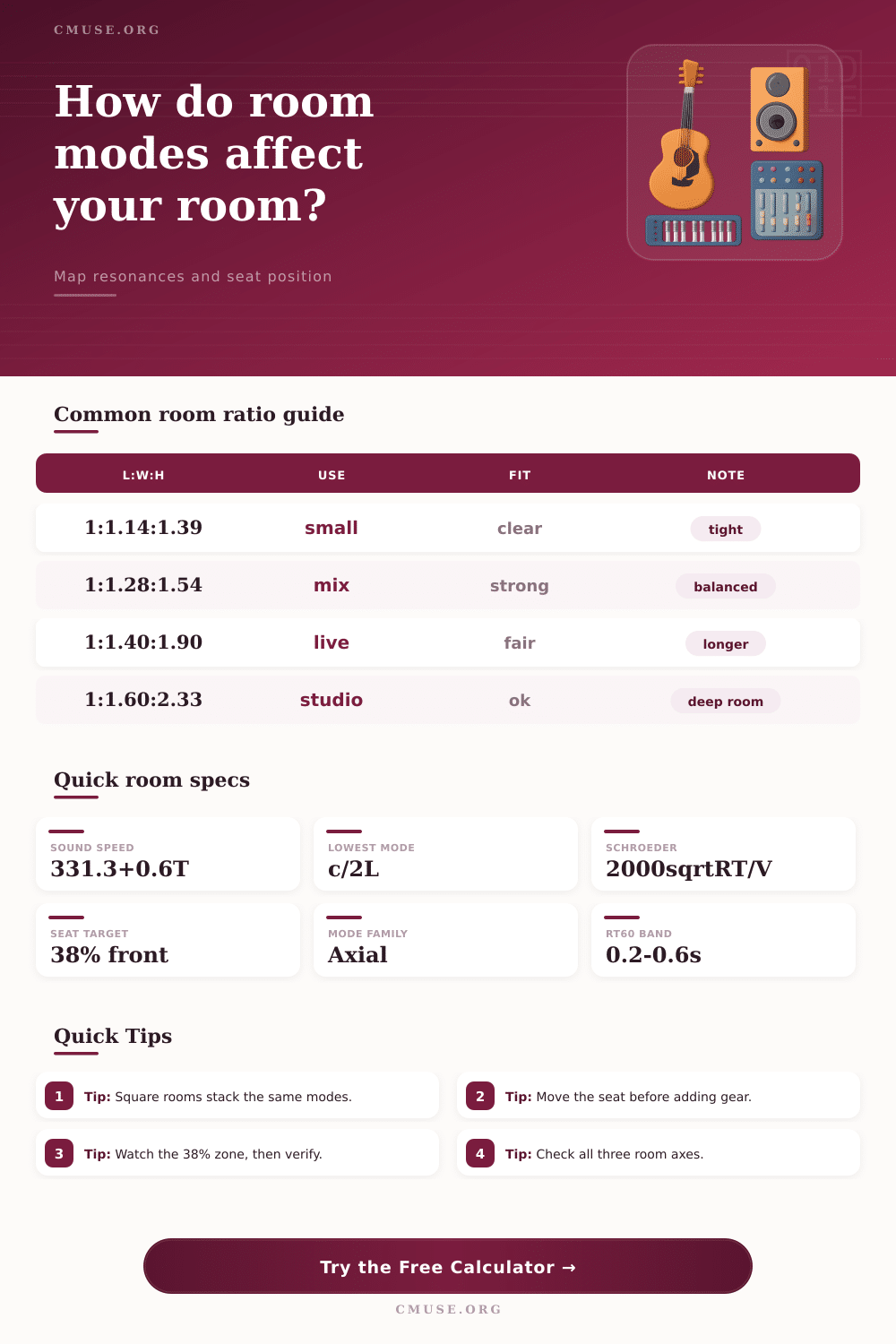
| Bolt A | 1.00:1.14:1.39 | Small room | Clear spread |
| Bolt B | 1.00:1.28:1.54 | Control room | Balanced |
| Bolt C | 1.00:1.40:1.90 | Live room | Longer decay |
| Bolt D | 1.00:1.60:2.33 | Studio room | Deep rear |
| Family | Axes | Behavior | Meaning |
|---|---|---|---|
| Axial | 1 | Strongest | One axis only |
| Tangential | 2 | Medium | Two axes share energy |
| Oblique | 3 | Dense | All three axes move |
| Schroeder | All | Blend | Modal field starts to smooth |
| Profile | Alpha | RT60 | Note |
|---|---|---|---|
| Bare concrete | 0.02 | Long | Very reflective shell |
| Painted drywall | 0.05 | Long | Typical apartment shell |
| Wood panel | 0.10 | Medium | Warm but still lively |
| Carpeted room | 0.18 | Medium | Less high-end ring |
| Furnished room | 0.24 | Shorter | Soft furniture helps |
| Mixed studio | 0.14 | Medium | Good all-round baseline |
| Treated control | 0.32 | Short | Better for mix positions |
| Heavy treatment | 0.45 | Very short | Dense control and bass work |
💡 Room Tips
Room modes are standing wave that occur in rooms due to sound wave bouncing off of the walls. Room modes occur when sound wave reflect off of the walls of the room. As a result of the sound wave reflecting off of the walls of the room, certain frequency of sound are present in the room and other frequency are not.
Therefore, certain frequencies may seem more loud in some areas of the room while other frequencies may seem to quiet in other areas of the room. As a result, room modes make it difficult for individual to hear the correct mix of sounds within a recording studio. There are three different type of room modes: axial modes, tangential modes, and oblique modes.
Room Modes: What They Are and How to Fix Them
Axial modes are the strongest form of room mode within a room because they occur when sound wave bounce between two surface of the room. Tangential modes are created when sound wave interact with four surface of the room. Oblique modes are created when sound wave interact with all six surface of the room.
Axial modes are typically the most problematic form of room mode because they occur at low frequency and are difficult to manage within a room. Axial modes are created at each of the length, width, and height of the room. Room modes relate to the concept of temperature within a room in that room mode have certain frequencies that are created as a result of the temperature within the room.
Within a room, the temperature of the air will impact the speed of sound within that area. As a result, if the temperature within the room change, the frequencies of the room modes will change as well. Using a calculator that determine the impact of temperature on sound, it is possible to adjust for temperature within a room and view how that will impact the room modes within that specific space.
One way that individual can experience the effect of room modes is through sitting in a pressure null. A pressure null is a spot within a room in which sound wave cancel each other out resulting in little to no bass response at that location. To avoid experiencing the effect of room modes, individuals should avoid sitting in spots within a room where the wave cancel each other out.
For instance, many individual find that sitting at 38 percent of the depth of the room from the front wall allow them to avoid the dip in bass that cancel out in that portion of the room. Testing different spot within a room will allow individuals to find the spot that minimize the impact of room modes. Afterwards, individuals should avoid moving from those position.
Additionally, acoustic treatment can be used in these spot to continue to avoid the effect of pressure nulls. The shape of the room can impact the behavior of the room modes. For instance, rooms that are in the shape of squares create problem with the room modes because the dimension that create the axial modes all become the same.
As a result, the square rooms create more problem caused by the axial modes than do rectangular rooms. To address these issue, specific shape and size ratio can be used. For instance, a ratio of 1:1.28:1.54 is one ratio that has been proven to even out the axial modes within a room.
Using the dimension of the specific room that individuals would like to treat for room mode issue, that ratio can be calculated to determine the impact that the ratio will have on the room modes. Within a room there is a specific frequency that separate the modal (room mode) reflection from statistical reverb. Below that frequency there are distinct room mode but above that frequency the reflection become reverb.
The Schroeder frequency is created as a result of the size of the room and how much sound is absorbed by the surface within the room. Additionally, the amount of absorption of those surface is dependent upon the finish of those surface. Thus, the finish of the surface within the room will impact the Schroeder frequency.
For instance, bare concrete will have a higher Schroeder frequency then a treatment with acoustic panel. While acoustic treatment can be utilized to address the issue created by room modes, it is not necessary to eliminate the room modes entirely. One form of acoustic treatment is the use of bass trap that are placed at distance of 1/4 wavelength from each of the room walls to tame the axial modes.
Additionally, acoustic cloud can be placed on desk to even out flutter echo that occur between the walls of the room. However, the best initial step is to move the seating within the room to avoid the effect of room modes. Additionally, other form of furnitures can be placed in the room such as couch that will absorb the low frequency of the sound within the room.
Finally, the change made to the room should be tested to determine if they have successfully evened out the room modes.