Map progressions to key, chord, and function in seconds.
🎵Quick Presets
📝Analyzer
Use spaces or hyphens between chords. Supports secondary dominants like V/V and borrowed chords like iv.
Primary Result
-
Roman to chord map
Secondary Result
-
Functional labels
Coverage
-
Chords analyzed
Extra Metric
-
Cadence score
Key center-
Mode-
Progression-
Notes-
📊Reference Tables
Degree
Major
Minor
Role
I
Tonic
i
Home
ii
Supertonic
ii
Pre-dominant
V
Dominant
v
Tension
vi
Submediant
VI
Relative
Cadence
V-I
Plagal
IV-I
Deceptive
V-vi
Minor pivot
iv-V
💡Practical Notes
Tip: Match the key center first, then label borrowed chords.
Tip: Secondary dominants should point to the next target chord.
📖Common Patterns
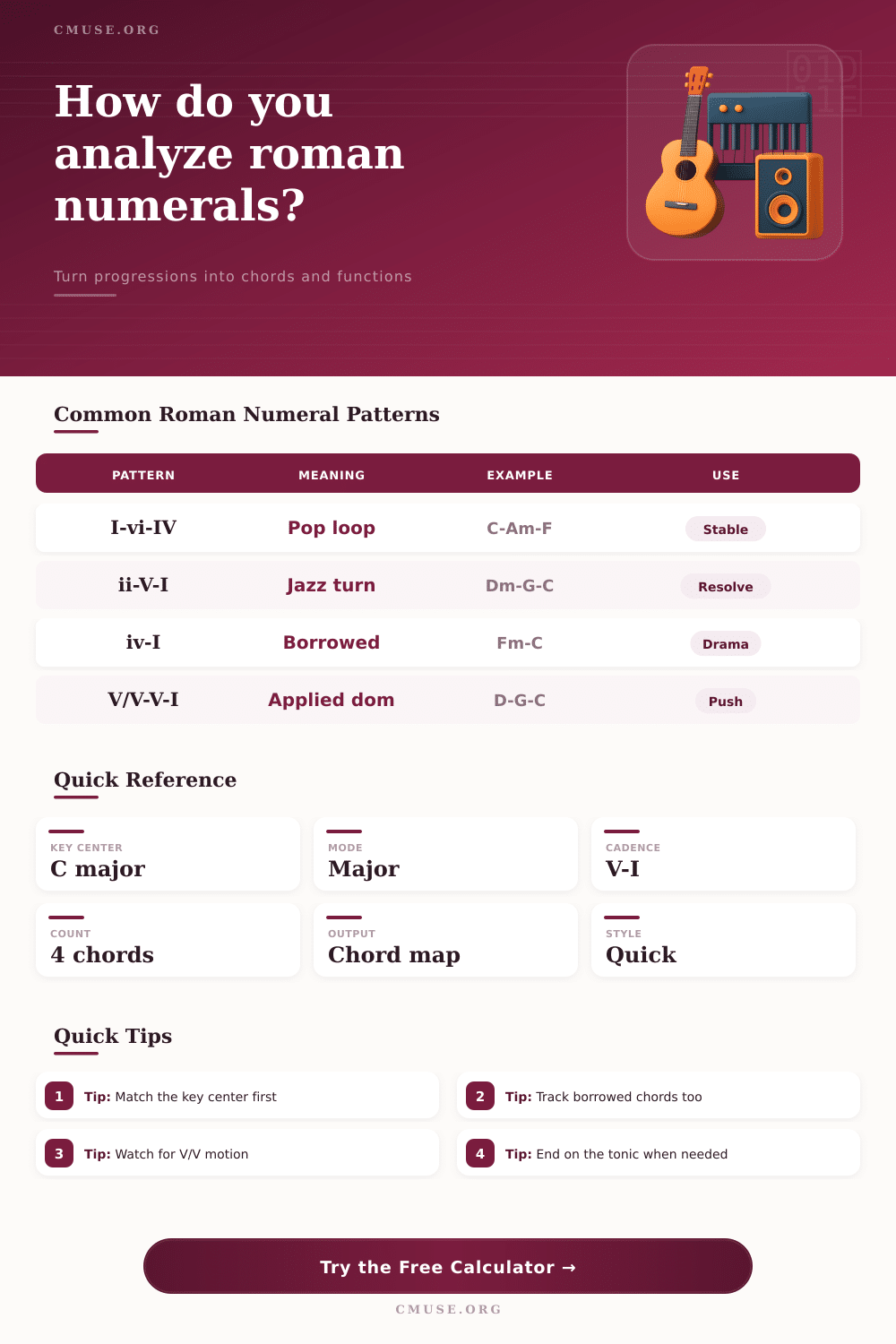
Pattern
Meaning
Example
Use
I-vi-IV-V
Pop loop
C-Am-F-G
Stable
ii-V-I
Jazz turnaround
Dm-G-C
Resolution
iv-I
Borrowed color
Fm-C
Drama
V/V-V-I
Applied dominant
D-G-C
Push
Roman numeral analysis is a way to recognize and mark chords in musical progression by means of Roman numerals. They show the grade of the scale in the tonal center Thanks to this method, musicians can well understand the relations between chords, which simplifies the study of music.
The goal is to think beyond concrete chords in separate keys. For instance, C chord in C major and F chord in F major both operate as the “I” in their own key. Because of that, Roman numerals help to think about all music without fixed keys, for more clarity.
How Roman Numerals Help with Chords
Same consistent progression in various keys is the same during analysis.
During musical analysis, every diatonic triad receive Roman numerals. Capital figures mark major chords, lowercase write minor. All figures show the root of the chord regarding the scale.
Chords on those grades are major, and minor, or diminished, so the Roman numeral exprses that. Some systems use only caps for major and minor, so that the quality comes from the place in the scale. Roman numeral analysis helps capitalization to separate major from minor, so the system does not depend only on deduction.
Roman numeral analysis should note the key in the start of the bit or fragment. If do is in the bass, the figure is I. If re is in the bass, it is II. Thus forward.
Then you identify the whole chord together with every inversion.
The strongest relation is V-I. For instance G to C in C major. Everything that leads you through the basic Roman numeral analysis.
When things get complex, a way to not lose the overview of relations to the root chord is needed. Roman numerals give the sole solution for that.
The first such analysis existed in the end of the 18th century in France, where you reduced every chord to its root note. Initially you used Arabic figures for root chords. In 1778, the German musician Georg Joseph Vogler first applied Roman numerals for some chords.
Roman numerals show relation to the scale, while Arabic to the consistent root.
Except analyze and understand consistent progressions by means of Roman numerals, they ease also the transposition. They well operate for songs from the Great American Songbook. Even so some types of composers as Wayne Shorter can become genuinely confused by means of Roman numerals.
Melodies stay a set of notes with scale degrees, so Roman numeral analysis helps to understand the relations between consistent functions in some scale.