Riser Sweep Length Calculator
Time risers, noise sweeps, filter lifts, pitch climbs, and pre-drop uplifters in exact seconds, beats, bars, octaves per second, and semitones per bar.
Full Calculation Breakdown
| BPM | 4 Bars | 8 Bars | 16 Bars | Typical Riser Use |
|---|---|---|---|---|
| 90 | 10.67 s | 21.33 s | 42.67 s | Cinematic, ambient, half-time |
| 100 | 9.60 s | 19.20 s | 38.40 s | Pop transition, slow trap |
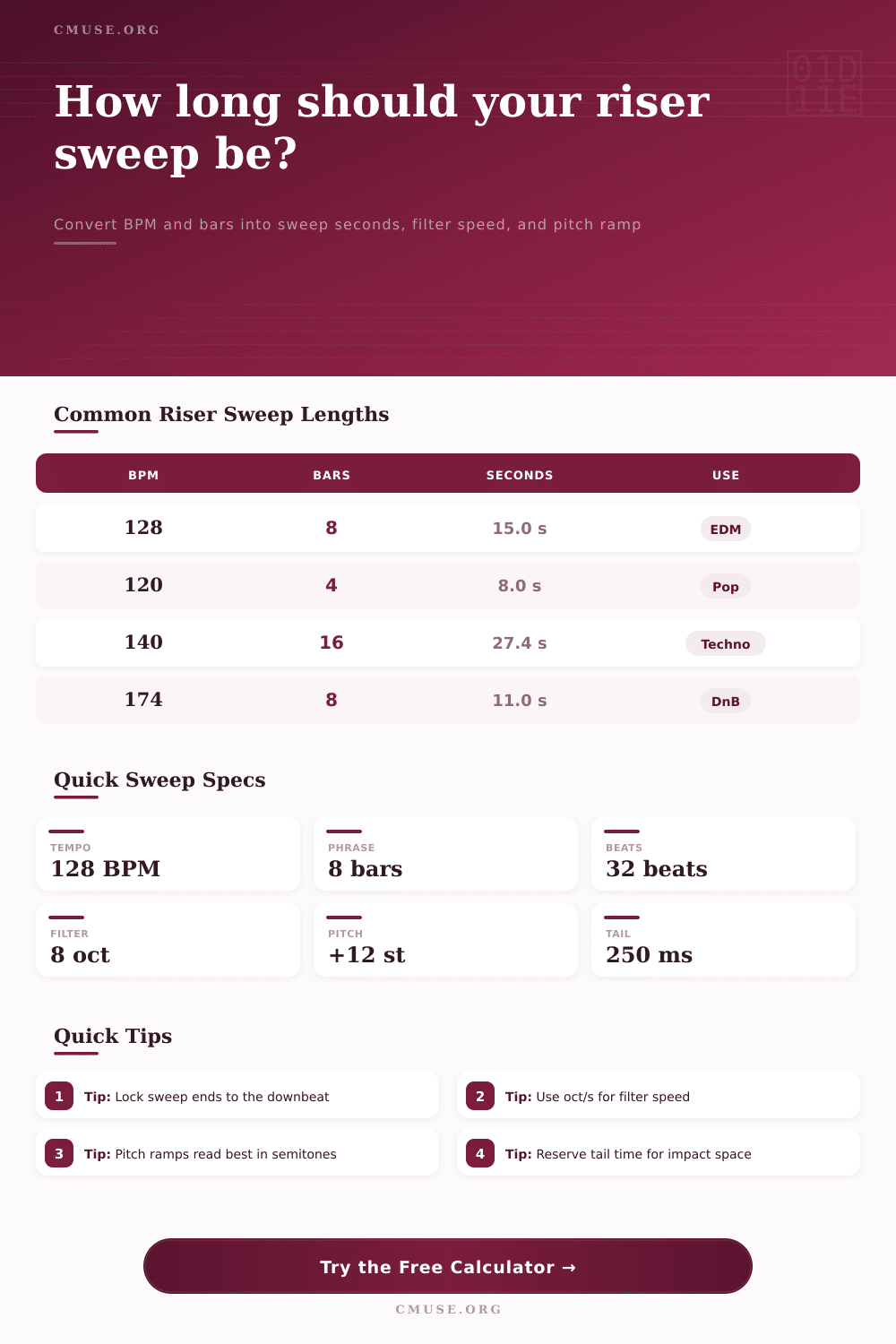
| 120 | 8.00 s | 16.00 s | 32.00 s | House, pop, synth build |
| 128 | 7.50 s | 15.00 s | 30.00 s | EDM drop preparation |
| 140 | 6.86 s | 13.71 s | 27.43 s | Techno, trap, garage lift |
| 174 | 5.52 s | 11.03 s | 22.07 s | Drum and bass, fast builds |
| Start Hz | End Hz | Octave Span | 15 s Rate | Best Use |
|---|---|---|---|---|
| 100 | 12000 | 6.91 oct | 0.46 oct/s | Deep noise lift |
| 200 | 16000 | 6.32 oct | 0.42 oct/s | Classic white noise riser |
| 400 | 10000 | 4.64 oct | 0.31 oct/s | Smoother pop sweep |
| 800 | 8000 | 3.32 oct | 0.22 oct/s | Subtle texture lift |
| 1200 | 18000 | 3.91 oct | 0.26 oct/s | Air-band shimmer |
| Semitone Rise | Interval | 8-Bar Rate | Sound Character | Useful Source |
|---|---|---|---|---|
| +3 st | Minor third | 0.38 st/bar | Subtle lift | Vocal texture |
| +5 st | Perfect fourth | 0.63 st/bar | Musical push | Pad or riser synth |
| +7 st | Perfect fifth | 0.88 st/bar | Open tension | Lead synth layer |
| +12 st | One octave | 1.50 st/bar | Classic build | Saw stack or noise tone |
| +24 st | Two octaves | 3.00 st/bar | Extreme rise | FX-only riser |
| End Offset | At 128 BPM | What It Means | Best Transition | Watch For |
|---|---|---|---|---|
| 0 beats | 0.000 s | Riser ends on drop | Hard EDM impact | Tail may mask transient |
| 0.25 beat | 0.117 s | Ends just before drop | Tight snare lift | Needs clean edit point |
| 0.5 beat | 0.234 s | Leaves a quick breath | Pop chorus entry | May feel rushed |
| 1 beat | 0.469 s | One beat of space | Reverse cymbal, impact | Can expose silence |
| 2 beats | 0.938 s | Half-bar gap in 4/4 | Trailer pause | Use with intention |
| Preset | BPM | Bars | Seconds | Main Ramp |
|---|---|---|---|---|
| EDM noise uplifter | 128 | 8 | 15.00 s | 200 Hz to 16 kHz |
| Pop filter lift | 120 | 4 | 8.00 s | 400 Hz to 10 kHz |
| Techno tension sweep | 140 | 16 | 27.43 s | 100 Hz to 18 kHz |
| Trailer pitch rise | 90 | 12 | 32.00 s | -12 st to +12 st |
| Drum and bass sweep | 174 | 8 | 11.03 s | 300 Hz to 18 kHz |
There’s also that moment where you’re five bars out from the drop and you’re still on a flat riser and you freak out. That tension should rises, but instead it feels like an elevator that stopped between floors. And no, it’s typicaly not your sound design. Typically it’s your math. Your automation might not be sync with the song grid. And the listener isn’t going to feel the tension, they’ll simply hear noise.
A riser sweep is more than simply getting higher in pitch or getting louder. It’s about playing with time and making something feel as if it’s arriving. Automation is a drawing exercise for most producers. They pull up their envelope editor and draw a line from A to B. Intuitively this seem like the way to do it … till you go to mix track. Maybe the riser collides with the lead synth; maybe it cuts out too soon leaving an empty space for the kick to fill.
Why Math Matters in Your Music
We are not good intuitively at dealing with frequency scales: we hear octaves, we edit in seconds. The disconnect weaken the power of the track. By turning phrase length and tempo into actual rates of change, the tool fills the gap between what we can imagine and what we can see.
Let’s take a simple eight bar structure on a 128 BPM beat. This means it last precisely fifteen seconds. In this time, sweep a filter through around six octaves from 200Hz up to 16kHz. Sweeping it linearly across the fifteen seconds give you a rate of approximately 0.4 octaves per second.
For instance, if you’re moving onto something with a faster tempo like drum and bass at say 174 BPM then the eight bars come and go in slightly more than eleven seconds. This means you have to move through those six octaves significantly quicker or they’ll sound sluggish and out-of-step with the pulse.
Of course, you can change the rate but it’s a pain to have to fire up a spreadsheet when you’re in your DAW. The calculator does all this conversion for you.
It’s not only about how fast the curve is, but also what it looks like. Real tension doesn’t build evenly; a linear sweep sound robotic. The brain perceives steady pressure different than late acceleration… Which is why exponential curves tend to sound better for electronic music builds. They begin subtlely during the first half of the phrase, then rush toward the peak. That late surge mimics the way adrenaline works before a sprint. Selecting an exponential option tell the software to save the dramatic movement for the last few beats. This is what generates a hook that grabs attention at the very moment the listener gets comfortabley.
Alternatively, we have Pitch ramps which is similar in their effect but provide other musical clues. Rising one octave over eight bars sounds like a classic build. A two-octave rise sound synthetic and aggressive. The semitone per bar measure helps keep it musical. This is detailed in reference charts. When using a synth riser staying in fifths or perfect fourths tend to hold it in harmony with the music. Anything more than this risks dissonance and fighting against the drop. It is a question of how much chaos versus how much tension.
Also, don’t forget about the post-hit. Too many producer run the riser all the way into the drop on the first beat. Wrong. You want some kind of vacuum before you come in with force. This is what an offset or tail time accomplish: it gives you a few moments for the sound to dissapears so the kick cuts through cleanly. It is the difference between crisp punch and mud. The end offset is used to clip the audio back a fraction of a beat before downbeat. Sounds like no big deal. Actualy, this is the secret to making a track sound really energetic and professional.
A good track’s timing is its skeleton. All the rest is flesh. If you get the math correct then the listener doesn’t even know you’re automating. They simply feel the rise.