Rigging Safety Factor Calculator
Check stage rigging WLL, sling angle tension, adjusted break strength, dynamic load allowance, and actual design factor from tagged component data.
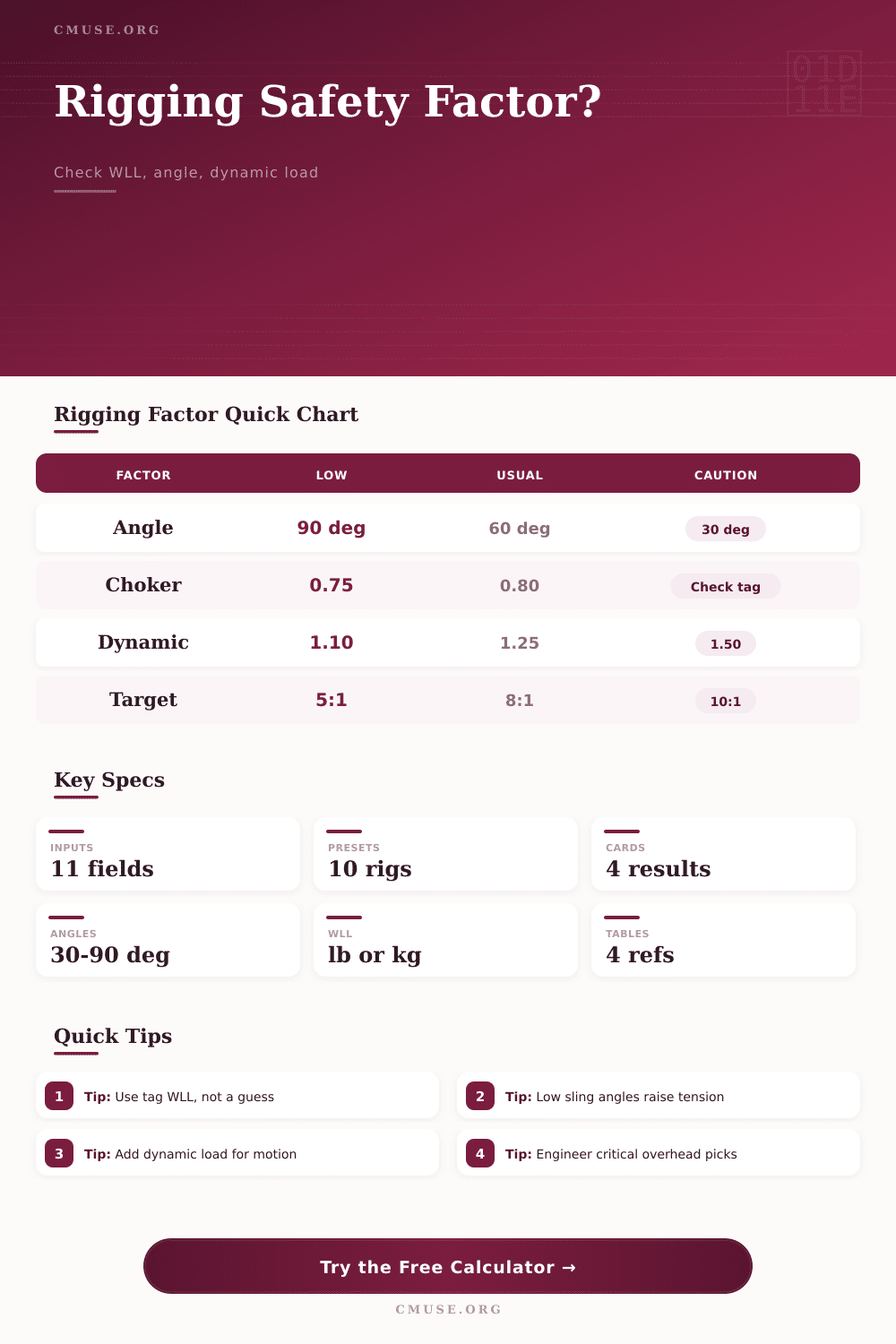
Use tagged WLL and manufacturer data. Angle is measured from horizontal: 90° is vertical, 60° adds 15.5% leg tension, and 30° doubles leg tension.
Wire Rope Sling
Often tagged at 5:1 design factor. Strong around heat and edges compared with synthetics, but damaged wires, kinks, and crushed eyes remove it from service.
Alloy Chain Sling
Common lifting chain slings are typically rated at 4:1 design factor. Good for abrasion, but twists, stretched links, and side-loaded hooks matter.
Polyester Round Sling
Often 5:1 in US lifting service. Light and useful around finished truss, but needs edge protection and removal after sheath cuts or chemical damage.
Anchor Shackle
Many screw-pin and bolt-type shackles use 5:1 or 6:1 catalog design factors. Pin seating and side loading can sharply reduce usable capacity.
Electric Chain Hoist
Hoists are rated by WLL and duty class. The hoist, chain bag, control cable, suspension hardware, and hook orientation all stay in the load path.
Beam Clamp or Trolley
Use the clamp tag and beam rating together. Flange width, beam condition, side pull, and attachment geometry can become the controlling limit.
| Angle From Horizontal | Angle Factor | Two-Leg Share of 1000 lb | Rigging Note |
|---|---|---|---|
| 90° | 1.000 | 500 lb per leg | Vertical pick, no angle amplification. |
| 60° | 1.155 | 577 lb per leg | Common bridle angle with manageable added tension. |
| 45° | 1.414 | 707 lb per leg | Tension increases quickly; check all collectors. |
| 30° | 2.000 | 1000 lb per leg | Low-angle bridle; engineered review is prudent. |
| Configuration | Typical Factor | What It Means | Field Check |
|---|---|---|---|
| Vertical hitch | 1.00 | Single straight pull at tagged WLL. | Confirm no side pull at hooks or eyes. |
| Balanced basket hitch | 2.00 | Two balanced legs can double vertical hitch capacity. | Keep legs seated and angles within tag limits. |
| Choker hitch | 0.75 to 0.80 | Choking bends and pinches the sling, reducing WLL. | Use tag data when available. |
| Eyebolt angular loading | 0.25 at 45° | Standard eyebolts may lose major capacity under side pull. | Use swivel hoist rings for angular loads when specified. |
| Condition | Dynamic Multiplier | Sharing Factor | Use Case |
|---|---|---|---|
| Static indoor trim | 1.00 to 1.10 | 1.00 to 1.10 | Dead-hung scenic or cable loads after trim is complete. |
| Controlled hoist motion | 1.10 to 1.25 | 1.10 to 1.20 | Normal motorized stage rigging with smooth starts and stops. |
| Moving show element | 1.25 to 1.50 | 1.15 to 1.33 | Scenic motion, performer interaction, or uncertain sharing. |
| Outdoor or wind exposed | 1.50 plus | 1.25 plus | Temporary outdoor structures need project-specific engineering. |
| Component Family | Common Catalog Factor | Primary Formula | Important Limit |
|---|---|---|---|
| Wire rope lifting sling | 5:1 | WLL = MBS ÷ 5 | Broken wires, kinks, crushed fittings, and sharp bends control. |
| Alloy chain sling | 4:1 | WLL = MBS ÷ 4 | Grade, hook latch condition, and temperature limits apply. |
| Synthetic round sling | 5:1 | WLL = MBS ÷ 5 | Edges, heat, UV, chemical exposure, and sleeve damage control. |
| Anchor shackle | 5:1 to 6:1 | WLL = MBS ÷ factor | Pin fit, screw engagement, side loading, and point loading control. |
The floor vibrate as you stand beneath it. Faster than you could of said the calculation in your brain’s physics processor, you know whether that is a safe hang or dangerous one. There is no guesswork in rigging; there are only numbers. Ignore the numbers and steel will become shrapnel.
Enter your geometry and load weights into this calculator. Let it do the number crunching for you. It will convert abstract tension forces to concrete safety margins, it will tell you whether your setup is sound or statistically dangerous.
Why Rigging Math Is Important for Safety
Even though a polyester round sling may be rated for certain working load limit, the rating is based off static, vertical conditions. Introduce an angle into the equation and physics are changed. As the legs of a bridle diverge, tension in both leg increases significantly. At an angle of sixty degrees off horizontal, you’ll multiply the load by approximately fifteen percent on each individual strand. If you reduce that angle to thirty degrees, you’ll double force on all components. Low angles feel intuitively right, but they play tricks on your mind. The geometric penalty is included in calculation automatically. What appears to be weight of the object you’re lifting is not its actual tension at all.
Most accidents occur because of dynamic loading which is often ignored when making casual estimates. The force of a speaker array sitting silently on a rigging point is predictable. Buffeting from wind on an outdoor stage or a jerk of a motor will cause that same array to suddenly spike it’s load. That instant-in-time temporary force can be 25% or more greater than the static weight. Before hooking up hardware, you need to account for this in your safety buffer.
If you’re moving scenery where there might be performers, then you’re dealing with kinetic energy. With the tool, you’re able to apply a dynamic multiplier so that you’re sure your design factor doesn’t hold up in a spreadsheet vacuum but also under motion.
The real story is capacity tied to hitch configuration. In theory, a basket hitch increases vertical rating by twice the amount of sling used (so long as it’s not too near a sharp edge, is properly centered, etc.). The choker hitch cut down on strength and constricts material. Derating the component according to the hitch is what you have to do so going with a tag value for a choked load doesn’t work. That’s another little part of rigging up that make all the difference when the rig gets stressed. Does it hold? Or will it fail?
There are safety factors built into these things. Humans err and materials does too. There’s a five-to-one design factor, which means the component could theoretically withstand five times its rated load without failing. That leaves some wiggle room for accidental increases in load, corrosion, and general wear and tear.
While all this math makes everything precise as hell, there’s no substitute for looking at it yourself. Are the shackle bends still straight? Is the chain tight and not stretched out? Are the fibers on your straps still intact? Does it pass the numbers test? Do they look like they’ll do the job still?
If the angle looks right and the load hangs still, then you’ve got the job done right. Respect the metal, trust the math.