Rhythm Dictation Accuracy Calculator
Score beat placement, note values, rests, ties, tempo, attempts, and partial credit in one structured rhythm dictation pass.
🎼 Dictation presets
🎵 Dictation score inputs
📊 Rhythm scoring grid
📘 Note value reference
| Rhythm value | Simple meter count | Common error | Scoring note |
|---|---|---|---|
| Whole note | 4 beats | Released one beat early | Beat grid loses sustained beat credit |
| Half note | 2 beats | Written as two quarters | Beat may pass, value may lose credit |
| Quarter note | 1 beat | Placed on wrong beat | Beat and note value both affected |
| Eighth pair | Half beat each | Grouped against the meter | Partial credit can preserve duration |
| Sixteenth group | Quarter beat each | Missing inner subdivision | Difficulty adjustment flags the excerpt |
⏱ Tempo and attempt bands
| Tempo band | BPM range | Dictation feel | Score interpretation |
|---|---|---|---|
| Slow study | 50 to 66 | Plenty of counting space | Expect cleaner rest and tie notation |
| Moderate classroom | 67 to 96 | Typical theory exercise | Balanced score with normal attempt penalty |
| Moving pulse | 97 to 120 | Requires quick grouping | Subdivision errors become more meaningful |
| Fast recall | 121 and up | Memory and pattern recognition | Final score is read with tempo context |
🎯 Common rhythm dictation presets
| Exercise | Measures and meter | Rhythm focus | Expected target |
|---|---|---|---|
| 4-measure clapback | 4 measures, 4/4 | Beat location and quarter rests | 80% or higher |
| Syncopated melody rhythm | 8 measures, 4/4 | Offbeat attacks and ties | 70% or higher |
| 6/8 compound dictation | 6 measures, 6/8 | Dotted pulse and grouped eighths | 75% or higher |
| Advanced mixed rhythm | 12 measures, mixed | Rests, ties, and subdivision shifts | 65% or higher |
📝 Score band table
| Final score | Accuracy band | What it usually means | Next scoring check |
|---|---|---|---|
| 90% to 100% | Excellent | Beat map and event values are secure | Increase tempo or reduce attempts |
| 80% to 89% | Strong | Core rhythm is clear with small notation misses | Review rests and tied values |
| 70% to 79% | Developing | Pulse is mostly stable, details need repair | Separate beat grid from note values |
| Below 70% | Rebuild | Counting frame or subdivision is unstable | Slow the excerpt and count aloud |
💡 Scoring tips
With headphones on, you sit down for your weekly theory exam and listen to a four measure phrase that seems undeniably simple. Confident in the pulse, you tap along while you write it out but notice something is not right. Perhaps you tied two note together incorrectly or forgot a rest. It’s frustrating. You can hear the rhythm, but your pen refuse to catch the nuance.
This is where precision matters most because what you hear does not match how you write it down. When it comes to rhythm dictation, its almost never a question of pitch but rather a matter of time. It is a tight grid of sound mapped out in relation to silence.
How to Improve Your Rhythm Dictation Skills
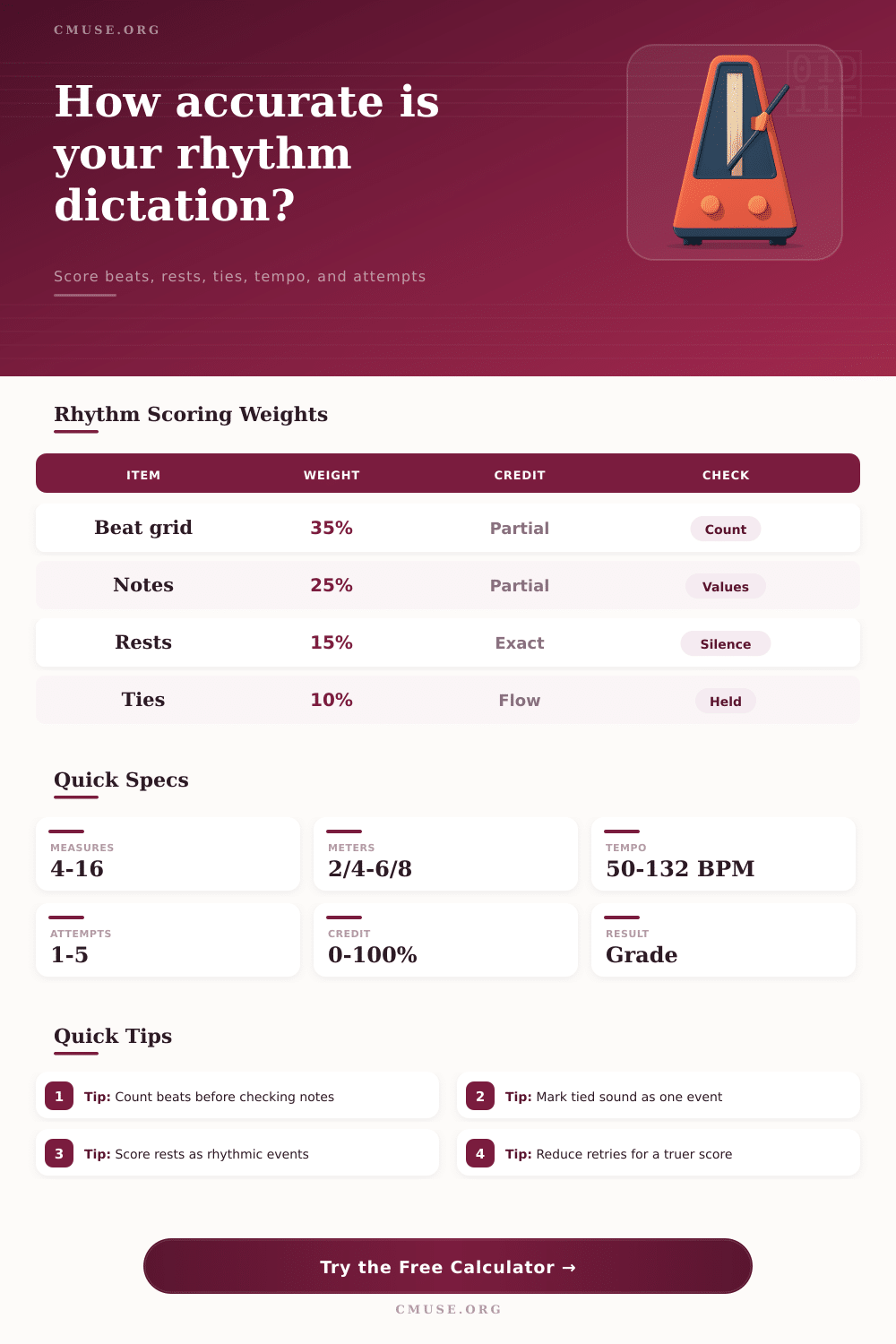
One common reason students struggle with this type of exercise are attempting to write it all down at once. Once you have entered your raw scores into the calculator above (beats, notes, rests, ties), the math is done for you. It removes the guesswork by giving weight to each category.
This forces you to realize that placing the wrong beat is worse then choosing the wrong note value. In this scoring model, beat placement bear the greatest weight and can constitutes more than one-third of your total score. Why? No matter how accuratley you spell the duration, the rhythm fails if the attack hit the wrong subdivision. The pulse is everything and unfortunately, it’s what many students ignore while they obsess over whether to use an eighth-note beam or a quarter note with a dot.
The notation is elegant. The beauty. It is architecture. That’s what everyone misses.
Note values comes next in importance, followed by rests and then ties. Rests can be problematic as you need to write down silence correctly. Putting a half-rest where you should of put a quarter rest changes the phrasing completely. This happens even if timing of following notes falls perfectly on the beat.
Similarly, ties are frequently viewed as optional decoration, yet they determines how your melody flows. Splitting a tie into individual notes may or may not maintain the overall length, but destroys the legato effect the composer sought. Because of this, the tool scores partially for the correct sound, but not quite the correct symbol.
In the last calculation are tempo and how many times you have listened. If you have only written after having listened five times then your score should reflect this level of dependence on repeating the passage back to yourself instead of memory. A high percentage of accuracy gained by excessive retries is not as good than that made on the initial attempt. The factor of tempo also need to be adjusted since quick pieces require rapid pattern recognition while slow passages lend themselves more to careful analysis. Without taking into account any or all of these factors, its impossible to make a fair assessment of your skill.
The first thing to try is separating out the beat grid. Forget about those note heads completely and simply indicate which attack occur in what part of the bar. Next, flesh it out with the duration. These are two distinct layer that match how musicians work professionally. First, they feel the pulse, and then they fit the notes into the space. Why? Because your brain understands rhythm in levels rather than in a line and it works.
Take a look through what threw off your score when you reviewed it. Low on beats? Slower, slower, slow. Clap out the rhythm until the grid rolls off your fingers like clockwork. Rests? Write measures of nothing and get comfortabley with blank spaces in your music. Ties? Listen closely for those extended sounds that bridge the gap from one measure to another, spanning over a barline or beat boundary.
Every rhythmic problem has its solution and sometimes there isn’t one. But knowing exactly where the derailment happened will point you in the right direction.
Rhythm dictation is a learning process. It is a process of translating one thing you hear into another thing you write down. And like any such process, you have to be patient. And expect to get it wrong a lot before it make sense.
These aren’t marks on a test. They’re clues. They are clues to where you need to go next in your practice. Get the pulse going first and everything else will come together over time.