Rest to Note Ratio Calculator
Measure how much of a rhythm is active sound versus written space using note counts, rest counts, duration weighting, grid occupancy, and silence percentage.
| Rest-to-note ratio | Silence percent | Rhythmic impression | Common use |
|---|---|---|---|
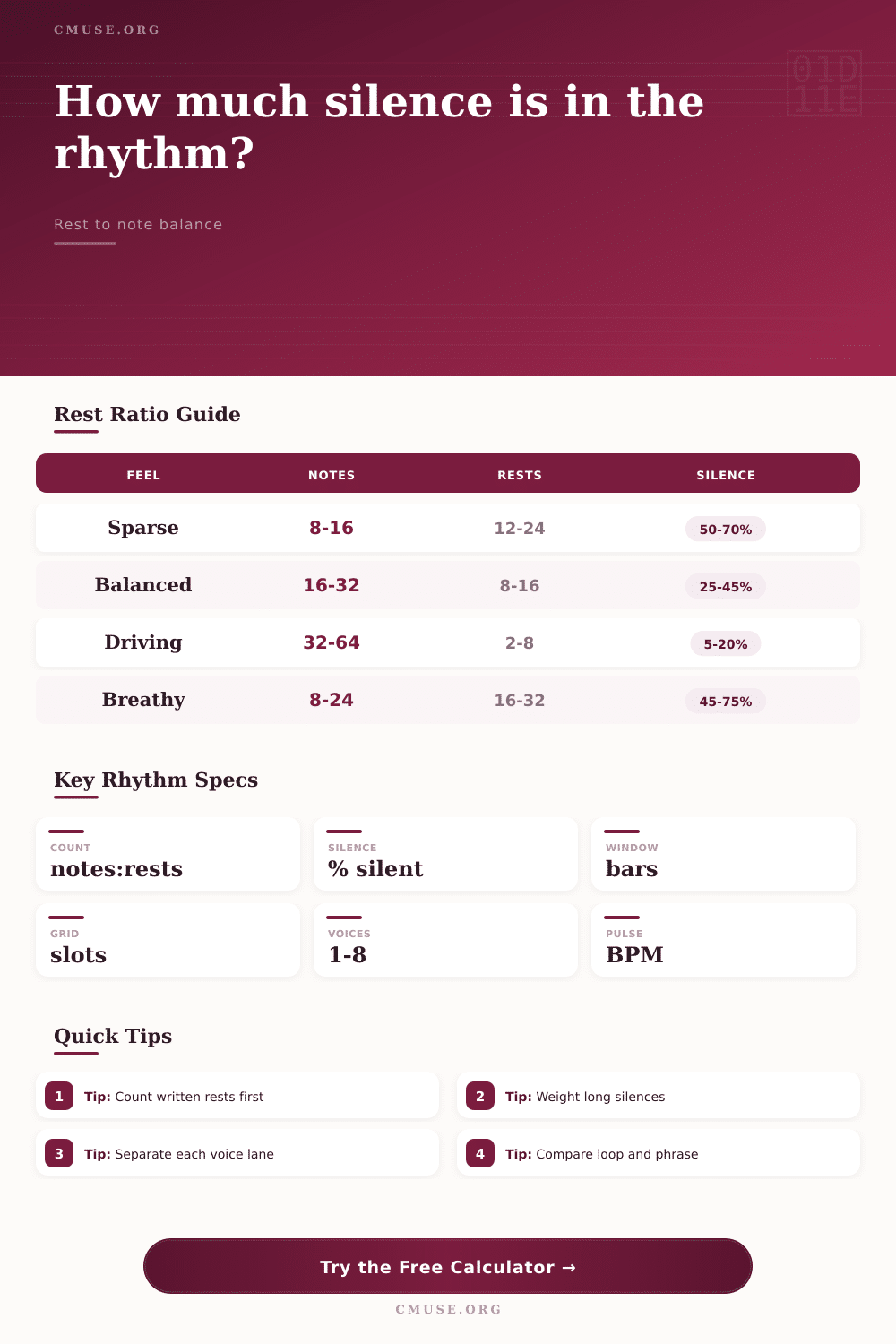
| 0.00 to 0.15 : 1 | 0% to 12% | Nearly continuous motion | Runs, rolls, tremolo, dense comping |
| 0.16 to 0.40 : 1 | 13% to 28% | Driving but articulated | Groove parts, eighth-note bass, active hats |
| 0.41 to 0.85 : 1 | 29% to 46% | Balanced call-and-response feel | Melodic hooks, syncopated guitar, horn riffs |
| 0.86 to 1.50 : 1 | 47% to 60% | Space-led phrase shape | Vocal breaths, sparse motifs, stop-time figures |
| 1.51 : 1 and above | 61% and above | Silence is the main feature | Ambient gestures, punctuated stabs, dramatic pauses |
| Grid setting | Slots per 4/4 bar | One slot at 120 BPM | Best for counting |
|---|---|---|---|
| Quarter-note grid | 4 slots | 500 ms | Slow harmonic rhythm and broad rests |
| Eighth-note grid | 8 slots | 250 ms | Backbeat grooves and simple bass lines |
| Triplet grid | 12 slots | 167 ms | Swing, shuffle, compound tuplets |
| Sixteenth-note grid | 16 slots | 125 ms | Funk, pop, electronic patterns |
| Thirty-second grid | 32 slots | 62.5 ms | Fast ornaments, rolls, detailed drum editing |
| Passage type | Typical window | Note/rest count | Balance cue |
|---|---|---|---|
| Funk rhythm guitar | 2 bars, 16th grid | 18 notes, 10 rests | Percussive with audible gaps |
| Trap hi-hat pattern | 1 bar, 32nd grid | 22 notes, 4 rests | Dense with brief release points |
| Vocal verse line | 4 bars, eighth grid | 20 notes, 14 rests | Lyric-forward phrasing |
| String stab cue | 8 bars, quarter grid | 12 notes, 20 rests | Silence creates impact |
| Bass ostinato | 4 bars, eighth grid | 28 notes, 4 rests | Steady drive with small pockets |
Continuous Drive
Low rest ratios keep momentum high. Use this band for parts that must carry pulse without leaving many holes.
Balanced Groove
Middle ratios preserve movement while letting accents speak. This is common in syncopated riffs and pop hooks.
Breath-Led Phrase
Higher rest share makes phrasing feel vocal, conversational, or spacious while still retaining a clear contour.
Punctuated Texture
Very high silence percent turns notes into events. Stabs, hits, and ambient motifs often live in this range.
| Notation detail | Count as note | Count as rest | Duration handling |
|---|---|---|---|
| Tied note continuation | No new attack | No | Add duration to the note slot average |
| Staccato mark | Yes | Usually no | Shorten note slots if release is written |
| Explicit eighth rest | No | Yes | Use 1 slot on an eighth grid |
| Pickup silence | No | Yes if part rests | Include only inside the measured window |
| Layered two-hand piano | Each lane or attack | Each silent lane | Use voice count to normalize workload |
Too many times you land on something that feels tight but empty or maybe it feels full but there’s just too much going on. More than likely it’s not a problem with the notes, usually it’s a problem with the silence. We spend years learning what notes to play and sometimes we forget to learn what spaces to leave open.
Once you plug in your note and rest counts, the calculator above do the math for you. You won’t have to guess about conversions and coefficients anymore. It converts vague feelings of groove into measurable data off space.
Why Silence Is Important in Music
Rests are considered by most musician to be nothing more than no sound. But they aren’t just silence; they are an active part of the phrasing. Rests has their own place in the phrasing and become an active part.
Think of listening to a funk guitar comp. Where does the power lie? It lies in space between each hit. This creates the tension that is resolved with the following note. Remove the silence and you have a roll, keep it and you have a pocket. The effect is subtle yet completely changes the feel of the whole track.
Counting doesn’t have to be vague, that’s where bad decisions come from. Before you count you should of know what grid you’re using. For popular music, the norm would be a sixteenth note grid while something like shuffle or swing might make more sense on a triplet grid. So what does this do? It changes the denominator in the ratio. And it also tell you how long you intend to measure the silence. In one context, such as a slow ballad, a quarter rest will take up same relative time as a sixteenth rest in a faster punk track. Weighing these durations allows you to compare apples to more then apples.
This is a vocal line, for example. If they sings every eighth note then the line sounds flat, lacking breath and therefore not human. Naturaly singers will take a breath at the end of their thought or before a hard consonant. Those are rests. The transcription of the vocal part needs to include those breaths too otherwise the phrasing has gone out of window. Count these as rest events too. Sounds pedantic I know but it’s the only accurate assessment you can make of how dense the part is.
On the page there is a table showing groupings of ratios into bands of style. You’ll notice that if silence percentage is over sixty percent, it is staccato or ambient stabs. Under twenty percent suggest a continuous driving motion. A frequent error that occurs here is to include ties as extra notes. They aren’t. A tie continues the existing attack. It doesn’t create an additional event. Include ties in the tally of notes and you overstate number of notes and understate the ratio of rests. Your score appears fuller than intended.
Instead of simply counting events, it considers how much time is spent making sounds compared to how much time is spent silent. That’s closer to the truth particularly when working with differing note lengths. Consider a drum pattern. It’s dense with something like kick-snare-kick-snare. Then you add some ghost notes and it gets thicker still. Now throw in a half-bar silence somewhere and the effect of that following kick grow exponentially. The silence is the weapon. Do you want impact? Or do you want momentum? Impact needs high rest ratios. Momentum needs low rest ratios. You can’t optimize both at once in one voice lane. You must choose: What should this part do?
The other wrinkle is layering. A well-balanced solo piano may be nicely weighted in favor of one or both hands, yet if there’s a constant repeating pattern going on in the left-hand, the overall sound will be full. You can enter as many layers of voices into the calculator. From this, you can view how much of the frequencies are being used. Muddy mixes occur when all layers drives. Sparse mixes lack energy when all layers are thin. There must be contrast. One fills the space created by another.
To conclude. All of this comes back to control. Control through rhythm. Control in knowing what to play and when to let go and just listen. The maths are your map but the ear tell you which way to turn. Let it be the tool that checks your instincts. If it feels like there’s too much on one end but the numbers balance out then follow your ears. Conversely, if it sounds dense but the numbers tell you it’s open, double-check your count. You’re aiming for no particular number. You’re aiming to use the silence to your benefit. Don’t forget, it’s the space between the hits that has the music.