Resonator Tube Length Calculator
Calculate acoustic tube length from a target pitch, or estimate resonant frequency from a physical tube using temperature, bore diameter, end correction, and harmonic mode.
Choose a practical tube, pipe, or instrument-style resonator, then adjust the frequency, bore, end model, harmonic, and tuning conditions. Presets recalculate immediately.
Calculation Breakdown
Sound speed
Wavelength
Mode used
Open ends
| Tube Type | Main Length Formula | Allowed Modes | Open-End Correction | Typical Use |
|---|---|---|---|---|
| Closed-open tube | L effective = n x v / 4f | Odd harmonics | One open end | Stopped organ pipes, clarinet-like bores, panpipes |
| Open-open tube | L effective = n x v / 2f | Integer harmonics | Two open ends | Flute-like air columns and simple test tubes |
| Closed-closed cavity | L effective = n x v / 2f | Integer harmonics | No open ends | Sealed cavities and pressure tube checks |
| Open-closed from open end | L effective = n x v / 4f | Odd harmonics | One open end | Slide whistles, stopped practice tubes |
| Pitch | Frequency | Closed-Open Length | Open-Open Length | Comment |
|---|---|---|---|---|
| C3 | 130.81 Hz | 25.84 in / 65.6 cm | 51.68 in / 131.3 cm | Low stopped pipe or long practice resonator |
| C4 | 261.63 Hz | 12.92 in / 32.8 cm | 25.84 in / 65.6 cm | Middle-C laboratory reference at 20°C |
| A4 | 440.00 Hz | 7.68 in / 19.5 cm | 15.35 in / 39.0 cm | Concert tuning reference before end correction |
| C5 | 523.25 Hz | 6.46 in / 16.4 cm | 12.92 in / 32.8 cm | Useful for short tubes and pitch demos |
| G5 | 783.99 Hz | 4.31 in / 11.0 cm | 8.63 in / 21.9 cm | Small whistle and slide-tube territory |
| Air Temperature | Sound Speed | C4 Quarter Wave | A4 Half Wave | Pitch Effect |
|---|---|---|---|---|
| 50°F / 10°C | 337.4 m/s | 12.69 in / 32.2 cm | 15.09 in / 38.3 cm | Cool air lowers resonance |
| 59°F / 15°C | 340.4 m/s | 12.80 in / 32.5 cm | 15.23 in / 38.7 cm | Slightly below room reference |
| 68°F / 20°C | 343.4 m/s | 12.92 in / 32.8 cm | 15.36 in / 39.0 cm | Common calculation baseline |
| 77°F / 25°C | 346.5 m/s | 13.03 in / 33.1 cm | 15.49 in / 39.3 cm | Warm air raises resonance |
| Preset | Boundary | Target | Bore | Primary Result |
|---|---|---|---|---|
| Stopped Organ C3 | Closed-open | 130.81 Hz | 2.00 in | Long quarter-wave pipe with one corrected open end |
| Open Flute A4 | Open-open | 440.00 Hz | 0.74 in | Half-wave tube corrected at both ends |
| Clarinet G3 Bore | Closed-open | 196.00 Hz | 0.58 in | Odd-mode cylindrical bore estimate |
| Panpipe C5 Tube | Closed-open | 523.25 Hz | 0.45 in | Short stopped tube trimmed after testing |
| Speaker Port 55 Hz | Open-open | 55.00 Hz | 3.00 in | Air-column estimate before box loading |
Blow across one end of a length of PVC pipe, and pitch sounds thin and sharp. Trim an inch off one end and try again? Nope. Still no good, because here’s the maddening truth about acoustic resonator construction: the actual length of your instrument seldom matches the effective length of its air column.
Because air doesn’t abruptly stop moving when it reaches pipe’s edge, it spills over a bit, which physicists refer to as an end correction. This tiny extension can make all the difference between an instrument that’s always sharp and a calculation that’s more guess than science. That’s why device above performs the tricky math for you.
Why Your Instrument Might Be Sharp
To understand why pitch isn’t right though, let’s examine what happens to sound waves within cylindrical instrument. Air vibrations create standing wave along any tube, and their shape is completely determined by whether ends are open or closed. For instance, reed creates a pressure node at one end of the clarinet, so its harmonic patterns differ from those of a flute, which has both ends open.
You can select these boundary condition in the calculator; however, understanding why they matter makes choosing easier. For example, if you model a panpipe as an open-open tube (i.e., open at both ends), assuming it’s really stopped at bottom means your length estimate will be half off. You should of not do that if you are cutting expensive pieces of metal or wood.
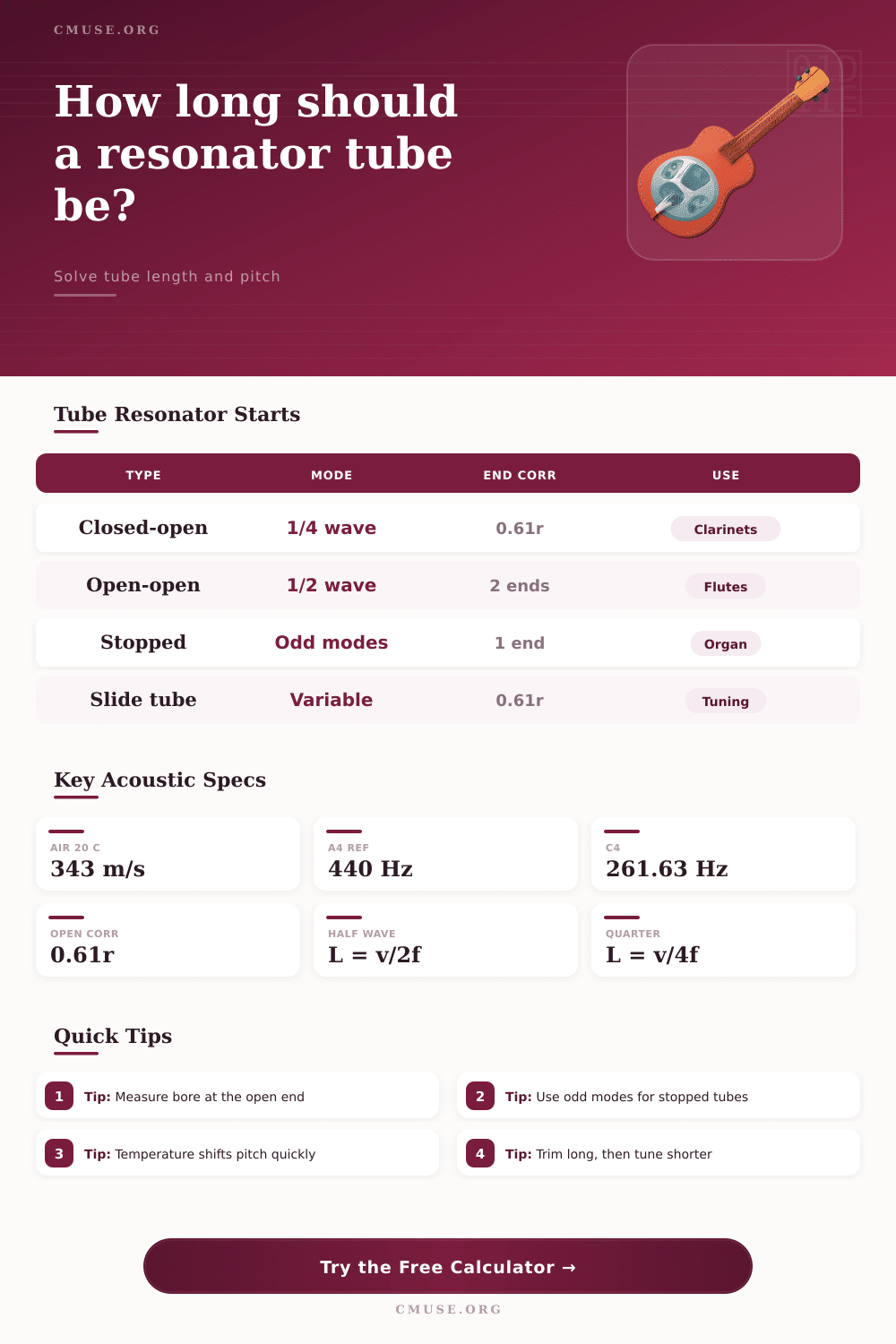
Your bore size also has a bigger impact than you’d expect. People who is starting often think the length is all that matters. But if you increase diameter of your pipe then you’ve got more air to escape round the outside before the pressure wave settles down and stays steady. This results in a higher note. A standard correction factor for an open ended pipe is about zero point six one times radius (of the pipe). This may seem small but when you’re dealing with short organ pipe or even a whistle it makes a noticeable difference in terms of note produced. You can cut yourself what you feel to be a perfectly good quarter wave but that additional virtual length in front of your hole becomes part of acoustic reality. The table on the page breaks this down for different type of tubes.
Another factor that trips people up is that warmer air also transmits sound more quickly. When you take a resonator you’ve constructed and tuned in a cold workshop into a room with sunlight streaming through it or a concert hall all warmed up, it’ll sounded sharper. By entering your temperature at which you’re going to use the instrument, calculator takes this into account and alters the speed of sound accordingly. If the instrument’s intended purpose is as part of an outdoor festival during summer months then set higher temperature. If you are in a climate controlled studio, stay nearer to room temperature. It eliminates that ever-so-slight mismatch that spoils an otherwise perfect creation.
The physics are only part of equation; how they’re built matters too. A good tip: always cut the tube a bit longer than theoretical length. It’s really hard to put more in there, impossible, actualy, without a saw or sand paper, but very easy to take some out. The trim allowance function in the tool assumes that and adds a little extra to its calculation. That buffer will allow you to play around, listen, and tweak until it sounds just right.
Blow through it. Hear it’s too sharp? Shave off a millimeter. And then another. Until it fits just right, and that’s when theory becomes practical.
A handful of pre-sets get you started quickly with some typical use cases. You can design a basic speaker port, an open flute model, or even a stopped organ pipe. It gets you going, saves time, and avoids mistakes in entering values, but do not follow them blindly. Double-check end correction assumptions and bore diameter to account for the materials being used since, for example, a thin copper tube will behave different than a thick walled plastic one. It’s all good math but your particular application has its own constraints.
Acoustic tubes are somewhat a combination of intuition and science. There’s no magic formula, it is part art and part math. While the equations provides a starting point, they don’t assure success. It also requires some listening and gradual trimming. But if you do your math correctly, you eliminate much of the guesswork which confuses so many tinkerer. That initial pure tone out of a properly tuned tube makes all of the careful planning worthwhile.