Repeat Sign Total Bar Calculator
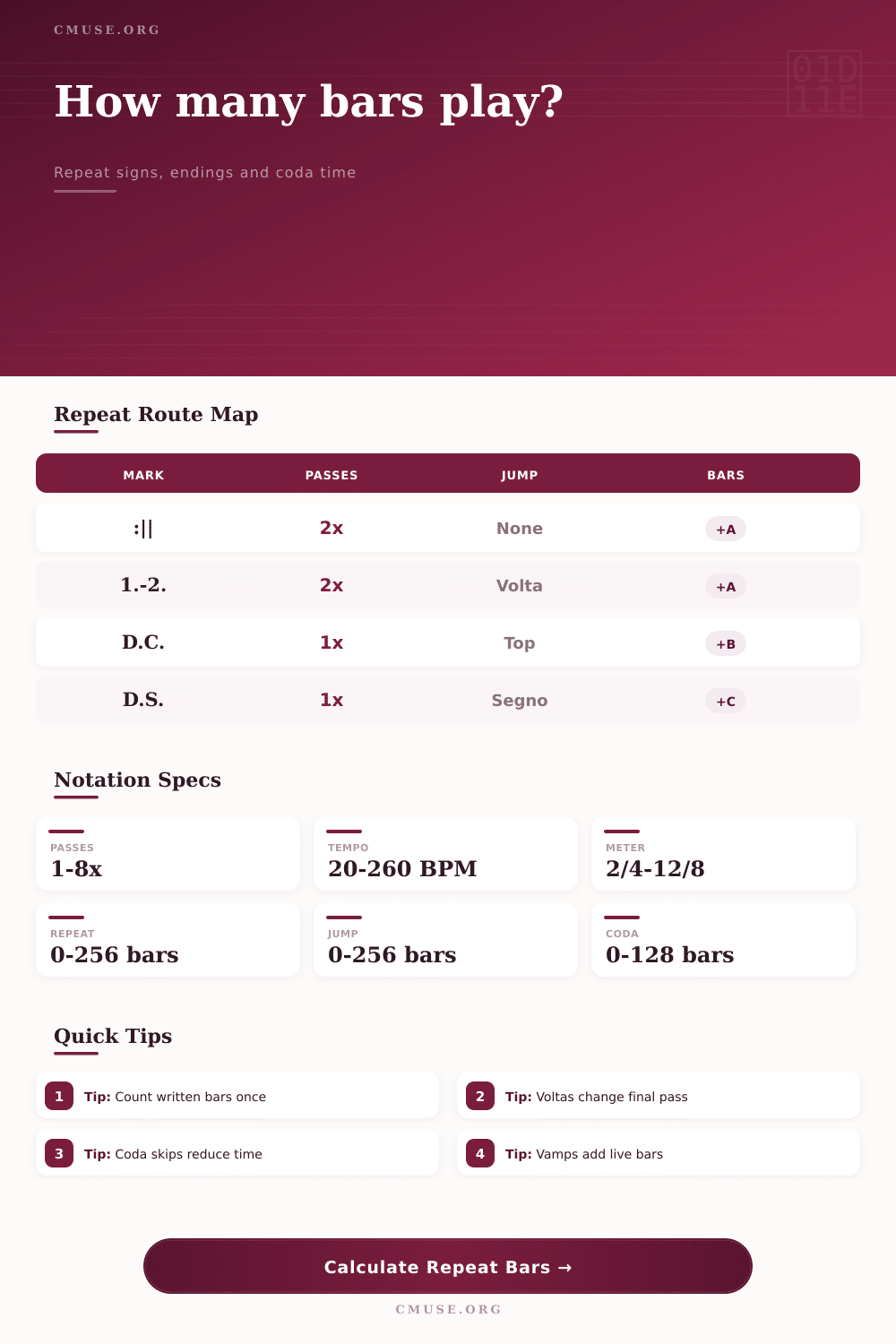
Convert written repeat notation into performed bars, written bars, repeat additions and playback time for simple repeats, voltas, D.C., D.S., coda jumps and vamps.
Preset use: Load a real repeat-sign route, then adjust the written bar counts, pass count, jump span, coda skip, vamp bars, meter and BPM for your score.
Repeat Route Breakdown
Seconds Per Bar
Seconds Per Beat
Phrase Cycles
Net Page Expansion
Same inputs, different routes: These cards compare the current page count against common rehearsal interpretations of the repeat map.
| Repeat mark | How to count written bars | How to count performed bars | Common trap |
|---|---|---|---|
| :|| | Count the repeated passage once on the page. | Multiply the passage by total passes. | Adding only one extra pass when the printed instruction says 3x. |
| ||: | Start marker has no extra bar count by itself. | Returns to this marker after an end repeat. | Assuming the repeat returns to bar 1 when no start repeat is present. |
| repeat 4x | Written bar count stays unchanged. | Total passes are four, not four extra repeats. | Counting four extra passes instead of four total passes. |
| measure repeat | Each printed slash measure is still a written bar. | Each measure repeat plays once unless enclosed by repeat signs. | Subtracting slash-repeat measures from the page total. |
| Ending type | Written bars | Performed route | Calculator field |
|---|---|---|---|
| 1st and 2nd ending | Repeat block + first ending + second ending. | First ending on earlier pass, second ending on final pass. | Earlier ending bars and final ending bars. |
| 1st, 2nd and 3rd ending | All printed ending boxes count once. | Earlier ending bars may cover two boxes before the final ending. | Use total earlier-ending bars before final pass. |
| Open repeat into last ending | Open vamp instruction may not add written bars. | Extra live vamp bars add to performed total. | Extra vamp bars. |
| No volta ending | Ending fields are zero. | Repeated block is simply multiplied by passes. | Set earlier and final ending bars to 0. |
| Jump sign | Meaning | Bar total method | Skip handling |
|---|---|---|---|
| D.C. al Fine | Return to the beginning and stop at Fine. | Add the replayed span after the first pass through the page. | Fine stop is entered as skipped bars from the replay span. |
| D.S. al Fine | Return to the segno and stop at Fine. | Add only the segno-to-Fine replay span. | Bars after Fine remain written, but not replayed. |
| D.S. al Coda | Return to segno, jump at To Coda, then play coda. | Add replay span, subtract skipped middle bars, keep coda bars after the block. | Coda skip bars reduce the jump playback only. |
| D.C. al Coda | Return to top, then jump to coda sign. | Add top-to-coda replay span and the printed coda once. | Skipped bars do not disappear from written count. |
| Meter | Quarter units per bar | At 120 BPM | Use in repeat timing |
|---|---|---|---|
| 2/4 | 2 | 1.00 s/bar | Marches, pickups and short tags. |
| 3/4 | 3 | 1.50 s/bar | Waltz repeats and trio returns. |
| 4/4 | 4 | 2.00 s/bar | Most pop, rock, hymn and theater charts. |
| 6/8 | 3 | 1.50 s/bar | Count dotted-quarter feel separately if BPM is dotted. |
The number of bar in a piece of music can be confusing when there are several endings and complex repeat signs within the musical chart. At times you might feel as if you are off the beat from the conductor when it feels like your inner count doesn’t tally up with his. The reason for this is that changing time of performed music differ from the static nature of written notation. What we hear must be carefuly calculated to bridge gap between what is on page and what is heard.
That’s the math that our calculator (above) does for you. For example, it take complicated repeat sections and breaks them down into straightforward numbers of measures and total playback time. It also separates any intro material from repeated block and applies correct multiplier for each section. This is an important point if you’re arranging music or preparing click tracks.
How to Count Bars in Music with Repeats
Most players counts through all the measure they hear. While that’s true for playing the music, it’s not helpful to manage your pages. With Volta endings, this means there are not just straight line paths but branching ones. First and second ending appear on the stave either vertically stacked or sitting next to each other on page. Only one of these ending is ever played at a time in performance. You will be overestimating the length of this section if you simply add up number of bars in main repeat block and then add those of endings. Earlier endings only count toward the overall length if it’s their turn, as the final ending take over for that final pass.
Jump signs like D.S. Are added. These include instructions like al Coda and D.C. Al Fine adds extra complications by folding time back in on itself. You skip what you’ve heard and then replay existing material. If there’s a D.C. Instruction it returns you to the start and all the bars up to the Fine mark play again. With a coda jump, you skip over the central section on your return journey. The page may be densely packed but the number of bars played overall are reduced. Knowing where the bar need to be skipped and replayed enables accurate timing.
Seconds turn to minutes with tempo and meter. A sixteen-bar repeat in 4/4 time at sixty beats per minute lasts twice as long than one at one hundred twenty. The calculator turns this hypothetical bar count into actual seconds, helping educators and producers when deciding whether a section will fit inside lesson plan windows or radio format limits.
Blocks of simple repeats is easy (they’re a multiple of the block). Open endings/vamps change things and make the maths move from set multiplication to additive extension. How much does conductor hold the vamp? It might be a variable number of bars. The tool lets you enter this manually. That’s recognition that what happens in real life is rarely what’s noted down, it’s about understanding the passage of time inside the boxes rather than just counting them.
So with repeat signs, it’s not enough to just read what’s written down; you must picture in your mind where the music goes. Will there be a jump? A skip? Where does it end? If you can visualize this then confusion is gone as the structure becomes clear. The music is the territory, the page is the map. This lets the ensemble stay together with knowledge of the distance in terms of bars from start to finish.