Relative Key Calculator
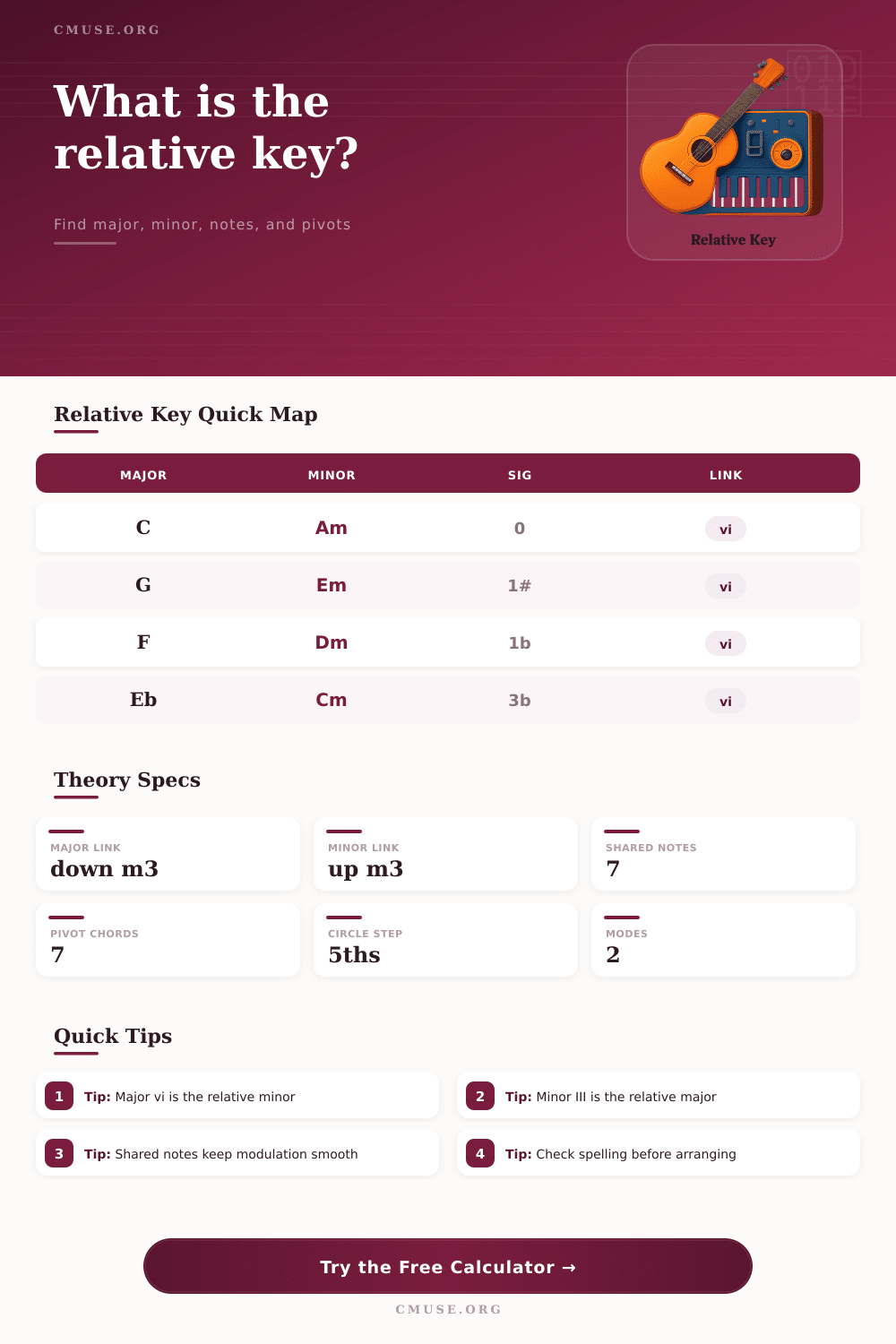
Find the relative major or minor key, shared scale notes, key signature, pivot chord, transposed target, and practical modulation relationship for common tonal music.
Preset use: Load a common major or minor key pair, then adjust spelling preference, pivot degree, seventh-chord color, and modulation shift.
Calculation Breakdown
| Major Key | Relative Minor | Key Signature | Relative Degree |
|---|---|---|---|
| C major | A minor | 0 sharps or flats | vi |
| G major | E minor | 1 sharp | vi |
| D major | B minor | 2 sharps | vi |
| A major | F# minor | 3 sharps | vi |
| F major | D minor | 1 flat | vi |
| Bb major | G minor | 2 flats | vi |
| Eb major | C minor | 3 flats | vi |
| Minor Key | Relative Major | Key Signature | Relative Degree |
|---|---|---|---|
| A minor | C major | 0 sharps or flats | III |
| E minor | G major | 1 sharp | III |
| B minor | D major | 2 sharps | III |
| F# minor | A major | 3 sharps | III |
| D minor | F major | 1 flat | III |
| G minor | Bb major | 2 flats | III |
| C minor | Eb major | 3 flats | III |
| Shared Chord | In Major Key | In Relative Minor | Typical Use |
|---|---|---|---|
| C | I in C major | III in A minor | Bright arrival before minor color |
| Dm | ii in C major | iv in A minor | Predominant link into a minor cadence |
| Em | iii in C major | v in A minor | Soft dominant-area connection |
| F | IV in C major | VI in A minor | Common pop and modal mixture bridge |
| G | V in C major | VII in A minor | Dominant in major, modal lift in minor |
| Am | vi in C major | i in A minor | Direct relative-minor arrival chord |
| Bdim | viio in C major | iio in A minor | Tense passing sonority |
| Signature | Major Key | Relative Minor | Useful Check |
|---|---|---|---|
| 0 | C | A minor | No printed accidentals in the signature |
| 1 sharp | G | E minor | F# appears in both key signatures |
| 2 sharps | D | B minor | F# and C# are shared |
| 1 flat | F | D minor | Bb appears in both key signatures |
| 2 flats | Bb | G minor | Bb and Eb are shared |
| 4 sharps | E | C# minor | G# minor leading tone is extra only in harmonic minor |
A composer often want to move from one key to another. However, a composer dont want teh music to sounding like it belongs to a different piece of music. One of the method composers use to move to a different key while maintaining the same sound is by using relative keys.
A relative key share the same key signature and use the same notes as the original piece of music. Additionally, when a composer use relative keys, it creates a shift in gravity in the music for the listener while the music maintains the same tonal material. A relative key calculator can help composers find these keys quick so they can test the musical transition in mere second.
How to Change Key Using Relative Keys
The relative keys shares a