Rehearsals Needed Before a Show Calculator
Estimate full-band rehearsals, sectionals, technical calls, dress runs, and show-readiness confidence from the set length, lineup complexity, new material, attendance, and performance risk.
Choose a realistic performance scenario, then adjust the lineup, set risk, technical demands, and available preparation time. The calculator estimates rehearsal calls, not practice hours for individual players.
Detailed Rehearsal Breakdown
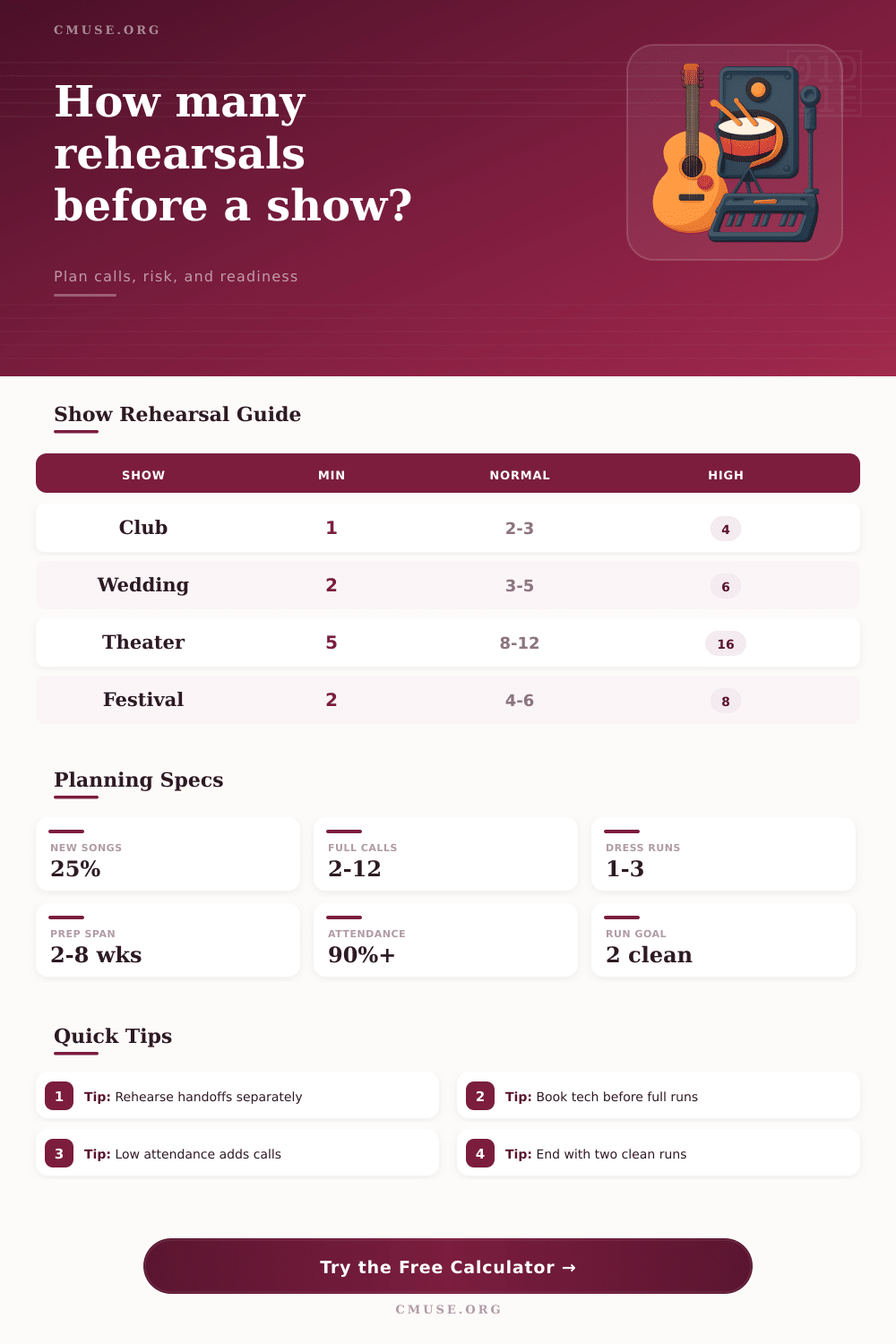
| Show Type | Typical Minimum | Normal Range | Extra Rehearsal Triggers |
|---|---|---|---|
| Club showcase | 1 full call | 2 to 3 full calls | New originals, unfamiliar subs, tight segues, or a long headline set. |
| Festival date | 2 calls | 4 to 6 calls | Fly rigs, short changeovers, IEMs, guest features, or no local soundcheck. |
| Wedding or private event | 2 calls | 3 to 5 calls | Special dances, medleys, requests, emcee cues, and multiple singers. |
| Theater or musical | 5 calls | 8 to 12 calls | Scene cues, underscoring, vamps, pit balance, choreography, and cue-to-cue work. |
| Broadcast or recording | 3 calls | 5 to 9 calls | Click tracks, camera marks, repeatable endings, and low tolerance for repairs. |
| Risk Factor | Low Load | Moderate Load | High Load |
|---|---|---|---|
| New or changed material | 0% to 15% needs review only | 16% to 45% adds learning calls | 46%+ should be treated like a new show |
| Lineup changes | No subs or one familiar player | Two to four new players | Five or more new players, rotating vocalists, or missing principals |
| Technical complexity | Backline and standard mics | Monitors, patch changes, or tracks | Broadcast, automation, timecode, wireless, or stems |
| Critical handoffs | Fewer than five transitions | Five to fifteen starts, stops, or segues | More than fifteen moments that need exact cues |
| Score | Status | What It Means | Best Next Move |
|---|---|---|---|
| 90% to 100% | Show-ready | The planned calls cover music, transitions, tech, and dress-run pressure. | Protect the schedule and rehearse only fixes, not new changes. |
| 78% to 89% | Mostly ready | The plan can work if players arrive prepared and attendance stays high. | Add one targeted sectional or a short tech confirmation. |
| 62% to 77% | Needs control | Risk is visible; the show may survive but weak transitions will show. | Freeze charts, split sectionals, and schedule a clean full run. |
| Below 62% | At risk | The rehearsal plan is thin for the amount of new, technical, or staged material. | Reduce scope, add calls, simplify tech, or lower the performance standard. |
| Time Before Show | Primary Goal | Best Call Type | Completion Target |
|---|---|---|---|
| 6 to 8 weeks | Lock keys, charts, demos, and personnel | Read-through and sectionals | Players know what to practice privately. |
| 3 to 5 weeks | Clean arrangements and identify weak transitions | Full-band music calls | Every tune can start, end, and recover. |
| 1 to 2 weeks | Integrate tech, staging, monitor needs, and guests | Tech call and dress run | At least one uninterrupted show-order pass. |
| Final 72 hours | Polish only; avoid rewriting the show | Short fix call or soundcheck | Two clean versions of the highest-risk moments. |
| Area | Rehearsal Need | Risk If Skipped | Confirm Before Dress Run |
|---|---|---|---|
| Lead vocals and guests | Blend pass, lyric cue points, and talkback notes | Missed entrances, uneven harmonies, and unclear feature moments | Mic order, monitor priority, and entrance cue. |
| Backline and rhythm section | Groove, tempo map, stops, endings, and patch changes | Dragging transitions or unreliable song starts | Set-list order, instrument changes, and count-offs. |
| Horns, strings, choir | Sectional intonation plus full-ensemble balance | Pitch spread and late cutoffs under stage volume | Seating, sightlines, and conductor or MD cues. |
| Playback, click, and timecode | Start, stop, count-in, failover, and recovery drills | Show stops, wrong cues, or players losing the grid | Redundant playback path and cue names. |
| Wireless, IEMs, and monitors | Dedicated line check before musical dress run | Players play safely but not musically | Mix notes, RF plan, battery policy, and spare packs. |
This calculator estimates practical rehearsal calls from common music-director planning factors. It cannot replace judgment about player skill, venue limitations, or contractual rehearsal rules.
It’s understandable if you’re panicked by realizing a song sounds fine in isolation but falls apart when the full band hits it together. Typically it happens too late. By now, youve assured the audience (or the client) that you are prepared.
Between practicing alone and playing live is the difference between a successful show and one that flops. Closing that distance isnt just about good intentions. It’s about a planned strategy for how often youll all be in the room together until curtains close.
How to Plan Your Rehearsals
A band’s own memory for itself tend to be exaggerated. A band underestimates the problems that new elements bring. Add a new key for vocal comfort. Sub in a new drummer. Introduce some tricky lighting cues? The rehearsal burden grows rapidy. Plug in your set length, line-up complexity and tech demands and the calculator do the math. That spares you from a guess about whether two weeks will suffice to correct something that could of been worked out three months prior. And it converts vague unease into decisions you can act on.
You know exactly how much extra time a wedding medley requires compared to a standard club cover set. You know a live broadcast recording session need more clean passes than a free-wheeling festival gig.
The most harmful source of incorrect inputs is the percentage of new material. Half your set that’s unplayed? That’s not rehearsal. That’s a lesson. A lesson belong in private practice and sectionals. Full ensemble runs are for polishing, not learning. To account for this, the tool weigh the recommendation calls against how stable the charts seem to be. Days out from the show with charts being tweaked and moved around isnt going to help you if you havent had targeted sectional work first.
The chart below shows you why having low numbers at an initial call makes all future full runs less reliable. Parts goes unaudited and people starts showing up late. This means the director has to spend limited rehearsal time teaching basics when they should of perfecting transitions.
Another wrinkle too easily overlooked is technical side. Learning how to use in-ear monitors, how to sync to a click track, and what time code mean requires practice separate from being musically proficient. There’s no point practicing learning a new bridge if you’re having problems getting your monitor mix right. The calculator differentiates between those two requirements: full ensemble calls vs support calls. If you burn up valuable full-band time working out a technical issue, you won’t have time for a dress run about confidence and flow. That’s meant to be an argument free zone between you and the sound engineer as to why the snare doesnt get louder in ear three.
“Ultimately, it’s all about risk management. That’s what this planning process is. What can go wrong in the show? Where can it fall apart? You’re strengthening the areas of weakness prior to bringing an audience in. Every time there’s a segue or a critical handoff; let’s say you have fifteen… Every one of them are a potential failure point. Does your rehearsal budget account for those risks? Having a high readiness score isnt the same as being perfect. It means being prepared so that when something goes wrong, you have practiced how to recover smoothy. And the other side of that is the harsh (but fair) verdict. “Book three calls instead of six when your plan said six? You’re taking a risk there. And that risk most commonly shows up in the form of dragged tempos, shaky starts, and missed cues in the opening set.”
But then what about the opposite problem: rehearsing too much, thus risking becoming bored and fatigued? Here we get into that sweet spot of feeling tight while not feeling tired. You must find the least amount of rehearsal for the highest quality show. Get an early start. Obtain lockdown charts. Work it out in private practice. Only use full groups after all your parts are learned and you can focus on polish and integration.
The difference between a good show and a great one is rarely talent; it’s logistics. What doesnt? Logistics. Respect the rehearsal process and the show will take care of itself. Most people miss this point. They believe that the magic occurs on stage. Actualy, the magic was created in those quiet hours, long before anyone ever walked through the door.