Rehearsal Hours Needed per Song Calculator
Estimate how much full-ensemble and individual practice time one song needs based on length, difficulty, arrangement density, personnel, familiarity, polish target, deadline pressure, and current accuracy.
Detailed Rehearsal Breakdown
| Factor | Lower Load | Middle Load | Higher Load |
|---|---|---|---|
| Difficulty | Easy: simple range, repeated groove, few exposed bars | Moderate: normal chart reading, typical transitions | Virtuoso: fast passages, wide range, featured accuracy |
| Density | Sparse: lead line plus support parts | Standard: verse, chorus, bridge, fills | Dense: layered cues, modulations, sectional writing |
| Polish | Rough jam needs musical orientation only | Stage-ready needs repeatable entrances and endings | Recording needs tight timing, tone, tuning, and recall |
| Accuracy | Above target: mainly maintenance passes | Near target: targeted loops plus full runs | Below target: slow work, sectionals, and rebuild time |
| Format | Typical People | Coordination Load | Best Time Use |
|---|---|---|---|
| Solo or duo | 1-2 | Low unless looping, tracks, or exposed memory are required | Spend more time on personal repetition and performance shape |
| Band or rhythm section | 4-8 | Medium, driven by groove, transitions, dynamics, and endings | Loop intros, stops, breakdowns, and vocal entries before full runs |
| Choir or vocal ensemble | 8-80 | Medium to high, driven by tuning, blend, text, and entrances | Use sectionals for note security, then full-group balance passes |
| Orchestra or theatre | 12-120 | High, because cues, conductor response, and staging add risk | Separate note learning, cue drilling, and performance continuity |
| Song Situation | Common Inputs | Full-Group Range | Prep Note |
|---|---|---|---|
| Simple acoustic cover | 3-4 minutes, easy, familiar, solo or duo | 0.5-1.5 hours | Most work is lyric memory, endings, and delivery |
| Stage-ready pop band song | 3-5 minutes, moderate difficulty, 5-7 parts | 1.5-3.5 hours | Transitions and background vocal entries often set the pace |
| Choir anthem or vocal feature | 4-6 minutes, layered harmony, 4+ voice parts | 2.5-6 hours | Sectional note work can save full-ensemble time |
| Studio or broadcast song | Click, exposed parts, high polish, tight repeats | 3-8+ hours | Lock timing, tone, intonation, and exact arrangement details |
| Detail Area | Rehearsal Trigger | Typical Add-On | What to Check |
|---|---|---|---|
| Rhythm instruments | Push-pull feel, stops, fills, odd bars, tempo extremes | 10-25% | Drums, bass, guitar, keys, and percussion agree on subdivision |
| Vocals and winds | Blend, breaths, diction, range, exposed entrances | 10-30% | Pitch center, vowel shape, consonants, and phrase releases |
| Strings or orchestral parts | Bowing, articulation, conductor response, section balance | 15-35% | Entrances, cutoffs, dynamics, tuning, and sectional alignment |
| Click, stems, or picture lock | In-ear count, backing tracks, tempo map, hit points | 15-40% | Count-ins, bar numbers, track starts, stops, and fail-safe cues |
There’s no sound quite as deafening as a missed cue. Bands has fallen apart on a failed bridge passage. Choirs have struggled on a tricky key change. Soloists have broke into a sweat over an intro they felt certain they had in hand. For all musicians, rehearsal time is precious but spent blindly. The assumption is that if you’re together in the room for three hours, then you’ve gained three hours worth of work. However, half the time may be lost while someone tries to find his or her part, or because you need to repeat something that was actualy solid.
By planning your rehearsal schedule with intention you avoid this burnout and keep group together. Once you know your polish target, difficulty level and song length, the calculator do all the math for you (so you don’t have to guess at what needs to be done).
How to Plan a Better Rehearsal
Arrangement density is worth its own category, as most folks severely undervalue it. You may think, “oh yeah I can knock that out in 3 minutes.” But if it’s an exposed vocal song with tricky dynamics and entries, the coordination load go up. The arrangement becomes heavy on the calculator because lining up seven moving pieces takes much longer than lining up two.
One more thing that colors how we experience time is difficulty. Even though something might be technically easy, it may take hours because music is unfamiliar to everyone or the players aren’t familiar with each other’s playing styles. This is an important differentiation for the calculator: it divides up personal preparation versus group rehearsal time. Showing up to a session where you haven’t prepared your part is essentially making the whole group pay for your learning curve. It’s inefficient and slows the whole group down. Prep well on your own before reserving that pricey studio space or booking a full band spot.
Margin of error is set by Polish: a recording take requires emotional consistency plus millisecond precision, whereas a rough jam require orientation only. What’s the big deal? Broadcast quality makes no allowances for recovery; it takes twice as many hours to get from stage-ready to broadcast. On tape, you can’t fake tightness.
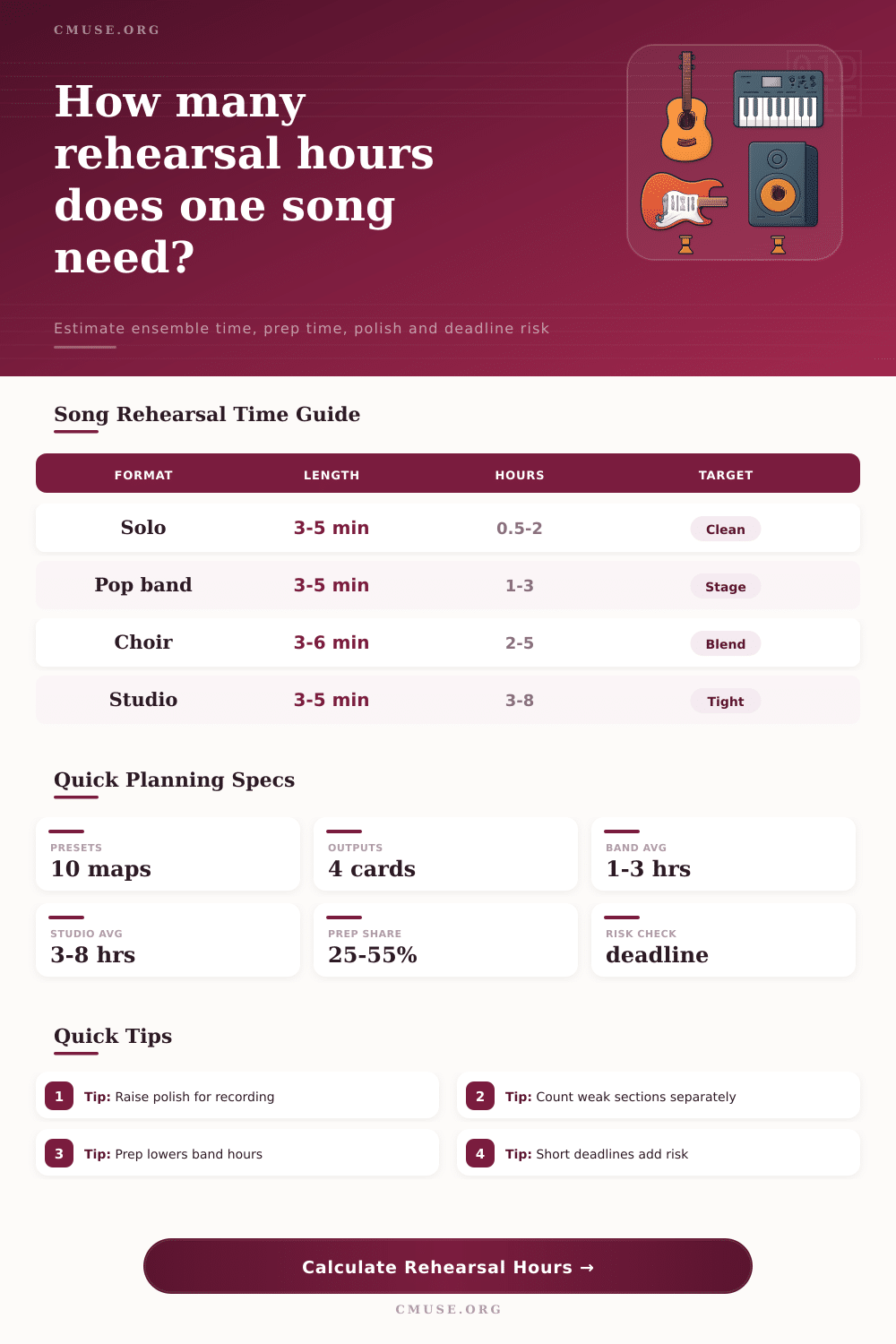
How do these factors play into the equation? The reference table on the page shows that frequently an eight-hour average in a studio stretches to eight or more, where simultaneous locking of intonation, tone and timing is required. It’s not just about playing right but also about playing right under pressure with no second chance. “Practice under deadline makes a difference in psychology. With 21 days you can pace yourself with full runs and sectionals. You can build memory from one session to the next. With tomorrow’s gig, you’re in damage control, only thinking about endings, stops and entrances. That’s where the calculator tweaks, based off how many calendar hours we’ve got versus our estimated hours required. If the readiness percent goes south, it warns that your present calendar are unrealistic. It challenges you to make tough choices: Add a session, simplify the arrangement, cut a song.”
Often the key to an effective rehearsal lies in sectional work. If it’s challenging material then it helps to divide it up before re-assembling the large group. For instance, dividing an orchestra or choir into smaller units speed up the process of note security. The tool includes inputs for sectional availability. Then when all the sections are locked-in you can concentrate on blend and balance with full group instead of just getting their pitches right.
It also values the fact that we only have a limited attention span when working for hours at a stretch. The bottom line is that rehearsal isn’t a quantity game; it’s a focus game. If you’re practicing productively with the time you have, then you don’t necessarly need more time. Identify your weakest areas, push for personal preparation, and focus on particular polish levels. This will turn crazy practices into meaningful preparations.
What was once the silence following the missed cue now gives way to the comfort of realizing precisely what has gone into each bar.