Rap Words Per Minute Calculator
Measure a rap verse by total words, active performance time, bars, beat tempo, pause share, and syllable density to estimate raw WPM, active WPM, words per bar, syllables per second, and clarity load.
Load a realistic verse pattern, then replace the word count and timing with your own take. Active WPM removes estimated ad-libs, rests, and breath space so dense verses compare more fairly.
Calculation Breakdown
Density Band
Clarity Load
Tempo Fit
Breath Margin
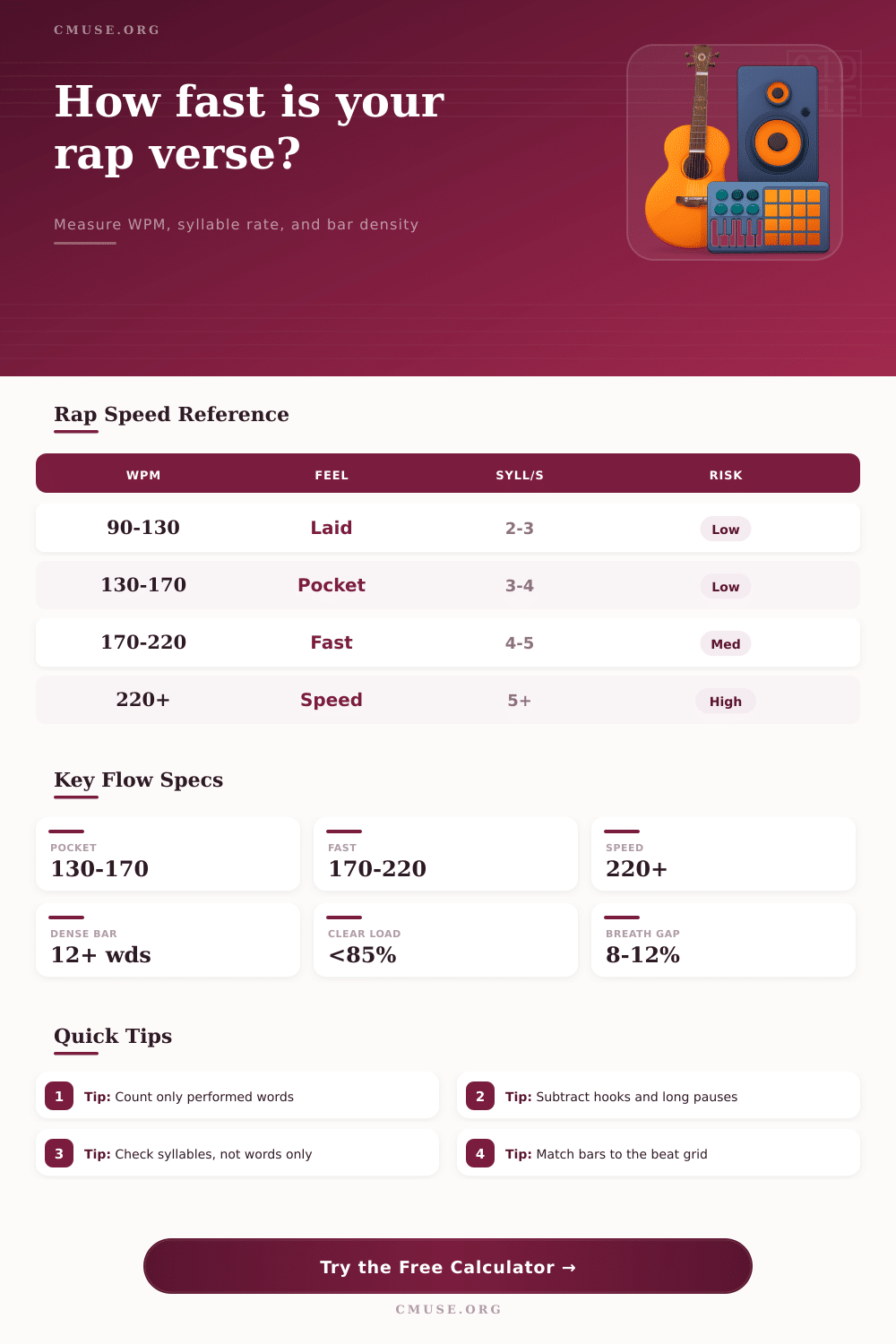
| Active WPM | Common Feel | Approx Syllables/Sec | Calculation Note |
|---|---|---|---|
| 80 to 120 | Spoken pocket | 1.8 to 2.8 | Useful for intros, storytelling, and very open cadence. |
| 120 to 160 | Standard verse | 2.7 to 3.6 | Comfortable for many 16-bar rap verses with clear breaths. |
| 160 to 200 | Fast verse | 3.6 to 4.7 | Often needs tighter consonants, planned pauses, and steady tempo. |
| 200 to 240 | Technical fast | 4.6 to 5.6 | Dense multis can sound faster than the word count alone shows. |
| 240 and up | Speed rap | 5.5 plus | Small timing errors become obvious; active-time counting matters most. |
| Words Per Bar | Flow Density | Typical Use | What To Check |
|---|---|---|---|
| 4 to 7 | Open | Hooks, chants, crowd callouts | Make sure the WPM is not inflated by silence. |
| 7 to 10 | Balanced | Most pocket verses | Compare words per beat with the BPM. |
| 10 to 13 | Dense | Multisyllabic schemes and internal rhymes | Use syllables per second for a fairer load. |
| 13 to 16 | Very dense | Double-time or packed technical runs | Check breath margin and grid fit together. |
| 16 plus | Extreme | Challenge takes and speed tests | Use active WPM; raw WPM can hide the strain. |
| Setup | Bars | Tempo | Grid Time |
|---|---|---|---|
| 16 bars at 80 BPM | 16 | 80 BPM | 48.0 sec |
| 16 bars at 90 BPM | 16 | 90 BPM | 42.7 sec |
| 16 bars at 100 BPM | 16 | 100 BPM | 38.4 sec |
| 24 bars at 88 BPM | 24 | 88 BPM | 65.5 sec |
| 32 bars at 140 BPM | 32 | 140 BPM | 54.9 sec |
| Preset | Words | Time | Expected Result |
|---|---|---|---|
| Spoken Intro | 72 | 0:45 | Low-pressure, narration-like WPM. |
| Boom Bap Verse | 138 | 0:43 | Classic 16-bar pocket density. |
| Trap Verse | 156 | 0:42 | More rests, higher active speed. |
| Fast Cipher | 220 | 0:50 | Technical fast band with high syllable load. |
| Speed Run Test | 310 | 1:00 | Extreme active WPM and low breath margin. |
You record a new sixteen bars and song sounds loose, although in your head, you had a nice tight verse going on. You were rapping quick but now listening back, you’re dragging on the snare. Here’s when measurement will help and raw intuition fail. Oftentimes knowing not only did you say something, but when you said it in relation to grid is what separates riding the beat vs. You are fighting the rhythm.
And most artist obsess over word count and forget about actual amount of time they take up. It’s this oversight that makes or breaks the final mix. Plug your pause and timing data into the calculator above, and let it do the work. No more guesswork about how fast (or not) you’re rapping when there’s silence. The point isn’t what your speed is, but rather what your speed actualy is.
Why Measuring Your Rap Speed Helps
Raw words per minute counts everything: ad libs, breaths, etc. Within the section. Active words per minute subtracts all that so you see how dense the spoken portion actualy is. If you rap a fast run but leave four bars of empty space, your raw number look moderate. You have four bars of nothing. Your raw number will look moderate. Your active number will tell the story.
That difference is important when comparing verses between different style or songs. It also standardizes pauses. How do I enter pause share? Think about it: What percent of the song is made up of intentional pauses (rests), ad libs and hooks? If you’re doing a rap verse where you leave a lot of space in between bar, that number will be higher.
Once you enter that figure into the tool, it will remove it from overall length of the song and calculate your pace. This provides some insight into how hard you has to articulate. Are you really using your vocal cords or simply pausing during a note? Adjust this dial to match. Otherwise, your goal of determining your true flow limit wouldn’t of serve its purpose when you pump up this value to increase your WPM score.
Another metric worth noting aside from raw word count is syllables per second. Sometimes two verses with the same number of words will be vastly different in their difficulty level; one verse may be composed mostly of short, simple, monosyllabic rhymes while the other verse use more complex, multisyllabic schemes. You can change the average number of syllables per word in the calculator to factor in this aspect of density.
A higher syllable count increase the clarity load, which is basically a measure of how hard it is for someone listening to parse your lyrics at that speed. If your clarity load exceeds eighty-five percent compared to your target, you’re probably sacrificing how well people understand you for the sake of speed. That is rarely a fair exchange unless you’re doing a pure challenge take.
Without diving straight into building something, the preset buttons also give a quick look at how common styles tend to sit on a spectrum of speed and breathing space. Typically, there’s plenty of time between notes during a boom bap verse that lands somewhere in the pocket range with just enough density to keep things moving along nicely. At double-time, it shift up and down the scale. This reduces the breathing space and pumps the Active WPM up considerably.
If you’re not sure which timings fit with which styles, then the presets allows you to adjust your own entry points based on practical considerations rather than theoretical possibilities. They serve to illustrate what works well and realisticly. What might work in theory but be impractical during live performance.
The last piece of the puzzle is timing fit. The tool compares your entered duration against mathematical duration of your bars based off the beat tempo. A large difference might indicate you are rushing or dragging in relation to the instrumental grid, which provides some feedback for adjusting your performance to sit properly in the pocket. It’s simple to think you’re playing along with headphones just fine only to find out later you sped up without even noticing. Having those numbers lining up gives proof your internal clock lines up with the producers grid.
In conclusion, how fast you say something should never be impressive in and of itself. It has to be clear and it has to serve the song. If you measure your verse, you have information needed to determine if what you’re doing adds value or is simply noise. Knowing exactly where the boundaries are allows you to push them, too.
Rapping fast isn’t the goal, rapping with control is. When your ear agrees with the numbers, you no longer guess and instead perform confidently. That’s what makes a good verse a memorable one.