Raga Note Calculator
Choose a tonic Sa, raga, tuning, intonation style, and octave span to calculate aroha notes, avaroha notes, swara frequencies, and practice range.
Preset use: Load a raga, then adjust Sa, octave, tuning, notation, intonation, and range. Frequencies are estimates for pitch mapping, not a replacement for raga grammar or ornamentation.
Calculation Breakdown
| Swara | Western Note | Offset From Sa | Calculated Frequency |
|---|
| Swara | 12-TET Offset | Just Ratio Reference | Common Western Degree |
|---|---|---|---|
| Sa | 0 semitones | 1/1 | Root |
| komal Re | 1 semitone | 16/15 | Minor second |
| shuddh Re | 2 semitones | 9/8 | Major second |
| komal Ga | 3 semitones | 6/5 | Minor third |
| shuddh Ga | 4 semitones | 5/4 | Major third |
| shuddh Ma | 5 semitones | 4/3 | Perfect fourth |
| tivra Ma | 6 semitones | 45/32 | Augmented fourth |
| Pa | 7 semitones | 3/2 | Perfect fifth |
| komal Dha | 8 semitones | 8/5 | Minor sixth |
| shuddh Dha | 9 semitones | 5/3 | Major sixth |
| komal Ni | 10 semitones | 9/5 | Minor seventh |
| shuddh Ni | 11 semitones | 15/8 | Major seventh |
| Raga | Aroha | Avaroha | Use This Preset For |
|---|---|---|---|
| Yaman | Sa Re Ga tivra Ma Pa Dha Ni Sa | Sa Ni Dha Pa tivra Ma Ga Re Sa | Sampurna raga with tivra Ma over a stable evening framework |
| Bhairav | Sa komal Re Ga Ma Pa komal Dha Ni Sa | Sa Ni komal Dha Pa Ma Ga komal Re Sa | Dawn mapping with komal Re and komal Dha |
| Miyan Ki Todi | Sa komal Re komal Ga tivra Ma Pa komal Dha Ni Sa | Sa Ni komal Dha Pa tivra Ma komal Ga komal Re Sa | Complex altered swara layout with tivra Ma |
| Kafi | Sa Re komal Ga Ma Pa Dha komal Ni Sa | Sa komal Ni Dha Pa Ma komal Ga Re Sa | Common folk-related scale color with komal Ga and Ni |
| Khamaj | Sa Re Ga Ma Pa Dha Ni Sa | Sa komal Ni Dha Pa Ma Ga Re Sa | Different ascent and descent with komal Ni in avaroha |
| Malkauns | Sa komal Ga Ma komal Dha komal Ni Sa | Sa komal Ni komal Dha Ma komal Ga Sa | Audav pentatonic map without Re or Pa |
| Sa Choice | Frequency At A4 440 | Common Voice Or Instrument Use | One Octave Above |
|---|---|---|---|
| C3 | 130.81 Hz | Lower male vocal, sarod or sitar reference | 261.63 Hz |
| D3 | 146.83 Hz | Male vocal and mid-low instrumental practice | 293.66 Hz |
| E3 | 164.81 Hz | Flexible vocal Sa and many practice tracks | 329.63 Hz |
| F3 | 174.61 Hz | Common vocal comfort point | 349.23 Hz |
| G3 | 196.00 Hz | Higher male or lower female vocal Sa | 392.00 Hz |
| A3 | 220.00 Hz | Female vocal and bright instrumental tuning | 440.00 Hz |
| Range Setting | Octave Span | Best For | Calculation Effect |
|---|---|---|---|
| Sa to upper Sa | 1 octave | Beginner note mapping and basic aroha practice | Upper frequency is 2 x Sa |
| Mandra to tar Sa | 2 octaves | Vocal warmups and alap outline | Lower is Sa / 2, upper is Sa x 2 |
| Two below, one above | 3 octaves | Bass instrument or low-register exploration | Lower is Sa / 4, upper is Sa x 2 |
| One below, two above | 3 octaves | Flute, violin, and upper-register practice | Lower is Sa / 2, upper is Sa x 4 |
| Full two each side | 4 octaves | Wide notation planning across instruments | Lower is Sa / 4, upper is Sa x 4 |
When you begins to practice ragas, determining which notes belongs to that specific raga is the first task. The notes of that raga will depend upon your choices of tonic (Sa), range, and tuning. A raga calculator will help you to determine these notes without have to perform the mathematics of pitch each time that you experiment with a different tonic.
The first decision of your choice of Sa will determine all of the frequency that follow Sa within that raga. For example, you may wish to use a lower Sa to allow for easier performance of alap, or you may wish to use a more higher Sa in order to provide some brightness to your taans. The raga calculator will show you the frequencies that result from each of your choice of Sa so that you can easily set your tanpura or shruti box to match those frequencies.
Find raga notes and frequencies with a raga calculator
Beyond your Sa, you can also choose other intonation settings for your raga calculator. Most digital musical instruments will default to twelve tone equal temperament in relation to Sa, but many musicians prefer the use of ratios and shruti estimates than those using a live drone. The raga calculator allows you to change between these settings and hear how each of these different tuning systems impact your raga.
While the difference between these tuning systems is subtle, it is noticeable when played against a tanpura note. Most people is unaware of this difference, however, as they believe that all tuning systems is the same. Beyond the frequency calculations of each raga’s swara note, the raga calculator will also display the raga’s aroha (ascending) and avaroha (descending) notes in both sargam and Western musical notation.
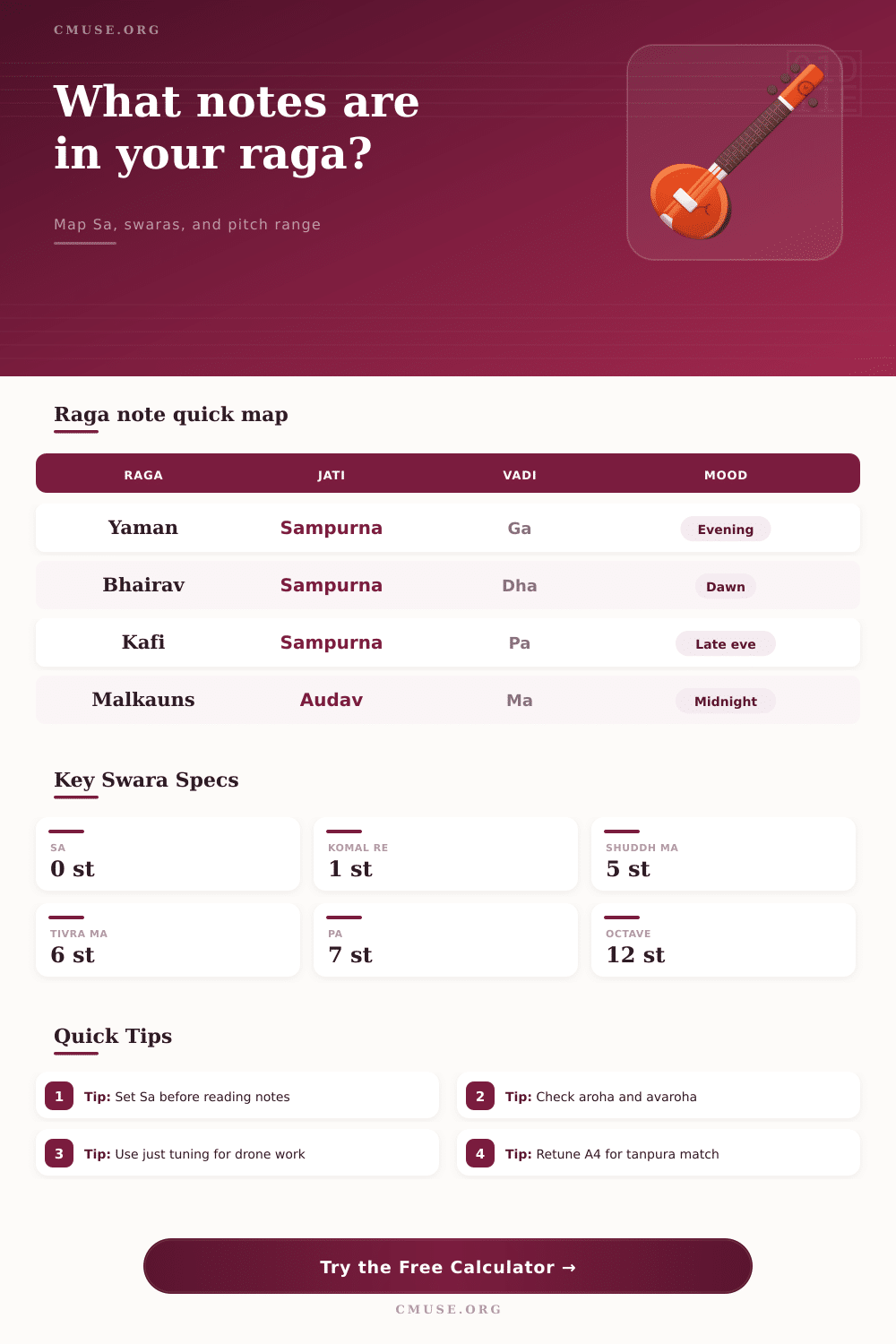
The aroha and avaroha for each raga are not always the same, so seeing them displayed together on the raga calculator will allow you to recognize the bending of the scale by that specific raga. Additionally, the raga calculator will also display the vadi (dominant) and the samvadi (sub-dominant) notes for that raga. These notes is essential to understand how you should perform that raga; the vadi and the samvadi of a raga will determine its emotional color more than the name of each of its seven swara notes.
Finally, the raga calculator also allow for the range of the raga to be controlled. For example, you may wish to extend the range lower to include the mandra notes or extend the range up into the upper octaves to practice tar. The raga calculator will calculate these lowest and highest frequencies for you so that you can determine whether your instrument or voice can reach those frequencies.
Within the raga calculator are a variety of tables that help you to understand the various parameters of the parameters. One table includes common choice of Sa and the frequencies of each of those Sa values at A4 tuning. This table can help you to determine your Sa relative to other instrument in your home.
A second table includes the various ranges of octaves that can be played for each raga and what each of these range is to be used for within the lessons for that raga. While these tables are not rules for each raga, they can provide you with a starting point for your choice if you are unsure of the range of your raga. The raga calculator will calculate each of the notes and frequency of the swaras for the raga that you select, but it will not tell you how to perform the raga.
For example, the raga calculator will not tell you how long to linger on the vadi note for that raga. While the raga calculator will assist you in your performance of the raga, the performance of the raga remain your responsibility. Overall, the raga calculator is a tool that will assist you in your practice of the ragas.
You will set each of the parameters for the raga that you practice, such as your Sa, the raga itself, and the range of that raga. The notes and frequencies of those ragas will be display for you. Thus, the raga calculator will provide you with the notes and frequencies for each raga that you practice, but will leave to you the performance of the raga.