Pythagorean Tuning Calculator
Compare pure fifth ratios, note spellings, and 12-TET cent drift from any tonic so you can hear how a stacked-fifth tuning changes the pitch grid.
🎵 Quick Presets
⏱ Tuning Inputs
📊 Pythagorean Reference Grid
📐 Core Ratio Tables
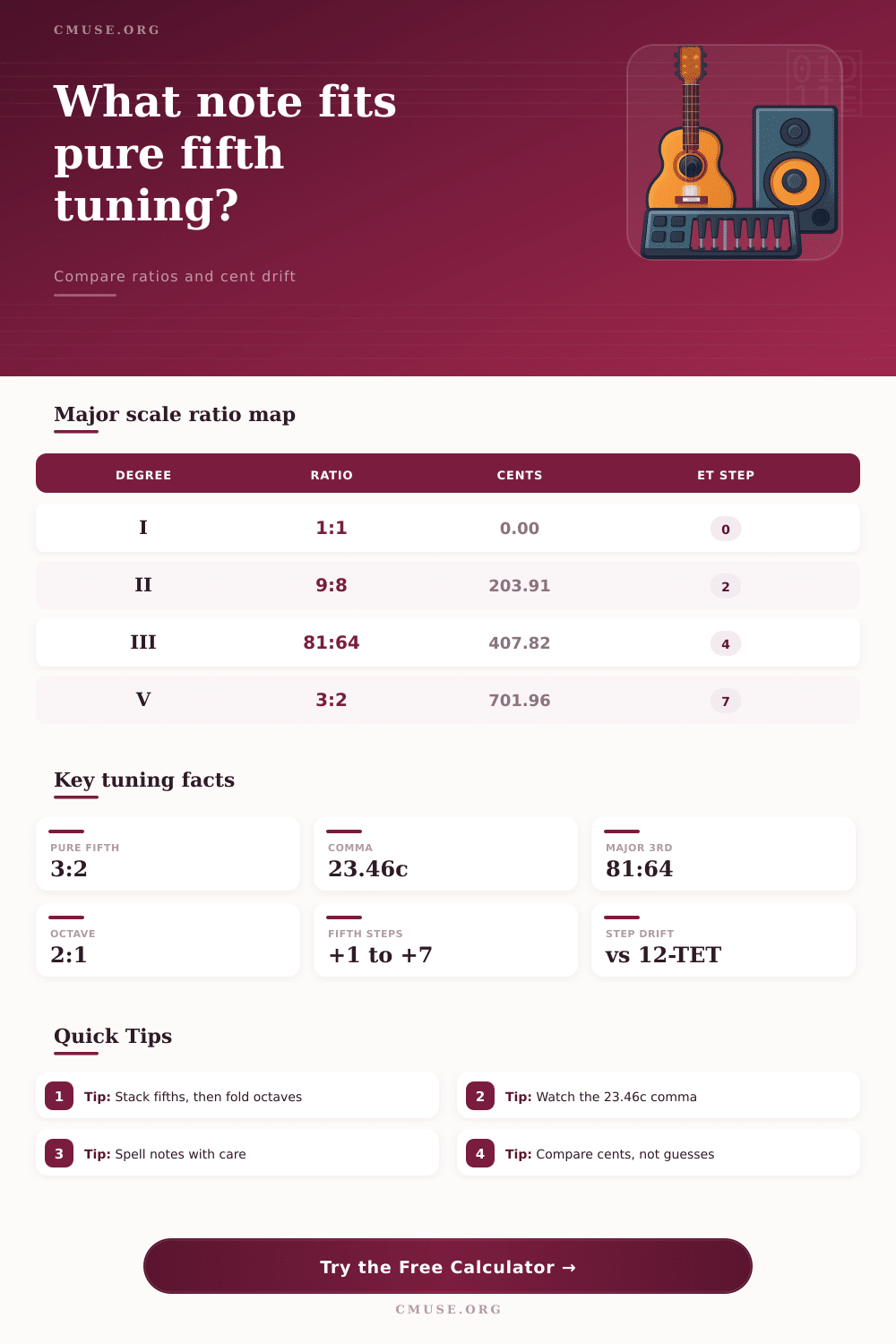
| Degree | Ratio | Cents | ET Step |
|---|---|---|---|
| I | 1:1 | 0.00 | 0 |
| II | 9:8 | 203.91 | 2 |
| III | 81:64 | 407.82 | 4 |
| V | 3:2 | 701.96 | 7 |
| Note | Fifths | Ratio | Use |
|---|---|---|---|
| C | 0 | 1:1 | Tonic |
| G | +1 | 3:2 | Fifth |
| D | +2 | 9:8 | Second |
| F | -1 | 4:3 | Fourth |
Pythagorean tuning is based on an idea that the best ratios to use for tuning are simple ratios of whole number. The ratio that are most commonly used in Pythagorean tuning is the 3:2 ratio, or the perfect fifth. Many person use Pythagorean tuning to create their musical scales.
Because Pythagorean tuning use the 3:2 ratio to create scales, a mathematical mismatch do occur when the tuning is complete. This mismatch is called the Pythagorean comma, and the Pythagorean comma exist due to the fact that twelve perfect fifths do not land on the same note as the starting note. To create the scales for Pythagorean tuning, the perfect fifths needs to be folded into the octaves using a ratio of 2:1.
How Pythagorean Tuning Works
For example, going up seven perfect fifths from C will arrive at B. Going down one perfect fifth from that point will arrive at F. The scale that is created will have all of the perfect fifths be mathematical correct. The major third interval, for example, will use a 81:64 ratio rather than a 5:4 ratio that is used in just intonation. Because 81:64 is a sharper interval than 5:4, the major third intervals created using Pythagorean tuning will be sharper than those created with other tuning system.
One tool that can be used to understand the difference between Pythagorean tuning and equal temperament is a tuning tool. Such a tool allow the user to pick a tonic frequency, such as A440, and to input the target note using the circle of fifths. The tuning tool will indicate the pure ratio of the Pythagorean tuning in cents, another unit of measurement of the distance between frequencies.
Furthermore, an octave shift input can be used to show the frequency of the note at different register. These outputs will indicate the frequency of the individual notes, as well as the drift between Pythagorean tuning and the equal temperament tuning used on pianos. Tables that list the various scale step as ratios can be used to create the scales.
For instance, the second step use a 9:8 ratio. Such a table is useful because stacking perfect fifths does not lead to a linear scale, but rather to a spiral due to the Pythagorean comma. The Pythagorean comma is approximately 23 cent, and ratios can be found for each scale step, such as the 4:3 ratio for perfect fourths.
Many people makes mistakes with Pythagorean tuning if they dont pay close attention to the spellings of the note. For instance, if someone chooses to name a note F-sharp instead of G-flat, the calculation change from six perfect fifths to negative six perfect fifths, which mathematically alter the tuning. Therefore, Pythagorean tuning tool provide note names as well as positions in the circle of fifths.
Furthermore, within the key of C, for instance, the note D can be calculated as two perfect fifths at a 9:8 ratio. Pythagorean tuning was used as the tuning standard prior to the 18th century, when instruments that use Pythagorean tuning became common. Examples of such instrument include organs, viols, and other string instrument.
These instruments accepted the wolf interval, or the discordant perfect fifths that resulted from the necessity to squeeze the Pythagorean comma into the scale of instruments. Today, Pythagorean tuning is used for specific purpose, such as using Pythagorean tuning to play acoustic guitar drones, or to play music on early musical instruments, like the hurdy-gurdy. Pythagorean tuning can be used for many musical purpose, but there are appropriate time to use it rather than others.
Pythagorean tuning is excellent for creating solo melody or harmonies built from perfect fifths. However, if you use Pythagorean tuning for playing triads, the wide perfect third intervals may sound tense to the listener. Furthermore, the difference between the two type of three note intervals can be trained by exposing the ears to the various cent offset between the types of intervals.
For instance, the major third created using Pythagorean tuning is 14 cents sharper than major third in equal temperament. Some of the mistakes that may be made when using Pythagorean tuning are attempting to tune the instrument from an A440 tuning reference but without ensuring that the resulting frequency match the tonic frequency of the key of music that is to be played. Since pianos use equal temperament tuning, an adjustment must be made to find the true frequency of the tonic.
Furthermore, another error is not folding the perfect fifths into octaves to find the true ratio of the notes. If perfect fifths are not folded into octaves, distortions will appear in the musical interval when the music is played. You’re going to notice it when the music is played.
It would of been better to check the math first. Actually, its easy to mess up. People often think that the tuning is easyer than it is, but it is alot more complex than most people think.
The moddern approach can be different than the old way. A musician should of checked the notes more carefuly. The notes’ pitch can be tricky.
All the tunes sounds different.