Pythagorean Comma Calculator
Measure how stacked fifths drift after octave reduction, then compare the cents error, ratio, frequency offset, and tempering correction needed to close the tuning circle.
Preset use: Load a common comma check, then adjust the reference pitch, fifth model, fifth count, octave reduction, direction, and correction plan.
Calculation Breakdown
| Interval Name | Ratio | Size In Cents | Where It Appears |
|---|---|---|---|
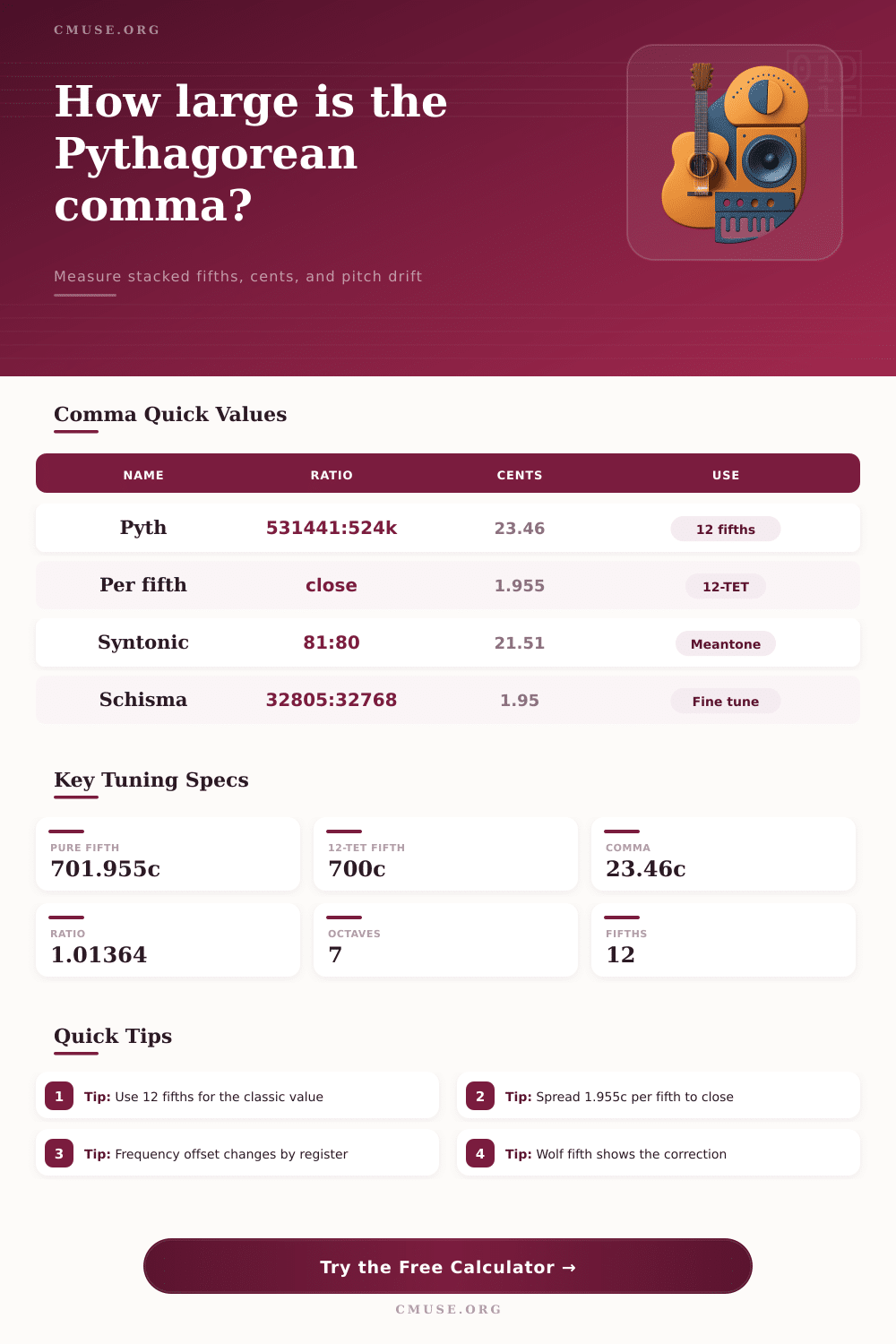
| Pythagorean comma | 531441:524288 | 23.460 cents | 12 pure fifths compared with 7 octaves |
| Syntonic comma | 81:80 | 21.506 cents | Four pure fifths compared with a just major third |
| Schisma | 32805:32768 | 1.954 cents | Difference between Pythagorean and syntonic comma systems |
| Diesis | 128:125 | 41.059 cents | Enharmonic gap in several just and meantone contexts |
| Equal fifth correction | Spread comma | 1.955 cents | Amount each pure fifth is narrowed in 12-TET |
| Fifth Model | Fifth Size | 12-Fifth Drift | Best Calculation Use |
|---|---|---|---|
| Pure Pythagorean 3:2 | 701.955 cents | +23.460 cents | Classic comma, medieval tuning chains, pure fifth stacks |
| 12-tone equal temperament | 700.000 cents | 0.000 cents | Modern piano, guitar fretboard, DAW MIDI pitch grid |
| Quarter-comma meantone | 696.578 cents | -41.059 cents | Meantone organ and keyboard checks around pure thirds |
| Sixth-comma meantone | 698.371 cents | -19.512 cents | Milder meantone layouts with less severe wolf behavior |
| Custom measured fifth | User entered | Calculated | Instrument, temperament, or historical layout inspection |
| Scenario | Typical Entry | Primary Result | Secondary Result |
|---|---|---|---|
| Full circle of fifths | 12 pure fifths, 7 octaves | +23.460 cents | 1.01364 ratio |
| Equal temperament check | 12 equal fifths, 7 octaves | 0.000 cents | Fifth narrowed by 1.955 cents |
| Wolf fifth planning | Pure chain, one corrected fifth | One fifth absorbs -23.460 cents | Wolf fifth about 678.495 cents |
| Violin open-string chain | 3 pure fifths, 2 octaves | +5.865 cents versus 12-TET | Offset grows by register |
| Quarter-comma organ | 12 meantone fifths, 7 octaves | -41.059 cents | Built to favor pure-ish major thirds |
| Strategy | Calculation | Sound Result | Use When |
|---|---|---|---|
| Leave pure | No correction | Pure fifths with a visible enharmonic gap | Demonstrating Pythagorean structure or melodic chains |
| Spread evenly | Comma divided by fifth count | All fifths slightly tempered | Modeling 12-TET or mild circulating temperaments |
| Wolf fifth | One fifth receives the correction | Most fifths pure, one noticeably narrow interval | Keyboard layouts that protect favored keys |
| Partial correction | Correction percent below 100 | Residual comma remains | Testing compromise layouts or measured instruments |
The Pythagorean comma are a mathematical gap that exist in the world of tuning in music. More specificaly, the Pythagorean comma exists because twelve pure fifths is not equal to seven octaves. If you play twelve pure fifths in a row, the resulting tone will be slightly more high than the tone resulting from seven octaves.
That small gap between these two pitch is the Pythagorean comma. While the Pythagorean comma is small in measurement, the Pythagorean comma create large consequences for musicians and composers. For instance, composers must decide whether to leave the Pythagorean comma in one specific place, to spread it evenly across all intervals, or to hide it within a single interval altogether.
What is the Pythagorean comma?
Using the calculator provided here, you can calculate the mathematics that relates to the Pythagorean comma. More specificaly, to use this calculator, you must enter the starting pitch for you composition, the size of the perfect fifths that you will use, the number of steps that you will take, and how many octaves that you wish to subtract from your calculation. Additionally, you must also select whether you wish to measure the Pythagorean comma, or to temper it (that is, to actively adjust for its existence).
Each of these decision will impact your composition. For instance, if you wish to maintain pure fifths, then you will have to compromise some of the purity of your thirds. The same is true for choosing pure thirds; you will end up with a wolf fifth that will sound out of tune when played.
Perfect fifths are intervals that contains no beats and are, therefore, inherent stable intervals. For this reason, many composers wished to use perfect fifths in their compositions. The problem, however, is that twelve perfect fifths will create a pitch that is twenty-three cents higher than seven octaves.
This gap in cents is the Pythagorean comma. When reached again with a composition, the Pythagorean comma will become audible. For instance, on a harpsichord or an organ, the Pythagorean comma will create a harsh-sounding interval that must be avoided.
However, on an instrument like a violin, the Pythagorean comma will be audible over a longer period of time, as the violinist can adjust each note by ear. One solution to the issues that arise from the Pythagorean comma is equal temperament. In the equal temperament system, slightly narrow each perfect fifth by approximately two cents “closes” the Pythagorean comma.
This adjustment in cents is so small that most listeners cant even detect the difference. With equal temperament, however, every interval is slightly compromised. Using the calculator, one can determine how many cents each fifth will have to be adjusted in order to achieve the target of equal temperament.
Additionally, the calculator can determine the frequency offset from the chosen reference pitch. Thus, the Pythagorean comma that is calculated at A440 will not have the same number of hertz as the Pythagorean comma that is calculated at C261; however, the size of the Pythagorean comma will be the same. Some temperament systems place the entire Pythagorean comma into a single interval in the instruments range, termed the wolf interval.
This works well for compositions that use a limited number of musical key. However, the interval that is created within this wolf interval will sound out of tune when played. Some other temperament systems instead distribute the Pythagorean comma among several perfect fifths.
Using the calculator, one can choose whether to concentrate the Pythagorean comma in one interval, or if it should be distributed among many intervals. For example, quarter-comma meantone tuning introduces wolf intervals that are wide in comparison to the rest of the perfect fifths in the instrument. The reference tables that are provided place the Pythagorean comma in relation to the syntonic comma and the schisma.
These two intervals are smaller intervals that are created when comparing perfect fifths to major thirds, or when adjusting historical musical instruments. It is helpful for musicians to know the size of each of these three intervals. For example, knowing the size of each of these intervals will allow a composer to determine if a given tuning system will best serve a specific musical repertoire.
Additionally, the reference tables also contain the correction to each perfect fifth required to even out the circle of perfect fifths. Knowing this number allow for measuring perfect fifths in an instrument to ensure that they match the theoretical standards of a given tuning system. The Pythagorean comma exists as a mathematical gap between intervals of perfect fifths and octaves.
The mathematical ratio of perfect fifths and octaves do not “even out” when you play twelve perfect fifths in succession. Thus, there is a compromise to be made in each tuning system. Overall, each element of tuning systems can be evaluated using the calculator to help determine a compromise that will work best for a specific composers musical creation.