Publishing Split Calculator
Model composition publishing royalties by writer share, publisher share, administration percentage, co-publishing participation, collection territory, royalty source, and per-party allocation.
Choose a common publishing setup, then adjust the royalty source, collection territory, writer shares, publisher share, administration percentage, and co-publishing percentage to match the registration or statement.
Writer allocations are normalized to 100% for payout math. Empty or zero-total writer entries assign the writer pool to Writer 1.
| Party | Role | Entered Share | Normalized Share | Estimated Allocation |
|---|---|---|---|---|
| Writer 1 | Writer side | 40.0% | 40.0% | $0.00 |
| Writer 2 | Writer side | 30.0% | 30.0% | $0.00 |
| Writer 3 | Writer side | 20.0% | 20.0% | $0.00 |
| Writer 4 | Writer side | 10.0% | 10.0% | $0.00 |
| Administrator | Publisher side | 15.0% | Publisher pool | $0.00 |
| Co-publisher | Publisher side | 25.0% | Publisher net | $0.00 |
| Outside publisher | Publisher side | Remaining | Publisher net | $0.00 |
| Preset | Writer Side | Publisher Side | Best Modeling Use |
|---|---|---|---|
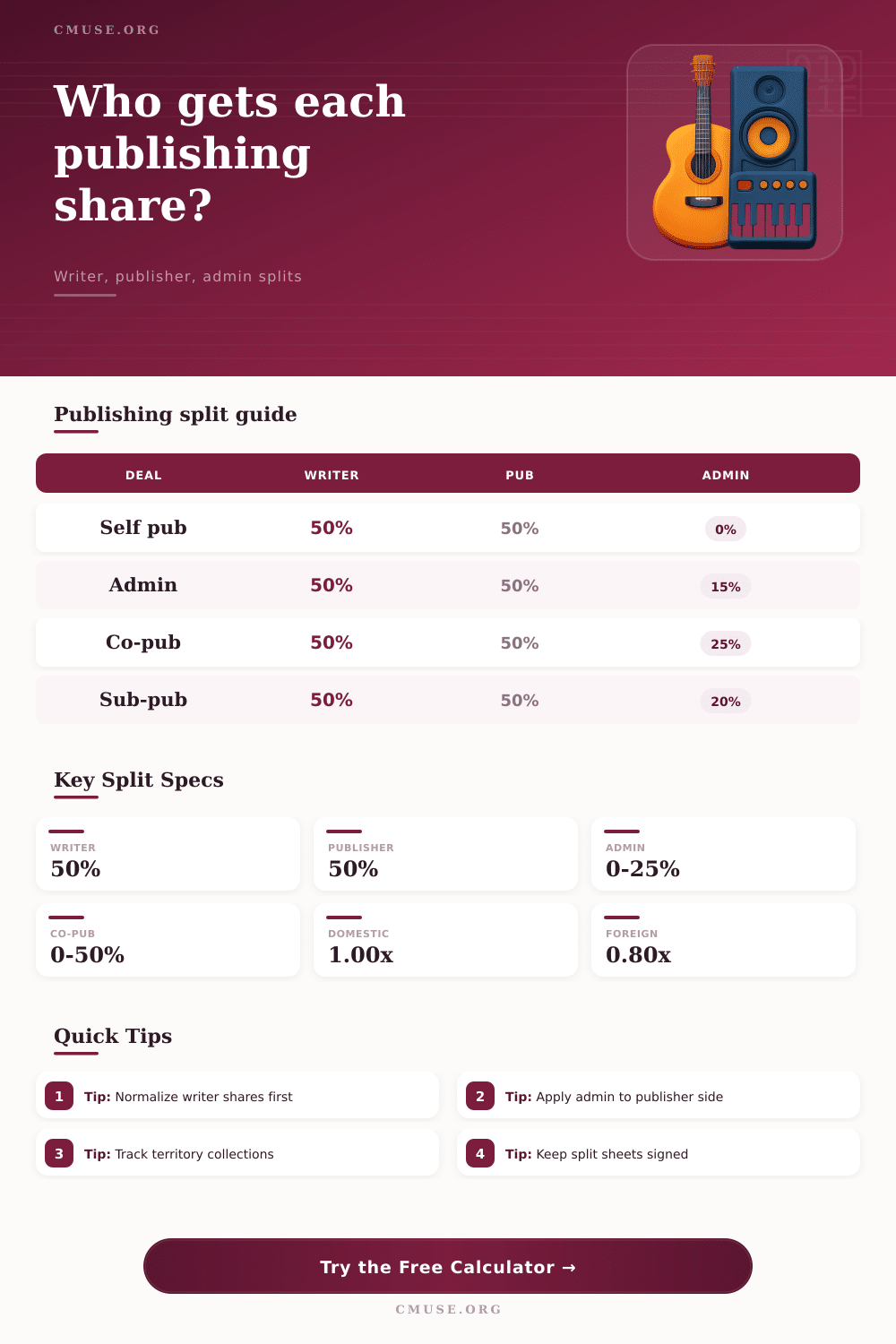
| Solo Self-Published | One writer at 100% | Writer controls publisher side | Single songwriter with own publishing entity |
| Standard Publishing | 50% writer pool | Publisher retains net publisher side | Traditional publishing agreement estimate |
| Admin Deal | Writer pool unchanged | Admin commission from publisher side | Administration-only catalog registration |
| Co-Publishing Deal | Writer pool plus co-pub amount | Publisher and co-publisher share net | Writer participates in publisher share |
| Sub-Publisher Route | Writer pool after territory factor | Admin and sub-publisher deductions | Foreign collection planning |
| Territory Setting | Factor | Collection Behavior | Use When |
|---|---|---|---|
| Domestic society | 1.00x | Normal domestic registration and claim flow | Home PRO, MRO, or publisher statement |
| Foreign reciprocal average | 0.80x | Reciprocal payment usually arrives later | Overseas performances or mechanicals |
| Slow-pay reciprocal territory | 0.65x | Lower certainty and longer processing | Territory with incomplete matching |
| Major media market | 1.15x | Higher license density and reporting weight | Large broadcast or high-use market |
| Premium network territory | 1.30x | High-value cue or network collection model | Television, film, and high-reach media |
| Partial or unmatched claim | 0.55x | Reduced certainty until metadata is fixed | Missing writer, ISWC, publisher, or work data |
| Source Type | Planning Weight | Publishing Side Affected | Allocation Note |
|---|---|---|---|
| Performance collection | 1.00x | Writer and publisher sides | Often arrives split by society rules |
| Mechanical collection | 0.90x | Composition ownership | Apply controlled composition share if needed |
| Synchronization publishing share | 1.15x | Negotiated publishing allocation | Use with a license statement or cue estimate |
| Print or lyric reproduction | 0.85x | Publisher-administered income | Often needs custom agreement review |
| Micro-sync or UGC pool | 0.70x | Matched usage pool | Use for lower-certainty platform estimates |
| Mixed catalog statement | 1.05x | Blended publisher statement | Useful for auditing a combined period |
| Registration Pattern | Writer Entry | Publisher Entry | Calculator Check |
|---|---|---|---|
| One writer, no publisher listed | 100% of writer pool | Publisher side may remain unclaimed | Use self-published preset if both sides are controlled |
| Two equal co-writers | 50% and 50% writer allocation | Publisher side follows each writer agreement | Normalize writer allocations to 100% |
| Four-way band split | 25% each writer allocation | May be one publisher or several entities | Use per-party rows to compare outcomes |
| Admin-only publisher | Writer ownership retained | Admin fee on publisher side | Confirm admin is not taken from writer side |
| Co-publishing agreement | Writer share plus co-publisher share | Outside publisher keeps remainder | Enter co-publisher percentage of publisher net |
When a songwriter begins to earn money from songwriting, the total amount of money that the songwriter receive is typically more smaller than the songwriter had initially expected. There are many different parts of the royalty income that is distributed to the songwriters who authored the song. For instance, one royalty may be distributed from a performance collection through a streaming service, another royalty may be distributed through mechanical royalty collection through a download service, and a third royalty may be distributed as a synchronization royalty from a foreign society.
Each of these royalty sources has different rules regarding the amount of money that will be distributed to each songwriter, based off the contract of each songwriter with that publisher or administrator of the song. The total amount of money that is distributed to each of the songwriters in a song is based upon a variety of factors that were established when each songwriter signed the contract with the publisher for that song. Factors that influence the amount of royalties that each songwriter receives include the writer share percentage, the publisher share percentage, the administration fees that must be paid to the administrator of the song, the participation of each songwriter in co-publishing the song, the territory in which the royalties are collected, and the type of royalty that is distributed to each songwriter.
How a Royalty Calculator Helps Songwriters
For instance, the percentage of royalties that each writer receives may differ according to whether the performance royalties are collected within the domestic territory as compared to when they are collected through a foreign reciprocal agreement. Additionally, each songwriter may receive a portion of the publisher share through a co-publishing deal, but the administrator of the song may take an administration fee from that publisher share prior to the songwriter receive any of that royalty payment. It is common for songwriters to experience some level of confusion when they receive a royalty statement that reveals that the amount of money that they received from that song was less than the amount of money that they had expected from the song.
A songwriters contract may provide for a split of the earnings with another songwriter or with the publisher of the song, for instance a split of 50% to the songwriter and 50% to the publisher. However, the total amount of money that may be distributed to the songwriter may be less than half of the total royalties due to the fact that an administrator may have collected an administration fee from the publishers share of the royalties. Additionally, a co-publishing songwriter may have collected a fee from the publisher share prior to the songwriter receiving any of the royalty income that is distributed to them.
Thus, each of these factors may reduce the total amount of money that each songwriter receives from their song. A modeling tool is a useful instrument that can help each of the songwriters to gain an understanding of how these different variables can impact the total amount of money that is distributed to each of the songwriters. For instance, each modeling tool allows each songwriter to input the publishing amount for the song.
Additionally, the modeling tool also allows for the songwriter to select the type of royalty that is to be distributed, to apply a territory collection factor to the royalty income, to input the percentage of royalties that each writer is to receive (the writer share), to input the percentage of royalties that the publisher is to receive (the publisher share), to input the administration fees for the publisher, and the participation of the songwriter in co-publishing the song. Based upon the inputs of each of these variables, the modeling tool can calculate the total amount of money that is to be collected by each of the parties to the song, the amount that will go into the writers pool, the amount that will stay with the publisher, and the amount that will go to the co-publishing songwriter. Additionally, the modeling tool can create a table that details how the royalties will be distributed to each individual writer of the song after the writer pool has been made standardized and normalized.
These reference tables are included within the modeling tool for two main reasons. First, they provide a songwriter with an understanding of the royalties that may be distributed based upon the type of publishing deal and the royalty source for the song. For instance, if a songwriter is attempting to distribute royalties from a song that will include both streaming and synchronization deals, the modeling tool can be used to model the royalties that will result from each of these types of royalty deals.
The modeling tool will automatically standardize the shares of royalties that each writer will receive, apply each of the factors that is established for the song, and then return the royalties that will be distributed to each writer. Despite the usefulness of a modeling tool, there are some limits to that tool. For instance, the split sheet that is distributed with the modeling tool may contain percentages for each writer that does not necessarily match the percentages of royalties that are published by the collection of societies that publish the song.
Additionally, each of the writers may have an administration deal that collects fees from the royalty share of the writer rather than the publisher. Finally, there may be additional fees that are collected from the song in its foreign countries that are not accounted for by the territory factor that is established within the modeling tool. Thus, while the modeling tool can provide a songwriter with an idea of the potential earnings from each of the royalties from their song, the songwriter should of treat that modeling tool as a planning and estimating tool only.
The songwriter should use the modeling tool each time that they file a new registration form for their song, or that they sign a new publishing deal with another individual. For instance, if the songwriter establishes that the territory factor and the royalty source will reduce the royalties that is distributed to the writers, the modeling tool will automatically adjust the royalty allocations for each writer to reflect the reduced royalty that will be distributed to each of the writers of the song. Additionally, if the percentage for co-publishing the song is high, the modeling tool will reflect the royalties that will be distributed to the entity that controls the song and publisher after the administration fees are applied to the royalty share of that publisher.
By using the modeling tool for each of these different scenarios, a songwriter will be able to avoid the shock and confusion that may develop when the songwriter discovers that the deal with another publisher was established and functioned more differently than the songwriter had assumed. Thus, while the modeling tool cannot account for all of the variables that may affect the royalties that is distributed to each writer, the goal of creating such a tool is to make each of the known variables visible to the songwriter. By making each of these variables visible, the songwriter can make more informed decisions regarding which publishing deals to accept, which administration deals to utilize, and which co-publishing deals to create with others that write songs.
Furthermore, when the royalty statement arrives, the songwriter will not have to waste time and effort considering the reasons for the relatively small amount of money that was distributed to the writer. Instead, the songwriter can simply review the royalty statement that was distributed to ensure that the amount of money that was distributed was the same as the amount that the modeling tool indicated that the royalty should be.