Practice Hours to Learn Singing Calculator
Estimate your vocal-learning timeline from range, breath support, pitch accuracy, vowels, passaggio, resonance, repertoire demands, and vocal health.
Your Singing Practice Estimate
| Voice type | Common comfortable range | Passaggio attention | Practice caution |
|---|---|---|---|
| Soprano | About middle C to high A | Upper bridge vowels | Avoid pushing high notes |
| Mezzo-soprano | About A below middle C to high F | Middle register blend | Keep chest mix balanced |
| Alto or contralto | About F below middle C to D above | Lower middle clarity | Do not darken vowels too much |
| Tenor | About C below middle C to A above | First bridge stability | Use breath flow before volume |
| Baritone | About A below middle C to F above | Upper-middle release | Build high notes gradually |
| Bass | About E below middle C to D above | Low resonance balance | Keep tone energized, not heavy |
| Changing voice | Range shifts by week | Gentle transitions | Use light sessions and rest |
| Learning goal | Base focused hours | Typical weekly pace | Main outcome |
|---|---|---|---|
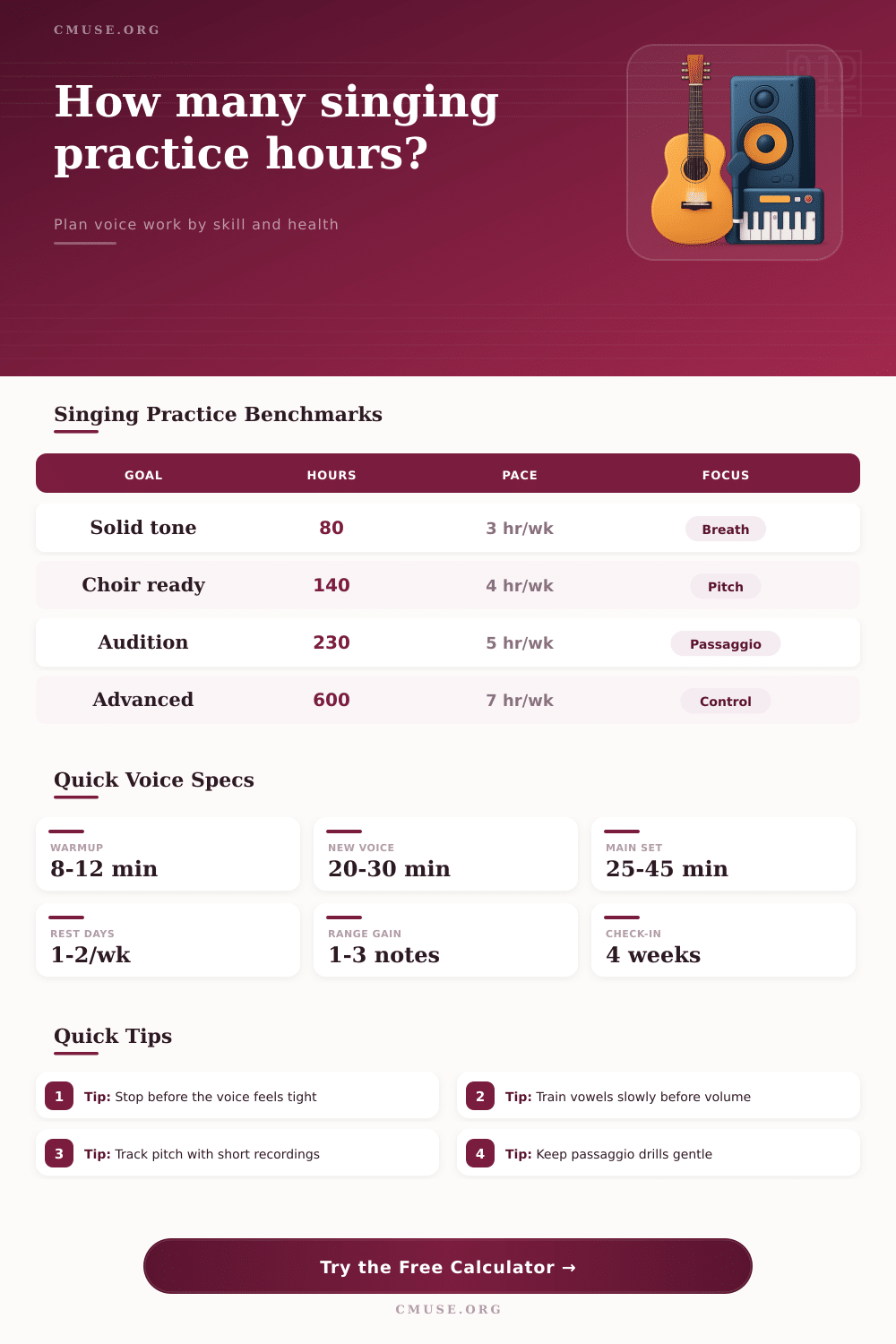
| Solid beginner singing | 80 hours | 2 to 4 hours | Steady tone, basic pitch, simple songs |
| Reliable choir readiness | 140 hours | 3 to 5 hours | Blend, rhythm, vowel matching |
| Audition-ready song | 230 hours | 4 to 6 hours | Controlled range, clean entrances, stamina |
| Performance-ready set | 360 hours | 5 to 7 hours | Consistent tone across several songs |
| Advanced vocal control | 600 hours | 6 to 9 hours | Nuance, passaggio options, agility |
| Technique area | Measured by | Calculator impact | Practice focus |
|---|---|---|---|
| Pitch accuracy | Percent of notes centered | Largest time reducer | Slow scales, intervals, recording checks |
| Breath support | Phrase steadiness | Improves stamina estimate | Silent breath, hiss, sustained vowels |
| Vowel tuning | Clarity across range | Reduces passaggio difficulty | Ah, eh, ee, oh, oo shaping |
| Passaggio | Smooth register transitions | Adds hours when unstable | Light sirens, semi-occluded drills |
| Resonance | Balanced tone quality | Improves efficiency | Buzz, nasal consonants, easy onset |
| Repertoire | Song demand level | Raises target workload | Short phrases before full run-throughs |
| Vocal health state | Suggested daily cap | Rest cue | Calculator adjustment |
|---|---|---|---|
| Excellent | Up to 60 minutes | Normal fatigue only | Small efficiency bonus |
| Good | Up to 50 minutes | Stop if tightness grows | Standard pacing |
| Careful | Up to 35 minutes | Rough tone after warmup | Adds recovery margin |
| Recovering | Up to 20 minutes | Hoarseness or throat effort | Strong pacing reduction |
| Strained | Up to 12 minutes | Pain, swelling, lost range | Minimal load estimate |
Estimates are educational planning ranges. Persistent hoarseness, pain, or sudden range loss should be handled with a qualified voice teacher or medical professional.
Everything’s going fine. You’re in tune, your voice sounds good. Then you reach for a note, and suddenly it won’t cooperate. Your throat closes up, your intonation falters, and before you know it you’re battling biology instead of making music.
Singing isn’t simply a matter of talent; it’s a physical skill based off coordinated effort; a universal milestone for singers. Once you enter your starting point and your target range into the calculator above, it do the math for you, sparing you the guesswork as to how long this may take.
How to Sing Well and Stay Healthy
The learning curve takes longer than most people realize; developing solid muscle memory is a must. You can’t think yourself into a solid high C. You have to get your body to remember how to do it through repetition until it happen automatically.
Because each of us has their own voice type and the tool takes that in account as well, a bass or a soprano will require different resonance training. An alto and a tenor face varying passaggio obstacles which dramaticly alter the amount of work they’ll be doing. Failing to acknowledge this result in frustration as you work hard but fail to make headway.
The one variable that affects all of this is vocal health. Pushing through fatigue train bad habits and reverses gains. So your inputs factor in how you’re feeling right now. If you’re hoarse or still recovering then the estimate shift downwards. That’s by design. Protecting your instrument means you don’t end up spending months undoing damage you spent weeks creating.
Tissue training is just as important for learning to sing as coordination training, and that makes more difference than any particular exercise regime. Breath support and pitch accuracy build from there. Adding more complexity or volume simply magnifies any inaccuracies in either of these area. They are must-haves for clean tone and are weighted heavily by the system.
It’s possible to sing forcefully to cover up inadequate breath support for some time, but under pressure it will collapse. Steady airflow is the foundation that make all other skills easier to learn; without it, you are building on sand instead of concrete.
The other common misunderstanding is range expansion. Sure, singers wish they could add an octave instantly, but it isn’t like that. Your voice acquires notes by becoming stable first and then adding the notes over time. And when you bridge, you don’t just stretch, you smooth the transition. That’s what the calculator does. It doesn’t force new notes to appear right away, but instead calculates the number of hours required to make those transitions reliable.
Patience here pay off in reliability. Cracking is difficult to fix once it occurs, so pushing up too soon without locking down the midrange leads to cracks.
How does it affect voice? The better we sing our vowels, the further we carry. If you’re not sure what that means, consider this: The clearer the vowel, the more evenly resonance can be carried throughout the range; the less clear the vowels become as you ascend into higher pitches, the less your tone will be consistent. Tuning those sounds reduces strain on the vocal folds. It allows the tough spots (bridge zones) to move smoothly, rather than forcing the sound. This is why vowel work takes time… In the estimates.
The other factor to consider is how difficult the repertoire is for you. You can learn that simple folk song without needing as much technical accuracy as you would for a challenging classical aria or piece of theater music. This will also reveal your weakness quickly, as it requires a level of control that you may lack. Your ambition may include songs that require more technique, which increases the time you need to practice because these are not just ‘passion’ songs, but require moddern polished technique.
Don’t think a rest day is something that interrupts your practice plan, it’s a key part of it. You need time for your vocal chords to recover from adapting to the training load. Missing rest will cause slower results and possibly even inflammation. The page has a reference table with safe daily caps linked to health states. Sticking to these ensures consistent results over years, not burnout in months.
Use the recordings to keep track of progress. What’s in the recording can be missed by the ear when you sing. Your brain hears what it expects to hear. Regular short checks (every couple of weeks) reveal trends. This feedback loop will turn effort into improvement and confirm the gains you have made.
It is all about little tweaks that become a marathon of learning to sing. One note at a time, one phrase after another you gain control. The estimate helps map out the way but the daily diligence should of be with gentleness. Don’t stop until you’re feeling loose. Stay light on the drills. Let your voice learn at her speed. If you honor the journey then the notes will return to you easly like they should of been from the beginning.