Practice Hours to Learn Cello Calculator
Estimate focused cello hours for bow arm control, intonation, shifting, thumb position, vibrato, clef reading, and solo or ensemble repertoire.
Your Cello Practice Estimate
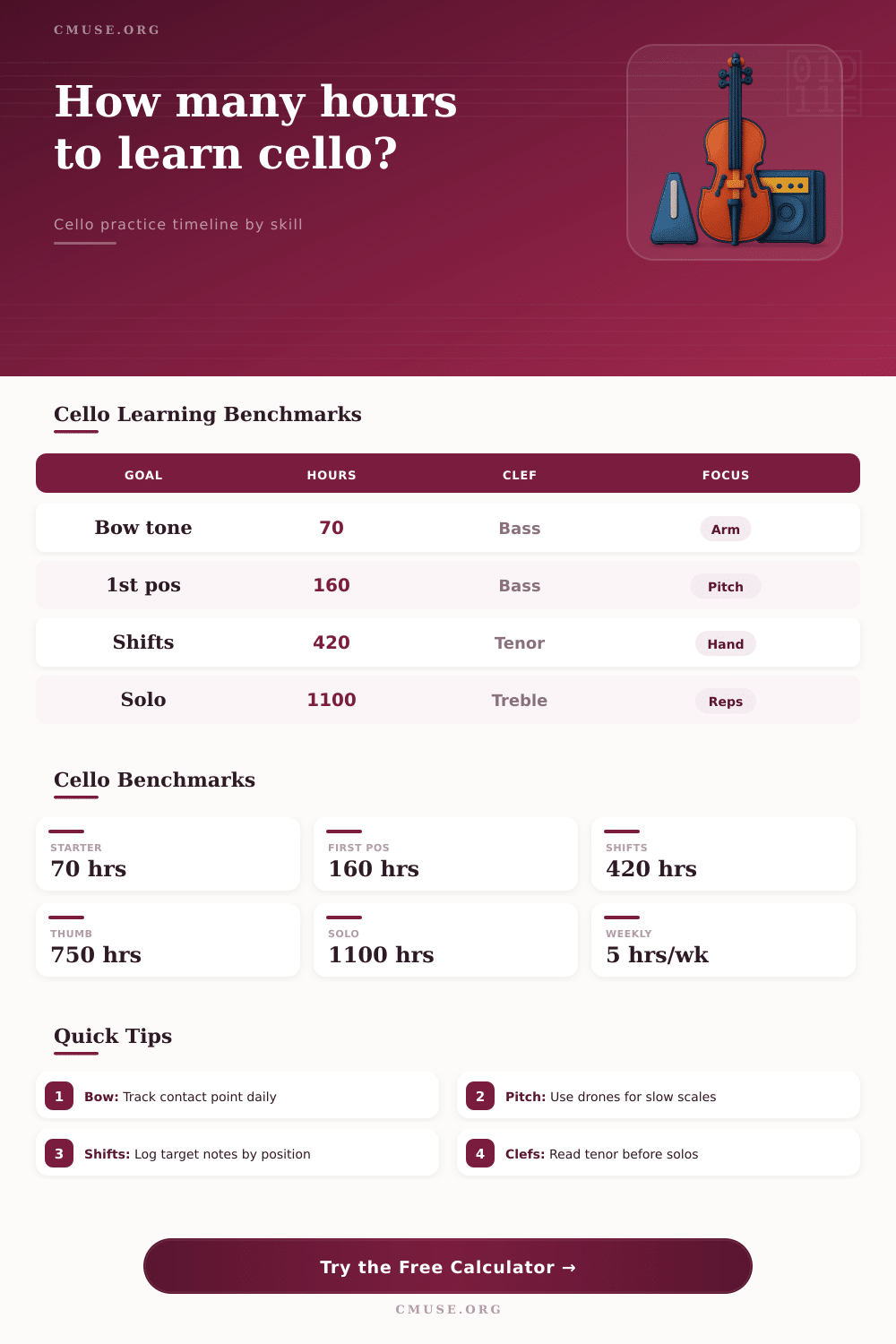
| Learning target | Typical focused hours | Clef demand | Main cello limiter |
|---|---|---|---|
| Open-string tone and bow changes | 50 to 90 | Bass clef entry | Bow path, contact point, relaxed right arm |
| Reliable first-position piece | 130 to 210 | Bass clef | Finger spacing, string crossings, basic rhythm |
| Tenor clef shifting etude | 350 to 520 | Bass plus tenor | Guide fingers, target notes, position mapping |
| Thumb position octave study | 650 to 900 | Tenor and treble | Thumb frame, arm balance, high-register intonation |
| Bach suite or comparable solo excerpt | 950 to 1300 | Tenor and treble as needed | Voice leading, shifts, bow distribution, phrasing |
| Technique area | Beginner weight | Intermediate weight | Advanced weight |
|---|---|---|---|
| Bow arm and sound production | Very high | High | Moderate but exacting |
| Intonation and left-hand frame | High | Very high | Very high |
| Shifts across positions | Low | Very high | High |
| Thumb position | Not required | Moderate | Very high |
| Vibrato shape and speed | Low | High | High and style-specific |
| Cello reading level | Typical repertoire | Practice emphasis | Calculator effect |
|---|---|---|---|
| Bass clef only | Early methods, simple ensemble bass lines | String names, first position, rhythm accuracy | Efficient for beginner goals, slower for solos |
| Bass plus tenor | Shifting etudes, orchestral inner lines | Fourth position, tenor landmarks, guide fingers | Reduces shifting and ensemble penalties |
| Bass, tenor, and treble | Upper-register solos, concerto passages | Thumb position, high intonation, fast clef switches | Best fit for advanced solo and audition goals |
| Ensemble-heavy reading | Orchestra, quartet, cello choir | Counting, cue awareness, blend, sight-reading | Improves ensemble goals, adds solo catch-up hours |
| Weekly cello load | Typical player | Best use | Watch point |
|---|---|---|---|
| 2 to 3 hours per week | Adult starter or busy student | Bow tone, first-position reading, short pieces | Progress depends on consistency more than session length |
| 4 to 6 hours per week | Steady hobbyist or school player | Scales, etudes, orchestra parts, early solos | Keep slow intonation work in every practice block |
| 7 to 10 hours per week | Committed intermediate player | Shifts, vibrato, tenor clef, chamber repertoire | Rotate right-arm recovery and left-hand precision |
| 11 or more hours per week | Advanced student or audition preparation | Thumb position, excerpts, concerto movements | Use teacher feedback to prevent repeating bad reps |
The thing is, when you pick up a cello for the first time, you discover it’s not quite an instrument as much as a big piece of wood that, if you’re fortunate, makes some sounds. The dream of playing those Bach suites collides with the ugly truth of open strings that don’t sound pretty. Many new cellists gives up on the instrument in the first year because there’s too wide a gulf between what they want to achieve and their current skill level.
That’s where the Practice Hours to Learn Cello Calculator comes in. It closes this gap by converting vague ambition into a solid plan with a realistic timeline so you can know exactly how long it’ll take you, depending on your real-world level of commitment, to go from screech to sing.
How to Plan Your Cello Practice Time
Rather than just calculating overall time played, the tool weights a number of key technical pillars. First, it need to know how many hours you practice and how often. More importantly, however, it asks that you rate each of the quality settings. Are your practices casual or deliberate? By deliberate we mean that you use a tuner. You work slowly, repeating until you get it right. You notice your mistakes and correct them. This will lead to faster results different than playing through pieces over and over again without correcting errors. The calculator takes this into account and adjusts the predicted timeline because mindlessly repeating things either reinforces good habits or bad habits equally well.
One of the main barriers when starting out as a cellist is developing control over your bow arm. We frequently hear from many students that they are working hard on their left hand. They fret about how they place fingers and shift, but they forget all about their right hand. When first learning, this is why the calculator gives a lot of importance to bow arm stability; if your sound isn’t secure then, even with accurate intonation, it’s going to be muddled up. If you have low bow control as an input and strong confidence on shifting, you’ll probably get a longer projection regarding goal repertoire expectations that expect long phrases to be held together. It may be a minor point, but it is worth considering.
Another important variable the estimator takes into account is intonation. Slowly played scales with drones or tuners give you the feedback loop for training your ear. The calculator looks at how accurate your intonaton is right now. It then calculates roughly how many hours of concentrated work you need to reach the next small improvement. So if you’re already sixty-eight percent accurate, the math indicates you’ve got some distance yet until you can tackle the more complicated changes in, say, tenor clef pieces. People misfire on this: they believe over time their intonation will become better without any targeted ear training specifically for intonaton.
On the page there’s a table that outlines how various skills develop as you move through stages of learning. At beginner level this means spending time on rhythm and basic finger placement in first position. For intermediates it’s that point when moving from one position to another becomes the limiting factor. At advanced level it’s about intonaton in thumb position and nuanced bow control for solo material. There is always a bottleneck at each stage and the calculator tells you what it might be for you.
The equation factors in Clef reading too. A beginner typically begins with only bass clef. Adding the treble and tenor clefs increases mental effort, as this is effectively a re-learning of the staff combined with learning new physical techniques such as thumb position. The calculator assumes that if you want to play repertoire or excerpt for auditions, you’ll likely have to be fluent in all three clefs which then multiplies the total number of hours required. You’re not simply reading notes more quickly; you are instantly recognizing the intervals, even in a higher register where there is little room for error.
The estimate also takes into account how often you recieve teacher feedback. If you’re self-guiding your learning, then you’ll hit a ceiling because you aren’t able to objectively hear when you’re doing something wrong. Weekly lessons provides correction loops that prevent weeks of wasted effort on incorrect techniques. For those who do get regular feedback from coaches/teachers, the correction loop happens weekly and avoids wasting weeks trying to learn the wrong things. It’s a tough pill to swallow but it’s accurate.
Bottom line: How well you learn to play the cello has more to do with your patience than your natural musical talent. Plug all those variables into the calculator, recieve a reasonable timeline, and commit to putting in the hours, one hour at a time, until you reach your goal. An otherwise impossible challenge becomes a string of achievable goals.