Practice Hours to Learn Bass Calculator
Estimate bass practice hours for pocket, groove timing, muting, fretboard recall, fingerstyle, pick, slap, walking bass, and song chart reading.
Choose a real bass-learning target, then adjust your weekly hours, timing accuracy, muting, fretboard knowledge, chart reading, technique path, repertoire size, and target tempo.
Calculation Breakdown
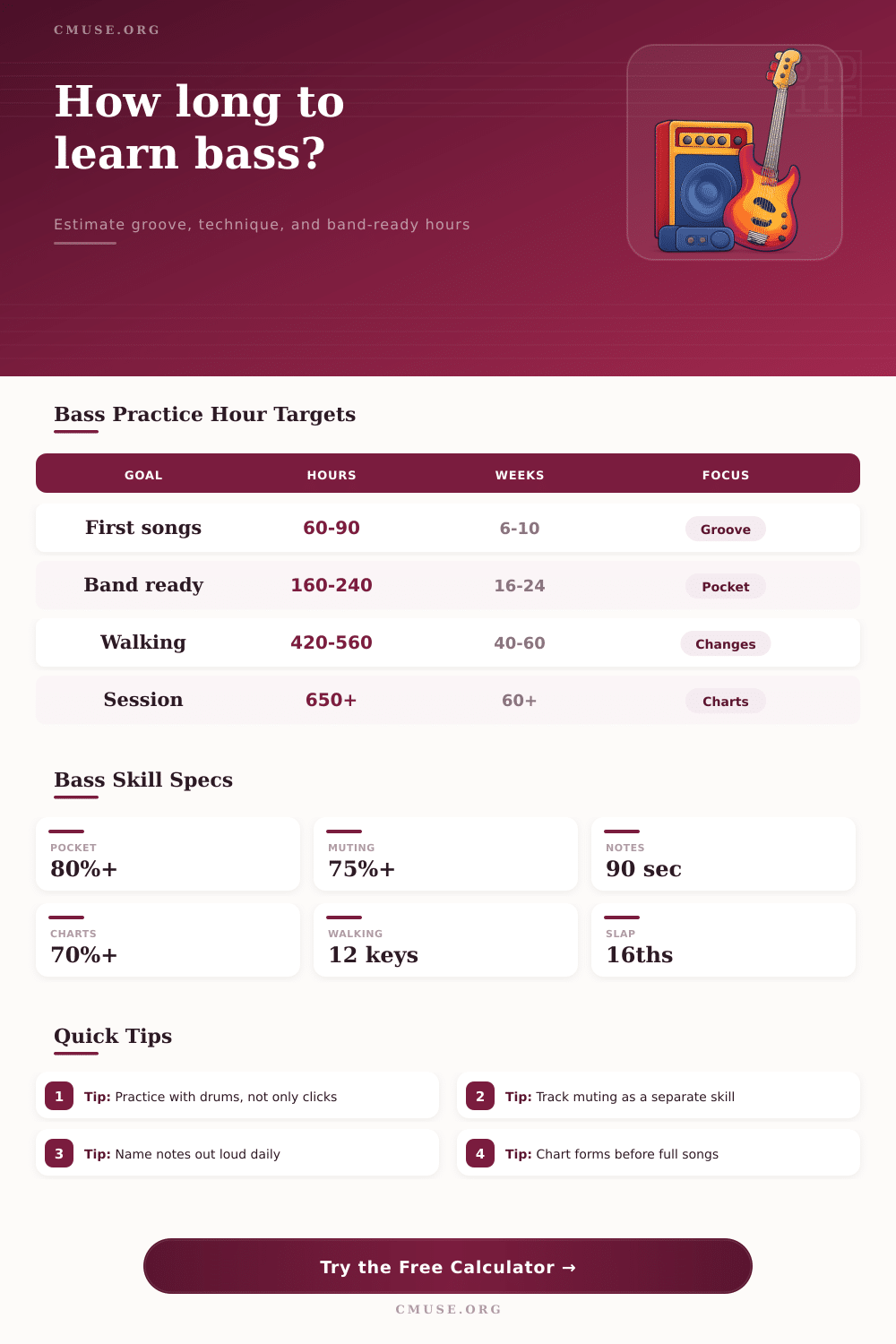
| Learning Target | Typical Focused Hours | Core Bass Skills | Ready Check |
|---|---|---|---|
| First songs | 60 to 90 hours | Open-position roots, eighth-note timing, simple muting, basic fretting stamina | Plays 3 to 5 songs with steady quarter and eighth notes |
| Band-ready groove | 160 to 240 hours | Pocket with drums, clean note lengths, common patterns, rehearsal form awareness | Locks with kick and snare without rushing fills or transitions |
| Walking bass | 420 to 560 hours | Chord tones, approach notes, voice leading, swing feel, ii-V-I movement | Creates four-beat lines through common changes at moderate tempo |
| Session pocket | 650 hours or more | Chart reading, tone control, subdivision accuracy, quick arrangement decisions | Records clean takes with consistent feel and minimal arrangement questions |
| Technique Path | Practice Load | Bass-Specific Challenge | Best Measurement |
|---|---|---|---|
| Two-finger plucking | Baseline | Even volume, alternating fingers, relaxed string crossing, note length control | Record straight eighths at several tempos and compare attack consistency |
| Pick bass | Slightly faster start | Palm muting, down-up control, pick angle, avoiding guitar-style overplaying | Check whether eighths stay even without overpowering drums or vocals |
| Slap and pop | Higher load | Thumb rebound, popped string accuracy, ghost notes, muted percussive strokes | Loop sixteenth-note patterns cleanly without extra ringing strings |
| Walking bass | Higher load | Fretboard mapping, chord tones, approach notes, line direction, swing placement | Outline changes with roots, thirds, fifths, sevenths, and chromatic approaches |
| Bass Setup | Learning Impact | Fretboard Consideration | Practice Note |
|---|---|---|---|
| 4-string long scale | Most direct path for common songs and standard learning material | EADG gives clear root patterns across the neck | Use this as the baseline for most early pocket and groove goals |
| 5-string bass | Adds range and muting demand because the low B can ring sympathetically | Shapes shift less often, but note naming includes an extra string | Add dedicated muting drills and low-string note quizzes |
| Short-scale bass | Can reduce reach strain while keeping the same musical responsibilities | Frets are closer, but note names and positions remain the same | Check intonation and left-hand pressure during higher-tempo practice |
| Fretless bass | Adds intonation practice before normal groove targets feel secure | Requires ear-led position accuracy instead of fret markers alone | Add slow tuner and drone work before chart or audition estimates |
| Weekly Hours | Groove And Pocket | Fretboard And Charts | Technique And Songs |
|---|---|---|---|
| 3 hours | 45 minutes of click, drum loop, and recording review | 35 minutes of note naming and chart form reading | 100 minutes split between technique and two songs |
| 6 hours | 100 minutes of pocket, subdivisions, and note-length control | 80 minutes of fretboard, chord symbols, and rehearsal charts | 180 minutes for muting, technique path, walking lines, and repertoire |
| 10 hours | 3 hours of groove accuracy, drum lock, and feel variations | 2 hours of notes, charts, transposition, and form marking | 5 hours for technique, songs, walking bass, fills, and recording review |
| 15 hours | 4.5 hours of pocket work across tempos and styles | 3 hours of fretboard, chart reading, and chord-tone mapping | 7.5 hours for repertoire, auditions, slap, walking bass, and endurance |
The first question most people ask when learning bass is how long? How much time will it take to go from holding instrument like a brick to locking in with a drummer who actualy cares about the pocket? It happens before you lock into a drummer who gives a rip about the pocket. Depending on who you ask, there’s no one answer.
Once you define what success mean to you, this will do the math and show you roughly how many focused practice hours you need. In other words: It’s less, you should just practice more. And that’s pretty vague. Instead, it gives you a clear picture of what it should look like. It shows how long it might take based off your skill level, desired outcome, and time each week.
How Long Does It Take to Learn Bass?
It factors in the unique requirements of bass playing and builds a plan. Why does any of this matter? Because bass learning isn’t linear. Every skill is not going to get better at the same pace. Groove timing are one muscle, fretboard recall is another muscle, and muting control is yet another muscle. This is where the tool asks you to rate each separately.
For example, person who knows their notes really well but has bad muting will sound muddy; whereas the person who has perfect muting but no fretboard map will sound limited. The calculator weigh these factors heavily. Bass errors often manifest as feel problems before they become wrong-note problems. If your grove is getting off, if your fingers wants to ring out when they shouldn’t, that’s what the band hears right away. That’s why muting and groove holds so much weight in the final estimate of hours.
Think also of difference between practice and playing casually. The quality selector in the tool tells the difference between more structured practice with a metronome or timers and mostly casual run-throughs. That changes outcome significantly. You can make progress in twenty hours of focused practice isolating two bars then repeating them over and over again until you are moving your fingers without thinking, which will never happen from forty hours of loose noodling.
It’s not so much the total time spent playing instrument but how much of that time is spent solving specific problems. The calculator lets you be clear on this trade off. Varying the hour target based on your own assessment of your practice quality help you see the tradeoff. If you want to learn how to read charts for session work, or are interested in learning how to walk some bass lines, it stretches out a good deal further. Playing just the root note plus a kick drum is not enough here. A better understanding of harmony and theory are necessary.
The page has a table that lays out the timeline. It shows that hundreds more focused hours must be spent progressing from a grooving member of the band to a consistent walking bassist. Don’t take this as a discouragement, but a reality check. This helps distinguish between immediate gratification (playing through songs) vs the longer term commitment needed to truly master the instrument. Then you can decide what fits where in your life now and match input to suit.
The projection is also affected by type of techniques you choose to use. Do you want to play with a pick? Fingers? Are you interested in slap bass, too? Each of these presents its own special physical demands. For instance, slap bass requires precise control over your ghost notes and thumb rebound, which makes the learning curve steeper then simple two-finger plucking. To account for this, the tool adjusts the number of hours required at the bottom end depending on what kind of technique route you plan to take. This way, it can be made sure that you’re estimating the true mechanical challenge of playing style you intend to pursue.
Interested in funk styles? Wonder if that’ll double your practice time? Don’t worry, the model’s got it covered. So in conclusion, you want to go from not knowing what to do, to confident that you know what to do. Whether that’s an audition for a professional session or getting ready for a worship band gig, having a real target to aim for keeps you motivated. And the calculator give you that target. It turns vague goals into clear timelines each week. This helps you know exactly how long you should of practiced each week to stay on schedule.
Establish some reasonable expectations and then follow through with them. You’ll find the time adds up and the time compounds. Before you know it, instead of thinking about the bass as an instrument you’re playing, you think about it as an extension of what you intend to say musically. That’s when the work become intentional instead of accidental.