Practice Hours to Learn Banjo Calculator
Estimate the practice hours, weekly schedule, tempo path, and technique split needed for bluegrass, old-time, Scruggs, clawhammer, and mixed banjo goals.
🪕Banjo Learning Presets
🎵Practice Inputs
🎯Banjo Skill Spec Grid
📊Reference Tables
| Banjo path | Typical focused hours | Core right hand | Useful checkpoint |
|---|---|---|---|
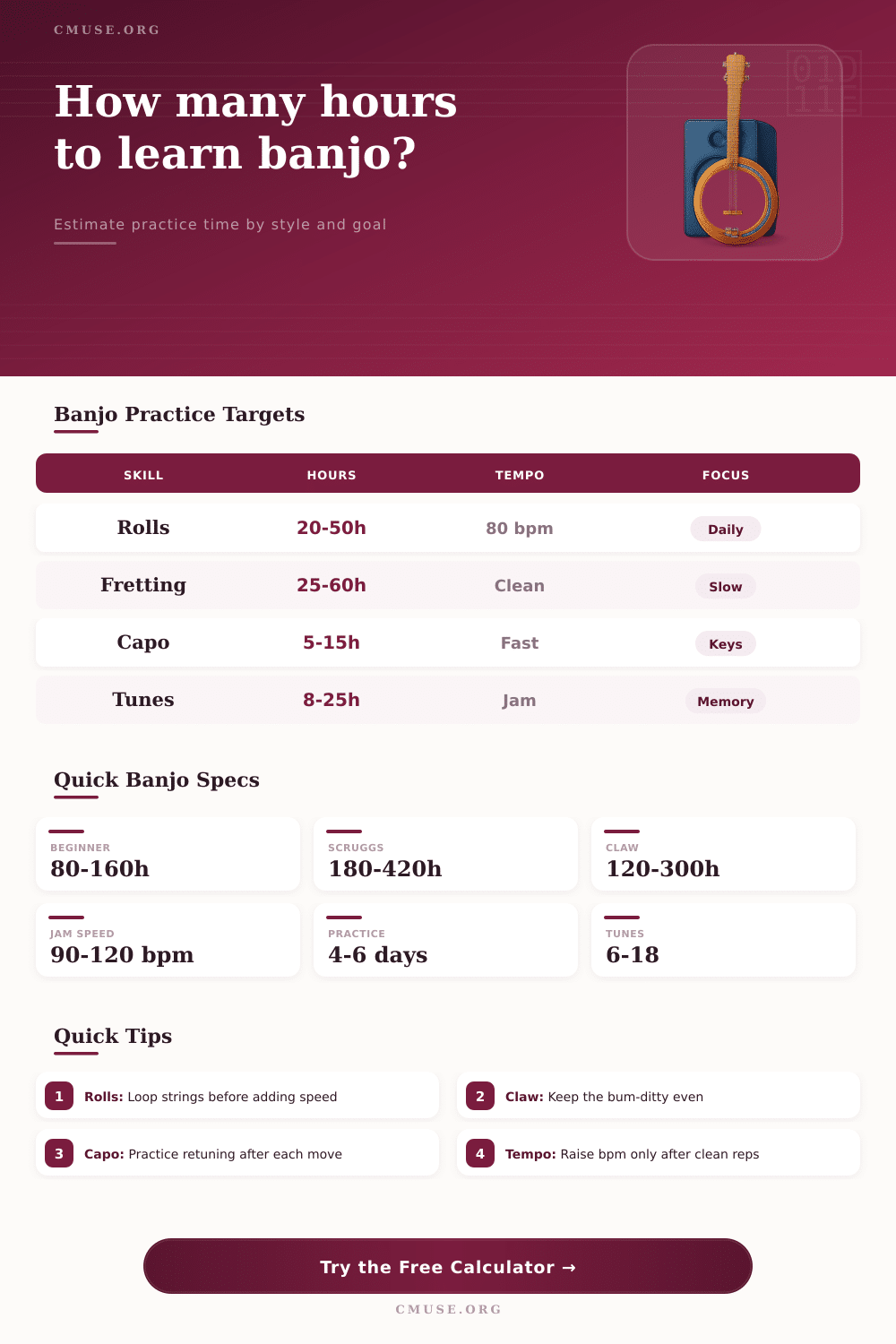
| First slow jam | 80-160 | Basic roll or bum-ditty | 4-6 tunes at 80-95 bpm |
| Clawhammer old-time jam | 120-300 | Brush, thumb, drop thumb | 8-14 fiddle tunes at 90-115 bpm |
| Scruggs bluegrass lead | 180-420 | Forward, reverse, square rolls | Breaks and backup at 100-125 bpm |
| Performance polish | 350-750 | Timing, tone, drive, recovery | Reliable set under light pressure |
| Technique block | Beginner allocation | Intermediate allocation | What improves |
|---|---|---|---|
| Rolls or frailing | 30% | 22% | Pulse, accent control, string accuracy |
| Left-hand fretting | 22% | 20% | Clean notes, slides, pull-offs, chord shifts |
| Repertoire memory | 26% | 30% | Song form, endings, backup placement |
| Tempo and recovery | 22% | 28% | Jam readiness and fewer train wrecks |
| Tempo band | Bluegrass use | Old-time use | Practice cue |
|---|---|---|---|
| 60-80 bpm | Roll mapping and chord changes | Frailing motion and clean thumb | No speed bumps until notes ring evenly |
| 80-100 bpm | Slow jam breaks and backup | Relaxed tune learning | Add singing or vamping checks |
| 100-120 bpm | Common jam comfort zone | Dance-tune practice range | Record weekly and check groove |
| 120-145 bpm | Fast bluegrass drive | Brisk fiddle-tune sessions | Short bursts, then return to clean tempo |
| Tuning or capo task | Extra hours | Banjo-specific issue | Readiness test |
|---|---|---|---|
| Open G only | 0-4 | Stable fifth-string drone | Tune quickly and return to pitch |
| Capo plus fifth string | 5-15 | Spike, pip, or fifth-string capo accuracy | Change keys without losing tempo |
| Double C or modal | 10-25 | New chord shapes and drone feel | Play two tunes without hunting strings |
| Multiple tunings | 20-45 | Memory split between shapes and drones | Retune, capo, and start cleanly |
💡Practice Notes
The first time you pick up a five-string banjo the sound is distinctive. It’s not music really, more of a metallic argument between string and your fingers. Maybe you’re thinking about playing Cripple Creek but after three notes, the rhythm break down into a nervous stammer because this is where many a player makes the critical error. They think that more volume mean more progress, so they pile on the hours. They hope that sheer repetition will get there hands to cooperate, but it rarely do.
Once you know what your target tempo and style is, then the calculator above takes care of math for you. You won’t have to guess how long you will be stuck with a metallic stammer before it starts sounding like melody.
How to Use This Practice Planner
Your primary input here is which style you want to play, as clawhammer old-time and Scruggs-style three-finger bluegrass are essentially two different instrument, both housed in the same instrument body. Clawhammer require a down-stroke driving the rhythm through the wrist while Scruggs uses intricate rolls of the right hand that has to flow continuously without interruption. To account for this, the tool balance the weight of your practice time, if you pick clawhammer, then it expects that you’ll spend more time perfecting evenness of your thumb work, and less time fussing with elaborate variation on the roll. This matters because if you try to learn rolls when you should of be learning how to fingerpick, you are just picking up bad habits faster.
Other variables such as tempo also trick beginner players as they want to play fast, which is only impressive if playing is clean. Setting the targets for playing cleanly forces us to think about them rather than just trying to play fast. This makes estimated number of hours jump significantly if you set a target of 97% clean. It isn’t a penalty, it’s a reality. Achieving perfect clarity of notes while playing at eighty beats per minute will require more discipline in practice than a ‘muddled’ attempt at one hundred and twenty. The reference table on the page correlates tempo bands with required skill levels and you can see from this that you cannot skip slow work. Speed is simply clean playing played quickly enough to make it sound like one thing, rather than many.
Where you start also sets the course in an entirely different direction. If you’re coming from the guitar then your fretting hand are already familiar with position and what tension feels like. You will likely sail through certain chords that stump the complete beginner. However, your right hand may have to fight some wrong instincts, as guitarists tend to pluck individual strings independentally. For the banjo, it is all about unity of motion, whether that is brushing or rolling across the strings. Therefore, the calculator take account of your experience level when adjusting how much you has to practice. It knows that you may spend less time figuring out where the notes are than unlearning how you want to move your hand.
Adding to the friction: Open G is already a tuning; add in modals such as Double C and capos and it’s adding even more layers. It’s not simply about learning songs now; you’re dealing with key signatures on-the-fly, which require more brain power, hence why the tool will also add additional hours for those intricacies. Your hand shape are changing each time the singer changes chord, and you can’t fall back on muscle memory alone.
It’s tempting to think that knowing many songs is overrated. It’s better to know one song really well rather than skimming through ten poorly. In a jam setting however, you’ll want some options in your back pocket. Focusing on fifteen tunes gives the calculator enough time to allow for recognizing the form (including the ending) as well as memorizing it. No one wants to be the person who forget the bridge and finishes on the wrong beat.
This helps you see how you divide your energy between the technique blocks. Frailing (or rolls) dominate the earlier phases, while left hand fretting grow in importance towards the top end of the neck. When approaching how well you can play, tempo and recovery start to come into play; therefore, it’s a moving balance and the key is largely around knowing what exactly is being evaluated at each stage.
Five days of concentrated practice is far better then two all-nighters; consistency beats intensity. The tool includes this in its calendar plan, creating a workload for you each week that seem doable and achievable. Think about it. You’re not just developing your skill but also your stamina. That banjo doesn’t give a hoot if you want to practice or not; it’ll react to what you can actualy produce regularly.
Go slowly and make it right. Allow the clock to tick steadily and methodicly. Before long, that metal debate will settle into something you’d be proud to listen to.