Practice Hours to Learn Flute Calculator
Estimate the focused practice time needed for flute progress using embouchure aperture, breath support, tone, fingerings, articulation, register jumps, and sight-reading.
Your Flute Practice Estimate
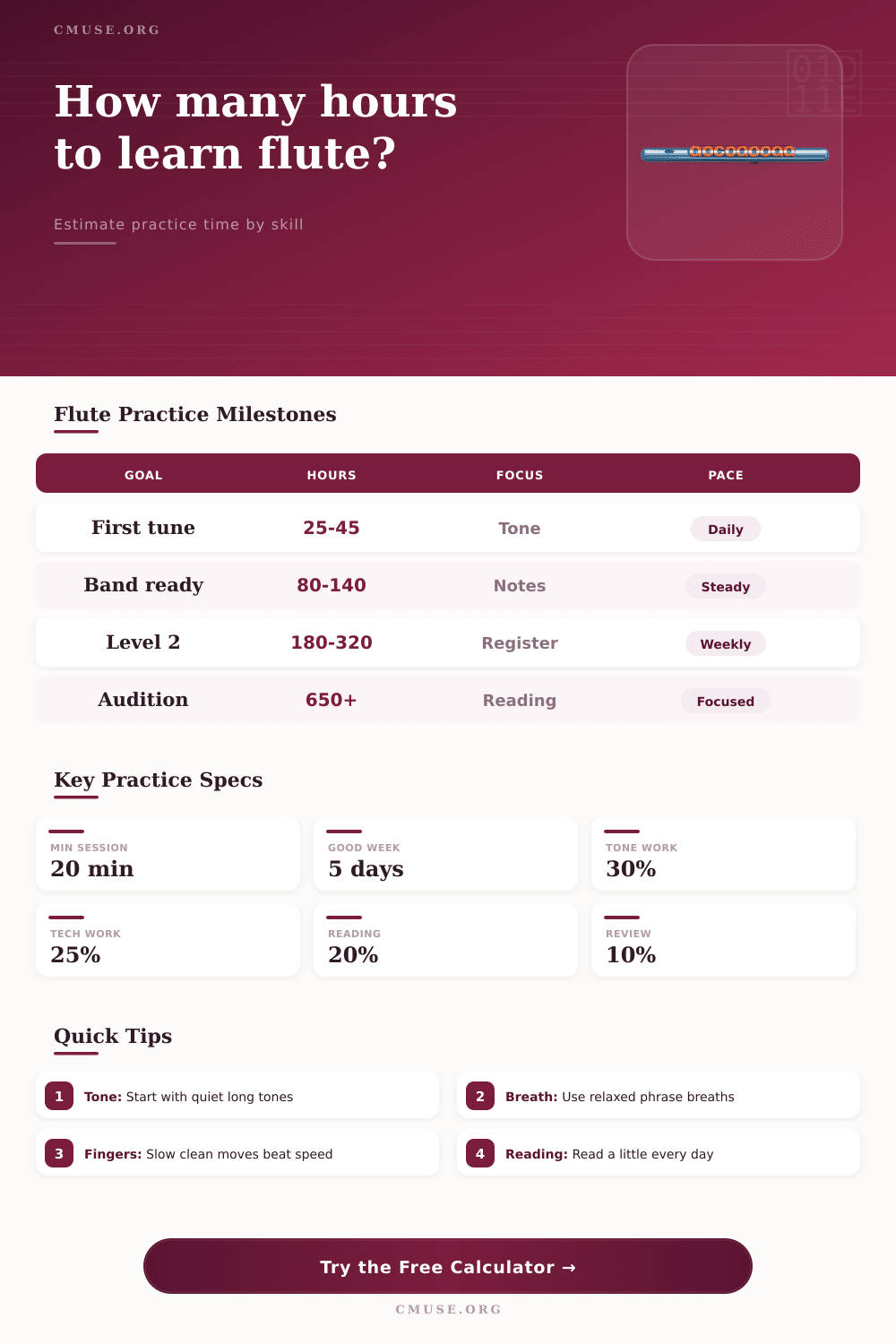
| Learning Goal | Typical Hours | Main Flute Hurdle | Practice Signal |
|---|---|---|---|
| First clear melody | 25-45 focused hours | Headjoint tone and small aperture | Notes start without a breathy scoop |
| Beginner ensemble ready | 80-140 focused hours | Fingerings, counting, and breath marks | Simple parts stay in time with a pulse |
| Solid beginner technique | 180-320 focused hours | Even tone, tonguing, and first scales | Middle register speaks consistently |
| Intermediate method level | 380-650 focused hours | Register jumps and key signatures | Octaves respond without overblowing |
| Audition or graded exam | 650-1100+ focused hours | Style, endurance, rhythm, and polish | Runs stay clean under performance pressure |
| Skill Score | Embouchure and Tone | Technique | Reading Standard |
|---|---|---|---|
| 1 | Airy tone, unstable aperture | Fingerings need visual checking | Pulse stops often |
| 2 | Sound appears but cracks or fades | Slow changes with frequent slips | Easy rhythms need counting aloud |
| 3 | Clear middle-register tone | Common scales and slurs are usable | Simple melodies stay mostly steady |
| 4 | Stable color and dynamic control | Register shifts and articulation align | New music can be scanned ahead |
| 5 | Refined tone across registers | Relaxed fingers at performance tempo | Rhythm and notes read fluently |
| Practice Block | Beginner Share | Intermediate Share | Purpose |
|---|---|---|---|
| Long tones and harmonics | 30% | 20% | Center tone, aperture, and breath speed |
| Fingerings and scales | 25% | 25% | Build relaxed hand motion and clean notes |
| Articulation patterns | 15% | 20% | Coordinate tongue, air, and finger changes |
| Register jumps | 10% | 20% | Stabilize octaves without jaw squeezing |
| Sight-reading and pieces | 20% | 15% | Turn skills into musical fluency |
| Register Area | Common Notes | Technical Focus | Progress Cue |
|---|---|---|---|
| Low register | C4-B4 | Relaxed air, covered keys, open throat | Notes speak without pressing harder |
| Middle register | C5-B5 | Centered aperture and steady air column | Tone stays even between finger changes |
| Upper register | C6-G6 | Faster air, smaller aperture, no jaw pinch | Octaves speak without sharpness spikes |
| Leap practice | Octaves and fifths | Air direction before finger speed | Both notes start with the same tone core |
The estimate is a practice-planning guide. Real progress varies with instrument condition, lesson quality, posture, listening habits, and how consistently each session starts with sound quality.
Imagine this; you pick up a flute for the very first time. You put it to your mouth and blow hoping to hear some music… instead, what comes out is more like a distressed dolphin then a beautiful melody. Not only is this embarrassing, but it’s confusing on a physical level as well. Your breath, tongue, and lips must now learns how to work together when they’ve never done so before.
Enter the calculator (above). Once you input your goals and where you’re at in terms of playing, it do all the math for you. No more guesswork: Are you still far off from being band-ready? Or are you getting closer? That question is important because practicing without a goal equal noise.
How the Flute Learning Calculator Works
Tone is always first hurdle. Your face has to figure out how to shape the air before your fingers know where to go. That’s why it asks about using the tool to control how you shape your mouth. The headjoint speak clearly when you have a small, centered oval opening. No matter how fast your fingers move, if your cheeks is puffed up or your jaw is trying to squeeze anything, your sound won’t work. That’s why the calculator weigh breath support and tone so heavily. Physically building those foundational elements take time to become muscle memory. A steady air column doesn’t happen overnight. It just takes focused, consistent attention to quality of sound before you concern yourself with reaching any particular notes.
Next up are fingerings, which can be misunderstood. New players wrongly believe they will play better if they just move their fingers quick. Usually they won’t. Instead, technique develop from clean finger motion practiced at a slow speed. To allow for that, the calculator allows you to rate your fingering accuracy/ articulation independent of pure speed. If you’re choking on slurs or hitting wrong notes, the system bumps up your estimated number of hours to account for it. That’s reality. It takes longer to fix a bad habit then it does to learn it right the first time. Slow practice isn’t lazy practice; it’s the only way to wire in precision.
Sight reading and register jumps further complicate things. There are three distinct registers on the flute where different apertures and air speeds needs adjusting, which is why moving between them smoothly feels unnatural at first. These present problems with transitioning into a new key or even from one octave to another. The calculation include the difficulties in these areas. It also accounts for reading ability and register control as part of the tool. If you’re having trouble maintaining a constant pulse when learning new rhythms, it take into consideration the additional mental load that places on your performance. It’s not simply a case of playing notes; you’re decoding music in real time.
Fewer people realize how valuable feedback is. Because we can’t easily correct ourselves, the calculator includes these factors as “session quality” and “teacher frequency“. Maybe you assume that your tone is clear, but it’s actualy vague. Without a recording or a good ear, you won’t notice the difference between what you want and what happens. The tool assumes you need extra time if you’re practicing alone with no checks. It is not out of punishment, but for accuracy. Our blind spots hold us back far more than our talent do.
In short, this means concentrated practice. If you are sitting at the instrument for an hour but only using that time to scroll through your phone you aren’t counting those hours as real practice. Real practice stops if you’re not getting it right. Instead, it drills on what isn’t working until it becomes right. On the page, there are reference tables that map out typical benchmarks such as audition prep or being ready for a band. This give you a feel for how slowly things might be progressing and also helps avoid discouragement.
The flute is both an art form and physical craft. Just like every other muscle in your body your embouchure requires rest days. Intensity never replaces patience. Begin with quiet long tones. Allow the sound to settle into its center. Soon enough the hours begin adding up to something you can actualy hear.