Position Shift Distance Calculator
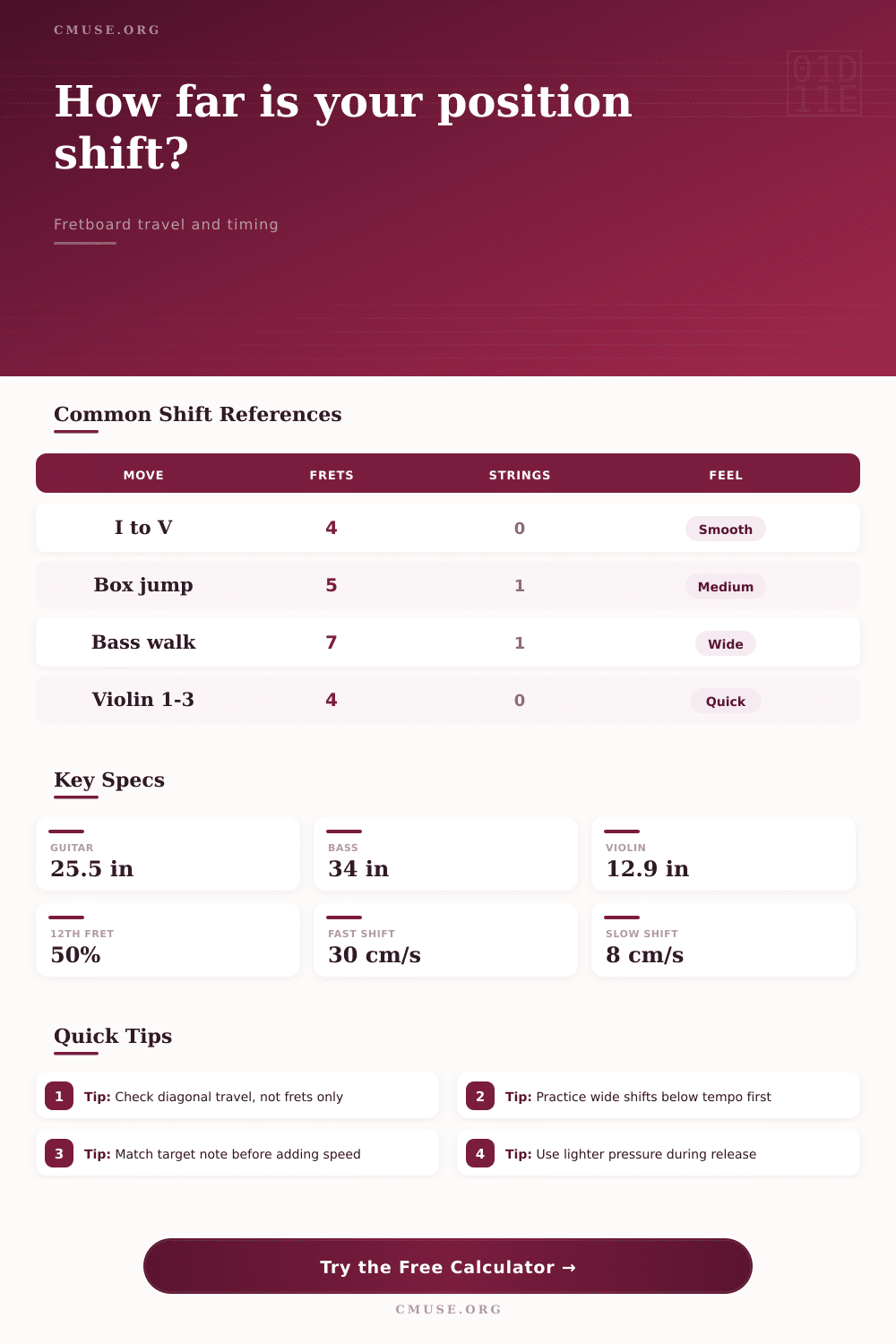
Measure how far the hand travels between fretted positions, including string crossing, fret geometry, scale length, target note, and shift speed.
🎯Real Position Shift Presets
📏Fingerboard Shift Inputs
Shift Distance Results
⚙Current Shift Spec Grid
📚Fret Geometry Reference
| Fret | Distance from nut | Remaining string | Use in shift planning |
|---|---|---|---|
| 1 | 5.61% of scale | 94.39% | Small open-position moves |
| 3 | 15.91% of scale | 84.09% | First-position reference |
| 5 | 25.08% of scale | 74.92% | Common box boundary |
| 7 | 33.26% of scale | 66.74% | Mid-neck target |
| 9 | 40.55% of scale | 59.45% | Upper box entry |
| 12 | 50.00% of scale | 50.00% | Octave landmark |
| 15 | 57.96% of scale | 42.04% | Compact high-register moves |
| 17 | 62.54% of scale | 37.46% | High position targets |
🎻Instrument Geometry Table
| Instrument | Scale length | String set | Typical shift concern |
|---|---|---|---|
| Electric guitar | 25.5 in / 64.8 cm | 6 strings | Box-to-box diagonal accuracy |
| Classical guitar | 25.6 in / 65.0 cm | 6 strings | Wide spacing with guide finger |
| 4-string bass | 34 in / 86.4 cm | 4 strings | Large low-position distances |
| Violin | 12.875 in / 32.7 cm | 4 strings | Short but exact position jumps |
| Cello | 27.375 in / 69.5 cm | 4 strings | Thumb and neck-position spacing |
| Mandolin | 13.875 in / 35.2 cm | 8 strings | Course crossing plus fret jump |
| Concert ukulele | 15 in / 38.1 cm | 4 strings | Small-scale intonation placement |
| 5-string banjo | 26.25 in / 66.7 cm | 5 strings | Roll patterns that skip strings |
⏱Shift Speed Table
| Speed | Centimeters per second | Inches per second | Practice use |
|---|---|---|---|
| Very slow release | 6 cm/s | 2.4 in/s | Silent setup and intonation work |
| Measured shift | 12 cm/s | 4.7 in/s | Half-beat shifts at moderate tempo |
| Confident shift | 22 cm/s | 8.7 in/s | Common guitar and violin moves |
| Fast passage | 35 cm/s | 13.8 in/s | Small targets in quick phrases |
| Slide gesture | 50 cm/s | 19.7 in/s | Expressive slides and rapid jumps |
🎵Target Note and Shift Type Table
| Shift type | Fret span | String span | What to verify |
|---|---|---|---|
| Same-string guide shift | 2 to 5 frets | 0 strings | Pitch lands cleanly after release |
| Position plus crossing | 3 to 7 frets | 1 to 2 strings | Diagonal hand path is direct |
| Register jump | 7 to 12 frets | 0 to 3 strings | Target note is named before speed |
| Thumb-position move | 4 to 9 positions | 0 to 2 strings | Thumb anchor changes smoothly |
| Slide arrival | 4 to 14 frets | 0 to 1 strings | Arrival note matches the goal |
💡Position Shift Tips
The odd sort of frustration you encounter when you have played this thing at speed and then you fall off a cliff with a shift. It’s not quite right: you’ve landed on the note you want but your hand has spasmed out a bit because it has been trained to make small increments of movement rather than large jumps. This looks like a rhythmical issue but is in fact a spatial one.
When most player count up four or five frets they are totally focused on what the number is but give no thought to where the notes they’re playing are in relation to each other. That makes all the difference as to how far your hand has to travel. We have used the calculator to do the maths for you by inputting your string crossing and scale length. This way, you don’t waste time wondering just how big a physical gap there really is between the two notes.
How to Measure Distance When Changing Positions
There’s also the fact that the fretboard doesn’t have a linear geometry. That means most intuitive guesses about how far things are apart on the fretboard don’t hold true. For example, a leap of four frets (such as from the tenth to the 14th) will take up less space on the fretboard than another four-fret jump (from the fifth to the ninth). As you approach the bridge end of the neck the frets are closer together. Therefore, jumps that is numerically equal further down the neck will demand much greater hand momentum and travel than those higher up the neck. In other words, you might be able to do those same-numbered leaps high up the neck at full speed. But if you find open position jump difficult, you have likely been unconsciousy compensating for that extra physical distance. This is where the tool comes into play; it knows the real-world scale-length of whatever instrument you’re playing; anything from a long-scale bass guitar to a short-scale violin.
Another aspect that most metronome drills totally disregard is string crossing. Moving up four frets on the same string is just a straight line of longitudinal distance. However, when you move four frets and at the same time change strings from the high E string to the A string, you are now taking a diagonal path. This diagonal is longer than the longitudinal distance by itself. The calculator measure your true travel distance to show you clearly how much physical effort is needed. It matters because your brain has to time the release accurately based off knowing exactly how far it needs to throw the hand. Underestimating the diagonal means you will land either short or late.
And then there’s timing. On paper it makes sense. I can slow down and do this big change perfectly, but trying it at 120BPM with only half a beat requires more accuracy. With the calculator you have an idea whether you’re going to get across and finish the travel within the given window of time on the beat. If you don’t, you’ll either want to begin more slowly or else use some sort of guide finger and reduce the travel distance. It has nothing to do with learning to play fast first, but rather to understand how long the physical movement takes so you can develop the muscle memory efficienty.
Not all shifts are the same; treating them that way leads to a poor practice plan. Nothing in a small two-fret slide compares to a seven-fret register jump. This page’s reference table breaks shifts into categories. It categorizes them by what they physically ask of us and how we commonly use them. Knowing how your shift type is classified helps determine if you should work for accuracy now and speed later, or vice versa. With wide jumps, accuracy must be first. Speed is just accurate repetition done quickly. You can’t short-cut that, so don’t rush the landing.
In conclusion then, learning to shift positions isn’t as much a question of brute force as it is one of spatial awareness. What you’re doing is mapping a two-dimensional fingerboard into a three-dimensional space. When you measure the time and distance, the awkwardness of the big leap suddenly has no mystery. What was once an unpredictable stumble becomes a calculated move. From that point on you have an exact idea of where your hand must go. You work with the geometry rather than fight against it. The shift stops being a jump in the dark and becomes just another note in the line.