Ported Subwoofer Box Calculator
Use this ported subwoofer box calculator to size a vented enclosure, set net volume, and dial in port length and tuning before you cut.
📦 Ported Presets
🔧 Ported Setup
📈 Reference Tables
Driver volume guide
| Driver | Sealed net | Vented net | Disp. |
|---|---|---|---|
| 8 in class | 0.45-0.90 | 0.75-1.25 | 0.03 ft3 |
| 10 in class | 0.75-1.40 | 1.10-1.80 | 0.05 ft3 |
| 12 in class | 1.00-2.00 | 1.80-3.50 | 0.08 ft3 |
| 15 in class | 1.80-3.50 | 3.00-5.80 | 0.13 ft3 |
| 18 in class | 2.80-5.00 | 5.00-9.00 | 0.20 ft3 |
Port tuning guide
| Alignment | Tune | Volume band | Use |
|---|---|---|---|
| Sealed | N/A | 0.45-2.00 | Tight bass |
| Daily vented | 33-35 Hz | 1.10-3.50 | Balanced |
| Low-tune | 28-32 Hz | 1.80-5.80 | Deeper low end |
| SPL vented | 36-40 Hz | 2.50-9.00 | Upper-bass hit |
Material guide
| Material | Thick. | Density | Note |
|---|---|---|---|
| 15 mm MDF | 15 mm | 740 kg/m3 | Light MDF |
| 19 mm MDF | 19 mm | 760 kg/m3 | Common build |
| 12 mm birch ply | 12 mm | 620 kg/m3 | Thin shell |
| 18 mm birch ply | 18 mm | 650 kg/m3 | Strong all-round |
| 18 mm Baltic birch | 18 mm | 680 kg/m3 | Premium panel |
| 19 mm marine ply | 19 mm | 660 kg/m3 | Moisture ready |
| 12 mm HDF | 12 mm | 880 kg/m3 | Very stiff |
| 15 mm composite | 15 mm | 720 kg/m3 | Stable board |
Port style guide
| Driver | Area | Tune | Note |
|---|---|---|---|
| 8 in class | 12-16 in2 | 34-38 Hz | Small cabin |
| 10 in class | 16-22 in2 | 32-36 Hz | Tight daily |
| 12 in class | 22-30 in2 | 30-34 Hz | Most builds |
| 15 in class | 32-42 in2 | 28-32 Hz | Large trunk |
| 18 in class | 44-60 in2 | 26-30 Hz | Big output |
💡 Ported Build Tips
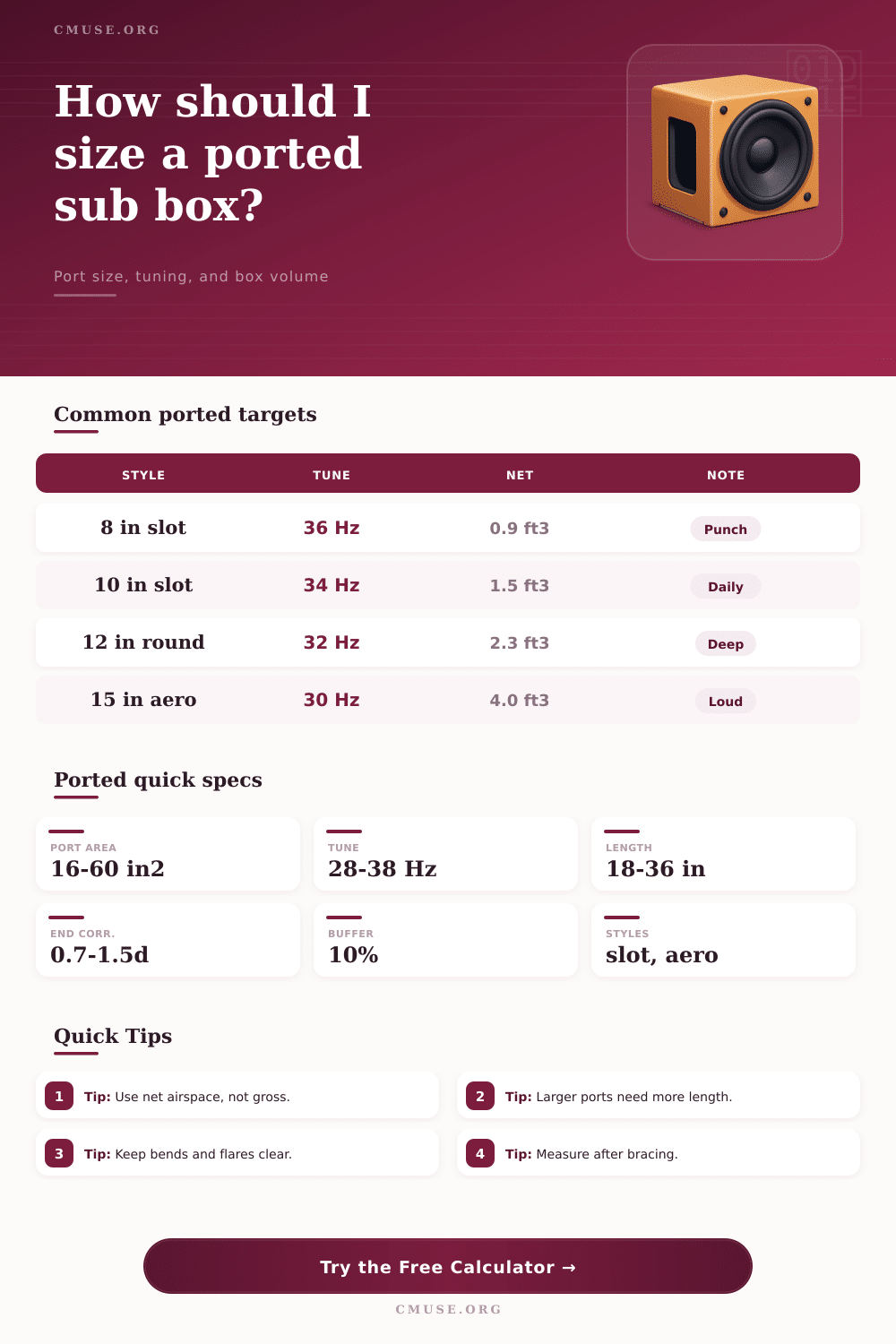
A ported subwoofer enclosure are a box that contains a tuned vent, also known as a port. This tuned vent is used to amplify the low frequencies produce by the subwoofer by resonating with the movement of the subwoofer driver. The tuned vent can be in the form of a tube or slot.
This vent add bass reinforcement to the subwoofer around a specific tuning frequency. If the tuning frequency is too high, the bass will be punchy on the subwoofer and may clip when playing music. If the tuning frequency is too low, the port will be too long for the enclosure.
How to Build a Ported Subwoofer Box
Ports that are too long take up too many space within the enclosure or dont allow the subwoofer to reach high volume. The builder must plan the tuning frequency before building the enclosure. To build the enclosure, the net volume must be determined.
The net volume is the total volume of the enclosure minus the volume of the subwoofer driver, the walls of the port, and any bracing that is add to the enclosure. Bracing is added to avoid flexing of the enclosure walls, which may cause buzzing sound from the subwoofer. You can calculate the net volume using a manufacturer specifications of the subwoofer.
For a 12-inch subwoofer, the net volume required is 2 cubic feet for standard use but increase to 3.5 cubic feet for more low-end sound reinforcement. The area of the port must be calculated to ensure that air velocity are maintained at 17 meters per second or less. Air velocities higher than this rate will create turbulence in the air movement in the port, which will mask the bass sound create by the subwoofer.
The area of the port required will vary depending on the size of the subwoofer driver. Subwoofers with smaller diameters require less area for the port then larger subwoofers. For instance, a smaller subwoofer only requires 12 to 16 square inches for the port area, but an 18-inch subwoofer may require 44 to 60 square inches for the port area.
Slot ports can be use in the walls of the enclosure or round ports can be used. Round ports require flares to allow smooth movement of the air. Another factor to calculate before building the enclosure is the length of the port.
The tuning frequency desired for the subwoofer will determine the length of the port. For example, 34 Hz will require a shorter port then 30 Hz. A longer port takes up more space in the enclosure, so a longer port may require bends in the port or an deeper enclosure to accommodate the length of the required port.
The enclosure may be of any shape, such as rectangular or triangular shapes. However, the shape is another consideration when placing the enclosure in a vehicle. Other materials that can be used to build the enclosure include 18 mm birch plywood, which provide strength to the enclosure walls.
Common mistakes to avoid when building the enclosure include creating a port that is too small for the subwoofer. This can increase the tuning frequency of the enclosure and clip the bass frequencies at high volumes. Another mistake is to not account for the volume that is lost due to bracing the enclosure and bends in the port.
The interior of the port should also not have sharp edge, as these will create noise in the air that mask the bass frequencies produced by the subwoofer. The last consideration in building the enclosure is the tuning frequency. If the listener desire a range of sounds for many types of music, the tuning frequency should be between 33 and 35 Hz.
Frequencies between 36 and 40 Hz will create more bass reinforcement for music with low frequency. However, if the listener desires the deepest bass for home theater systems or specific vehicle, the frequency can be tuned to between 28 and 32 Hz. When these factors is calculated, the enclosure can be assembled.
Its going to be alot of work, but you should of planed it out carefully.