🔊 Port Tuning Frequency Calculator
Calculate the tuning frequency (Fb) of your ported subwoofer enclosure from port and box dimensions
| Box Volume | Port Ø 3" | Port Ø 4" | Port Ø 6" | Application |
|---|---|---|---|---|
| 0.5 ft³ (14.2 L) | ~45 Hz @ 8" | ~45 Hz @ 12" | — | Compact 8" sub, studio monitor |
| 0.75 ft³ (21.2 L) | ~38 Hz @ 10" | ~40 Hz @ 14" | — | Compact 10" sub |
| 1.0 ft³ (28.3 L) | ~35 Hz @ 12" | ~35 Hz @ 16" | ~35 Hz @ 26" | Car 10" or 12" SQ |
| 1.5 ft³ (42.5 L) | ~32 Hz @ 14" | ~35 Hz @ 14" | ~35 Hz @ 22" | Car 12" SQ / standard |
| 2.0 ft³ (56.6 L) | — | ~35 Hz @ 12" | ~35 Hz @ 18" | Car 12" SPL / 15" SQ |
| 2.5 ft³ (70.8 L) | — | ~40 Hz @ 10" | ~35 Hz @ 16" | Car 15" SPL |
| 3.0 ft³ (85.0 L) | — | — | ~30 Hz @ 18" | Home theater 12"-15" |
| 5.0 ft³ (141.6 L) | — | — | ~28 Hz @ 22" | PA subwoofer 18" |
| Application | Fb Range (Hz) | Box Volume | Notes |
|---|---|---|---|
| Car Audio — SPL Competition | 40 – 55 Hz | 1.5 – 3.0 ft³ | High output, less extension |
| Car Audio — Sound Quality | 28 – 38 Hz | 1.0 – 2.0 ft³ | Deep extension, flat response |
| Home Theater | 18 – 30 Hz | 2.0 – 5.0 ft³ | Deepest extension, movie bass |
| Studio / Recording | 25 – 35 Hz | 1.5 – 4.0 ft³ | Flat, accurate response |
| Live PA / Stage Sub | 35 – 50 Hz | 3.0 – 8.0 ft³ | Efficiency and punch |
| Hi-Fi Audiophile | 22 – 32 Hz | 2.0 – 4.0 ft³ | Accuracy, transparency |
| Bass Guitar Cabinet | 55 – 80 Hz | 2.0 – 5.0 ft³ | Supports fundamental 41 Hz E |
| Port Diameter | Cross-Section Area | Recommended Max SPL | Port Area / ft³ Ratio |
|---|---|---|---|
| 2" (5.1 cm) | 3.14 in² (20.3 cm²) | Low – risk of chuffing | Only for boxes <0.5 ft³ |
| 3" (7.6 cm) | 7.07 in² (45.6 cm²) | Moderate | Min 1 port per 0.5 ft³ |
| 4" (10.2 cm) | 12.57 in² (81.1 cm²) | Good for car audio | Min 1 port per 1.0 ft³ |
| 6" (15.2 cm) | 28.27 in² (182.4 cm²) | Excellent | Works up to 3–4 ft³ |
| 8" (20.3 cm) | 50.27 in² (324.3 cm²) | Very low velocity | Best for large PA subs |
Port Tuning Frequency truly changes everything when one designs boxes for speakers. It affects the depth of your deep sounds and whether the sound is clear or different. If one does not pay attention to this detail and errs, that can cause serious problems in the sound.
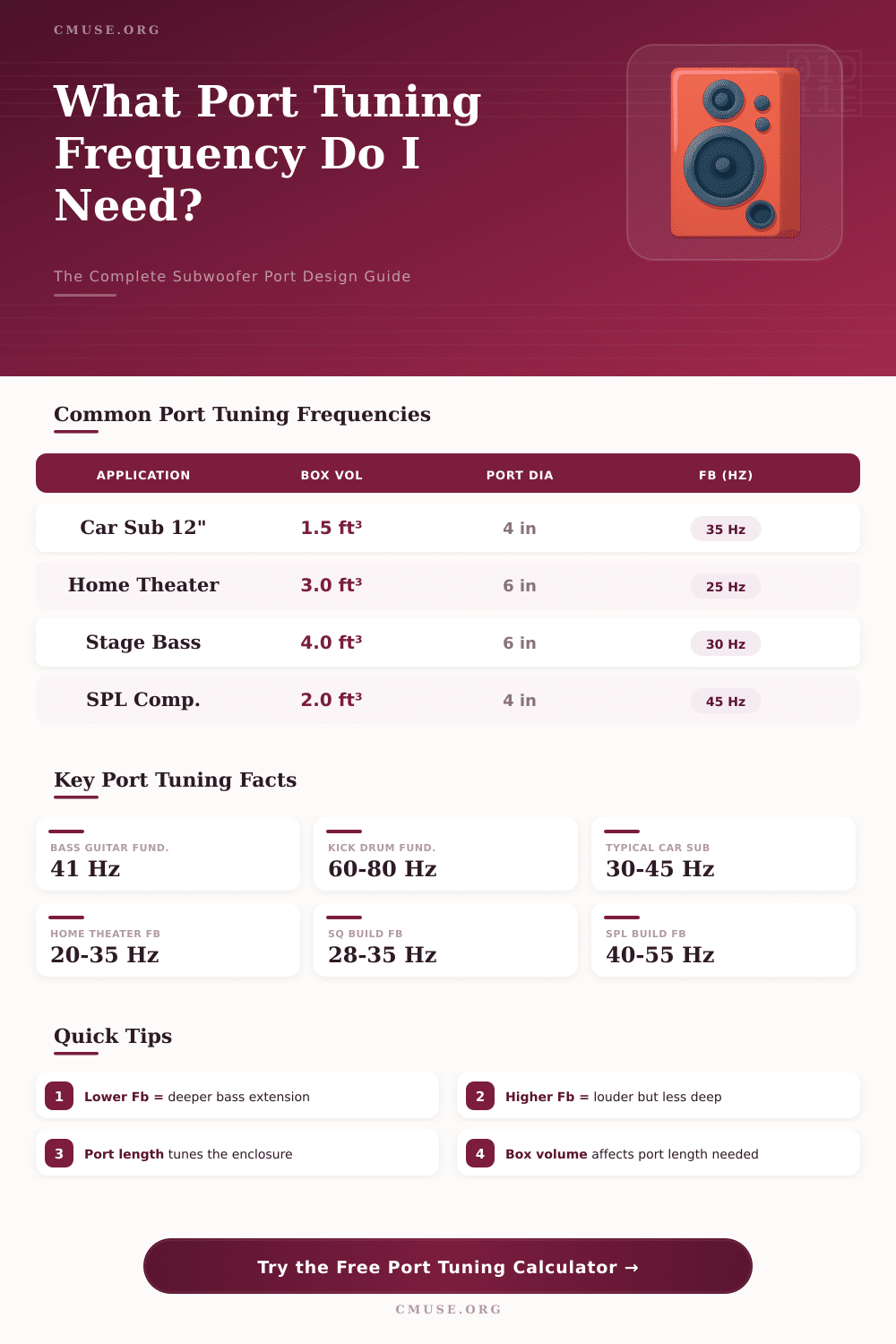
For typical setups aim for something between 30 and 35 Hz as a good base. Setting it higher helps to reach bigger level of sound pressure, so stronger volume output. On the other hand, lower setting usually gives better quality of sound.
Why Port Tuning Matters for Bass
Around 33 Hz gives good balance between those two sides. For live music, subs commonly sound better at 40 Hz. One can choose a setting in the lower part of the 40s, or even up to 50 Hz, depending on what one wants to reach.
Here is something that commonly surprises folks: the Port Tuning Frequency does not depend on its volume. It relates to the cross-section and the length of the port. Want a bigger opening?
Then make it longer to reach the same Port Tuning Frequency. Between two ports of different sizes, the bigger and longer almost always give cleaner sound. Because small ports commonly cause noise, as if air rubs through them.
In tight spaces or for very low settings, passive radiators can be teh best solution.
At the Port Tuning Frequency itself something remarkable happens. The cone of the speaker moves only a little, while air passes through the port at highest speed. Almost everything from the real sound output beside that frequency comes from the port, not from the speaker.
Below it the movement of the cone grows quickly, with a drop of 24 dB each octave in the sound output. That is a steep drop that separates the benefits of deep reflex box from sealed design, that only falls at 12 dB each octave.
The air in the port acts as a spring, that moves and resonates correctly at your Port Tuning Frequency. Beside that resonance point, the pressure of sound grows, which gives stronger and punchy bass response. The main task of a reflex port is too release pressure, that otherwise would stay trapped and would turn to heat in a sealed box.
It works well, a bit over and under your chosen tuning spot.
The position of the ports matters more than many think. Keep the distance between ports and speakers inside a quarter wave of your Port Tuning Frequency. If you add more speakers, you shrink the real internal volume, which will change your setting, even if the port itself stays the same.
Technically one can set below the resonance frequency of the speaker, but one will not gain much, the speaker hardly works down here. Port Tuning Frequency works best when it extends your frequency response, not just strengthens a resonance peak. Even small changes in the frequencies cause big differences in the length of the port.
Simple changes to the numbers make your tuning tube noticeably change in length. Speakers hardly move below thetuning spot, so too high a setting can cause problems more easily. The advice?
Set low, not high.