Podcast Episode Segment Planner Calculator
Plan a podcast rundown by balancing intro timing, host segments, sponsor reads, chapter markers, transition beds, outro length, script pacing, and runtime buffer before the record button is pressed.
Choose a named production scenario, then tune the runtime, ad reads, chapter detail, speech pace, transition beds, and buffer to match the episode you are building.
Detailed Episode Breakdown
| Episode Type | Useful Runtime | Main Segment Pattern | Planning Note |
|---|---|---|---|
| Daily news | 8 to 15 minutes | 3 to 5 short headlines or topic blocks | Keep transitions brief because each reset is a large share of runtime. |
| Solo commentary | 20 to 35 minutes | 3 to 5 topic blocks plus a closing takeaway | Use a clear midpoint so one section does not swallow the whole episode. |
| Guest interview | 35 to 60 minutes | Open, context, story, craft, rapid close | Put the strongest sponsor position after rapport is established. |
| Narrative | 25 to 45 minutes | Cold open, act turns, reveal, resolution | Chapter markers should follow story turns, not every music cue. |
| Panel | 45 to 75 minutes | 6 or more rounds with moderator resets | Reserve extra buffer because crosstalk and laughs expand runtime. |
| Placement | Typical Window | Read Length | Best Use |
|---|---|---|---|
| Pre-roll | 0:00 to 2:00 | 15 to 45 seconds | Short reminders, show sponsors, and network messages. |
| Early mid-roll | 20% to 35% through | 45 to 75 seconds | Good when the first segment establishes strong listener intent. |
| Midpoint mid-roll | 45% to 60% through | 60 to 90 seconds | Useful for interviews, narratives, and educational episodes. |
| Late mid-roll | 65% to 80% through | 45 to 75 seconds | Works before the final act, final lesson, or listener question. |
| Post-roll | After main content | 15 to 60 seconds | Low interruption, but lower attention than mid-roll placement. |
| Chapter Style | Marker Rule | Works Best For | Planning Risk |
|---|---|---|---|
| Compact | Intro, major turns, outro | Short news, daily coaching, quick updates | May hide useful subtopics from scanning listeners. |
| Standard | Each main segment and sponsor block | Interviews, commentary, education, panels | Needs disciplined segment names during the outline pass. |
| Detailed | Subtopics inside each main segment | Deep dives, narrative series, technical lessons | Too many markers can feel noisy in short episodes. |
| Story act | Cold open, act breaks, reveal, resolution | Documentary, fiction, true crime, reported features | Markers should not spoil a reveal before the listener reaches it. |
| Program Format | Speech Density | Sponsor Tolerance | Chapter Recommendation |
|---|---|---|---|
| Solo commentary | 135 to 155 WPM with pauses | 5% to 10% of runtime | Standard markers for each argument or example. |
| Guest interview | 120 to 145 WPM after edits | 6% to 12% of runtime | Use chapters for guest story, craft, advice, and close. |
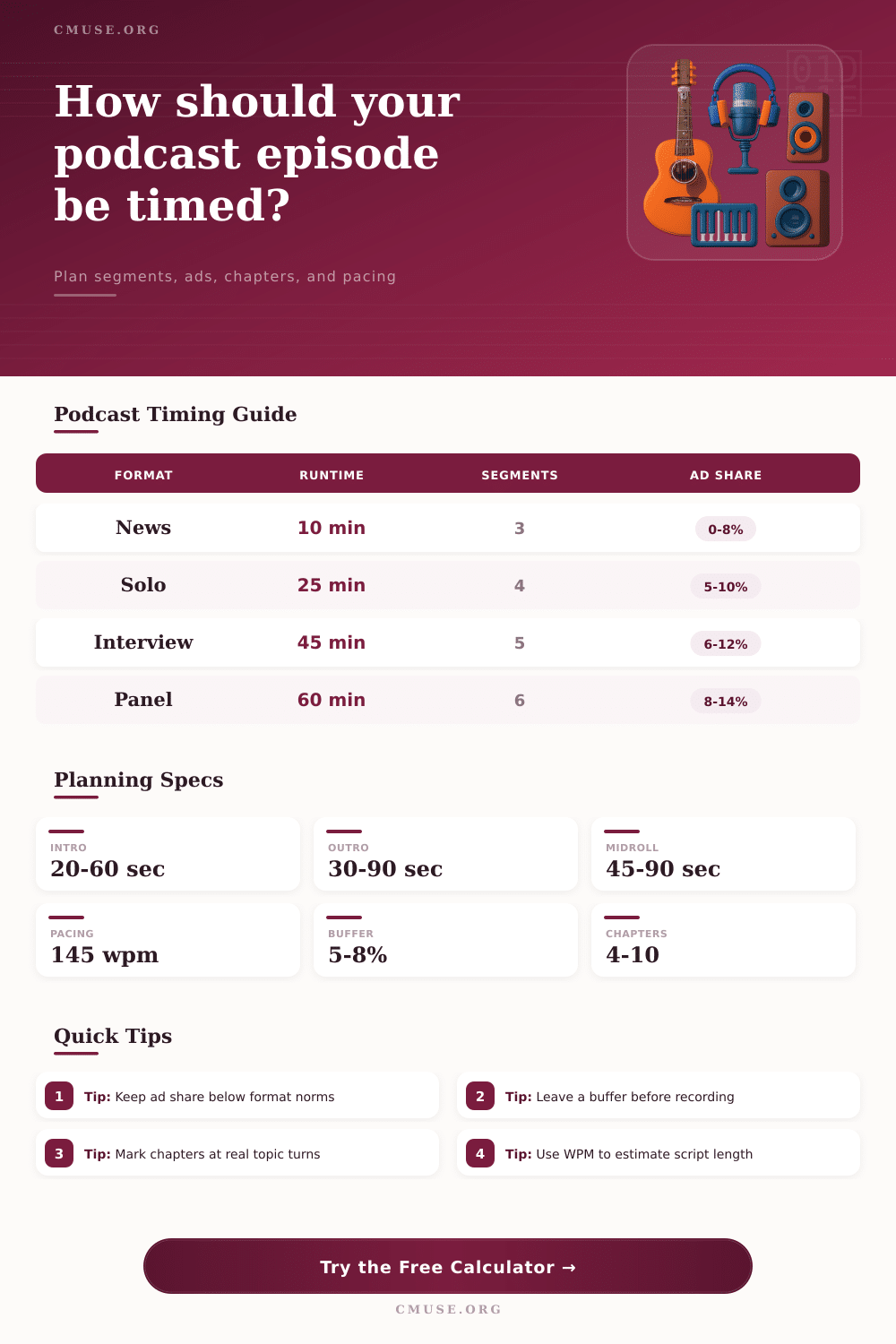
| Daily brief | 145 to 170 WPM | 0% to 8% of runtime | Compact markers work because the episode is short. |
| Narrative documentary | 115 to 140 WPM with sound design | 4% to 9% of runtime | Act-based chapters preserve story momentum. |
| Roundtable panel | 110 to 135 WPM after crosstalk edits | 8% to 14% of runtime | Detailed markers help listeners find each debate topic. |
| Planning Item | Formula | Example | Use In The Calculator |
|---|---|---|---|
| Core available time | Target minus fixed blocks minus buffer | 30:00 minus intro, ads, beds, outro | Determines how much real topic time remains. |
| Per-segment time | Core available time divided by segments | 22:00 divided by 4 equals 5:30 | Shows whether each topic block is too cramped. |
| Script word target | Host minutes times words per minute | 18 minutes times 145 WPM equals 2610 words | Estimates narration or solo outline length. |
| Sponsor share | Total sponsor seconds divided by target seconds | 120 sec in 30 min equals 6.7% | Compares ad load against format norms. |
Time’s limited. Most podcasters assume there’s no end to their time…until they’re staring at clock while recording and realize they’ve got 15 more minutes, but 20 more minutes worth of material. That’s when the panic begins. But you don’t need to panic. You could create each episode like a structured container with distinct compartments. Before you waste hours trimming out all the fluff, use planner above to visualize what those compartments will be. After all, it’s simply a matter of budgeting attention. If you spend one second on a rambling intro, another on music bed, and yet another reading sponsor copy, well then, that’s a second you didn’t spent delivering your core message.
Harsh? Yes. It is basic math when you apply it to human focus. Begin with the non-negotiables: These are fixed costs. They won’t vary from week-to-week. What is your theme song? How long is your cold open? How long does your outro run? Those all adds up. A forty-five second intro and a sixty second outro mean two minutes of structural overhead, or runtime that you won’t have available for the meat of your show. This is where many new creator trip up. They want a half-hour episode but don’t realize there’s this structural overhead). The calculator subtracts it out for you, allowing you to see precisely what’s left as topic time. It helps you avoid this creeping sensation of over-producing segments that water down host’s voice.
How to Plan Your Podcast Time
The second big variable is sponsor placement. Listeners demand narrative flow; advertisers desire visibility. This create a tension that must be managed carefuly. Generally speaking, most shows will accept up to five-to-ten percent ad share before listener retention suffer. That’s right on the edge if you’re placing two sixty-second midrolls inside a half-hour show. With this tool, you can experiment with different setups. You can move a pre-roll to become a post-roll or divide a long read into two shorter ones. Then see what effect that has on overall density. It takes the guess work out of consulting your media kit and wondering if you’ve got too many sponsors.
Most don’t realize: Pacing is everything. One host talking alone (at a rate of say 150 words per minute) will cover very different territory than a panel of three yakking at once. For formats in which the script drives the show, the word-per-minute feed in the planner is key, it tells you about your pace so you can ballpark how many words you has time to fit into each segment. It prevents you from writing four pages of notes when you only have room for two. This is especially important if you’re describing a complex technical concept or telling a true crime story. That’s an editing hell on earth.
The other way in which chapters serve is as a form of structuring: when you have to title a segment, you’re forced to think about what the point is. If you can’t come up with a simple title for a section, chances are there’s no clear point to that part of the show. This table on the page lays this out, connecting chapter density to episode type. Shorter episodes (a daily news brief) don’t need many chapters since listeners won’t likely be skipping around. Longer episodes (a sixty-minute panel discussion) do, since listeners will want to jump to certain debates. Having the correct level of detail allow you to provide value without getting cluttered.
Don’t forget the buffer. Tangents happen in real conversation; there are pauses and laughs. If you script out every second down to the second, where do you put all that humanity? A five to eight percent buffer is ample time to allow for those natural moments that make a show enjoyable, as well as giving you a cushion when you might want to run long with a really good story. Rushing at the end or cutting off abruptly hurt your credibility.
Ultimately, it’s about respecting yourself. When you plan out how long something will take, you’re respecting the person who has given you their time. And if you know exactly what you’re going to say when you sit down to deliver, you’re respecting your own energy too. Running out of time doesn’t have to cause any stress or anxiety because the math isn’t creative; instead, it leaves room for creativity. After you’ve got the structure solidified, that’s when you can concentrate on the stuff that realy matters: connecting, telling stories, shaping a tone. Get the frame first, fill in the rest with life.