Plate Reverb Calculator
Estimate decay, predelay, modal pitch, and plate mass for classic mechanical reverb tones.
🎹 Real Plate Presets
🔧 Plate Geometry
💻 Build Inputs
📊 Plate Benchmarks
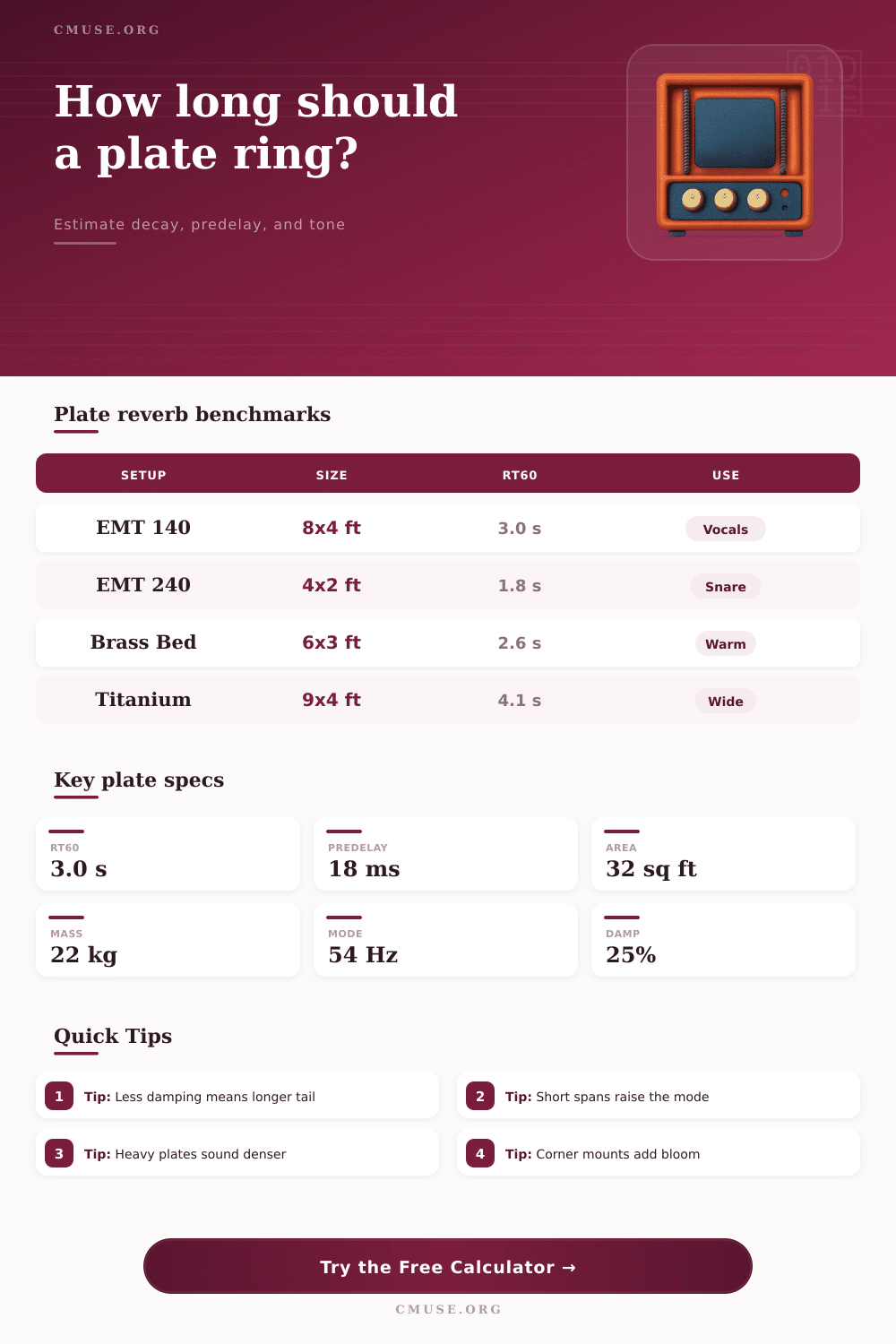
| Setup | Size | RT60 | Use |
|---|---|---|---|
| EMT 140 Vocal | 8 x 4 ft | 2.8 to 3.5 s | Lead vocal depth |
| EMT 140 Snare | 7 x 3.5 ft | 2.0 to 3.0 s | Snare bloom |
| EMT 240 Compact | 4 x 2 ft | 1.2 to 2.0 s | Tight mix space |
| Wide Chamber | 9 x 4 ft | 3.5 to 5.0 s | Long ambient tail |
🔬 Material Comparison
| Material | Density | Modulus | Tone |
|---|---|---|---|
| Spring steel | 7850 kg/m3 | 210 GPa | Bright, long |
| Mild steel | 7850 kg/m3 | 200 GPa | Classic, even |
| Aluminum 5052 | 2680 kg/m3 | 70 GPa | Fast, airy |
| Phosphor bronze | 8800 kg/m3 | 110 GPa | Shimmery, warm |
📡 Mount and Damping Guide
| Mount | Decay | Predelay | Character |
|---|---|---|---|
| Hard-clamped frame | Shortest | Low | Tight, focused |
| Corner suspension | Medium | Medium | Balanced bloom |
| Center suspension | Longer | Higher | Open, wider tail |
| Floating suspension | Longest | Highest | Slow, lush tail |
📋 Shape and Size Reference
| Shape | Span Bias | Mode Spread | Best Result |
|---|---|---|---|
| Rectangle | Balanced | Even | General purpose |
| Circle | Stable | Smoother | Soft vocal tail |
| Triangle | Short side | Sharper | Percussive bite |
| Custom area | User set | User set | Exact fit |
Plate reverb is a mechanical proceses that can be used to add depth to audio signals. Plate reverb are created by sending sound into a suspended sheet of metals. Unlike digital reverb, which use mathematical algorithms to create the sound of reflections, plate reverb uses the vibration of the metal to create the reverb effect.
A person can use plate reverb to adding a sense of space to vocal tracks or drum tracks. However, if the person doesnt choose the size of the metal plate correct, it can create unpleasant ringing sounds. Additionally, if the metal plate is of an wrong material, the tone of the plate reverb can be flat or incorrect.
How Plate Reverb Works and How to Use It
When sound hit the metal plate, the metal plate flexes and creates thousands of resonant frequencies that combines to create a wash of sound. A larger metal plate will sustain the vibrations for a more longer period because the vibrations will travel further on a large metal plate. Using a thicker metal plate will create a harder sound with the metal plate.
However, using a thicker metal plate will cause the sound to decay more quick on the metal plate. The material used to create the metal plate will change the color of the sound created by the metal plate. For example, using steel metal plates will create a bright tone with the metal plate while using aluminum metal plates will create an airy sound with the metal plate.
The RT60 of the metal plate refer to how long the reverb of the metal plate will ring before the sound decay by 60 decibels. To create beautiful plate reverb, you must adjust the RT60 to the specific instrument you are process. For example, drums such as snare drum have a short RT60 so that the snare sounds tight.
However, vocal tracks may have a longer RT60 to create the feeling of an intimate hall. The predelay on a metal plate refer to the time between the initial sound and the plate reverb. If there is too little predelay, the dry signal will get smacked into the reverb.
However, if there is too much predelay, the reverb will sound detached from the original sound. The size of the metal plate will determine the fundamental mode of the metal plate. The fundamental mode is the lowest pitch at which the metal plate will hum.
If the metal plate contains a short span, the fundamental mode will be raised. A higher fundamental mode is useful to create sharp sound for the drums. If the span on the metal plate is long, the fundamental mode will be lowered.
This is helpful for ballads to sound warm. Additionally, the shape of the metal plate will impact the sound created by the metal plate. Rectangular metal plates have more versatility then circular metal plates.
Lastly, damping pads will control the decay of the reverb created by the metal plate. Adding more damping pad will create a shorter sustain of the sound. The metal used to create the metal plate will impact the sound created by the metal plate.
Spring steel metal plates will create a bright sound with a long sustain therefore are used for vocal tracks. Brass metal plates will create a warm sound and are good for producing warm mixes for song. Aluminum metal plates will decay very quick creating a sparkling sound, which is good for pop music.
Additionally, the density of the metal will impact the movement of the sound wave on the metal plate. The elastic modulus of the metal will determine the sound of the metal plate with heavier metal creating a fuller sound. A person can make mistake when using plate reverb.
For example, a common mistake is to ignore the mass of the metal plate that will create the reverb. If the metal plate is too heavy, it will create a dense sound and require larger driver. A light metal plate will create a more freely sound but may sound thin for large sounds.
Additionally, you should include an extra ten percent of the area of the metal plate at the front of the metal plate to compensate for dead zone around the mounts. Finally, calculation are just that, calculations. A person must also listen to the sound that is created by the metal plate using pink noise to evaluate the resonant mode of the metal plate.