Plain Steel String Tension Calculator
Calculate tension for an unwound steel string from gauge, scale length, pitch, steel density, and break strength.
Calculation Breakdown
| Gauge | Diameter | Tension | Stress | Break Use |
|---|
| Gauge | E4 Tension | B3 Tension | G3 Tension | Typical Use |
|---|---|---|---|---|
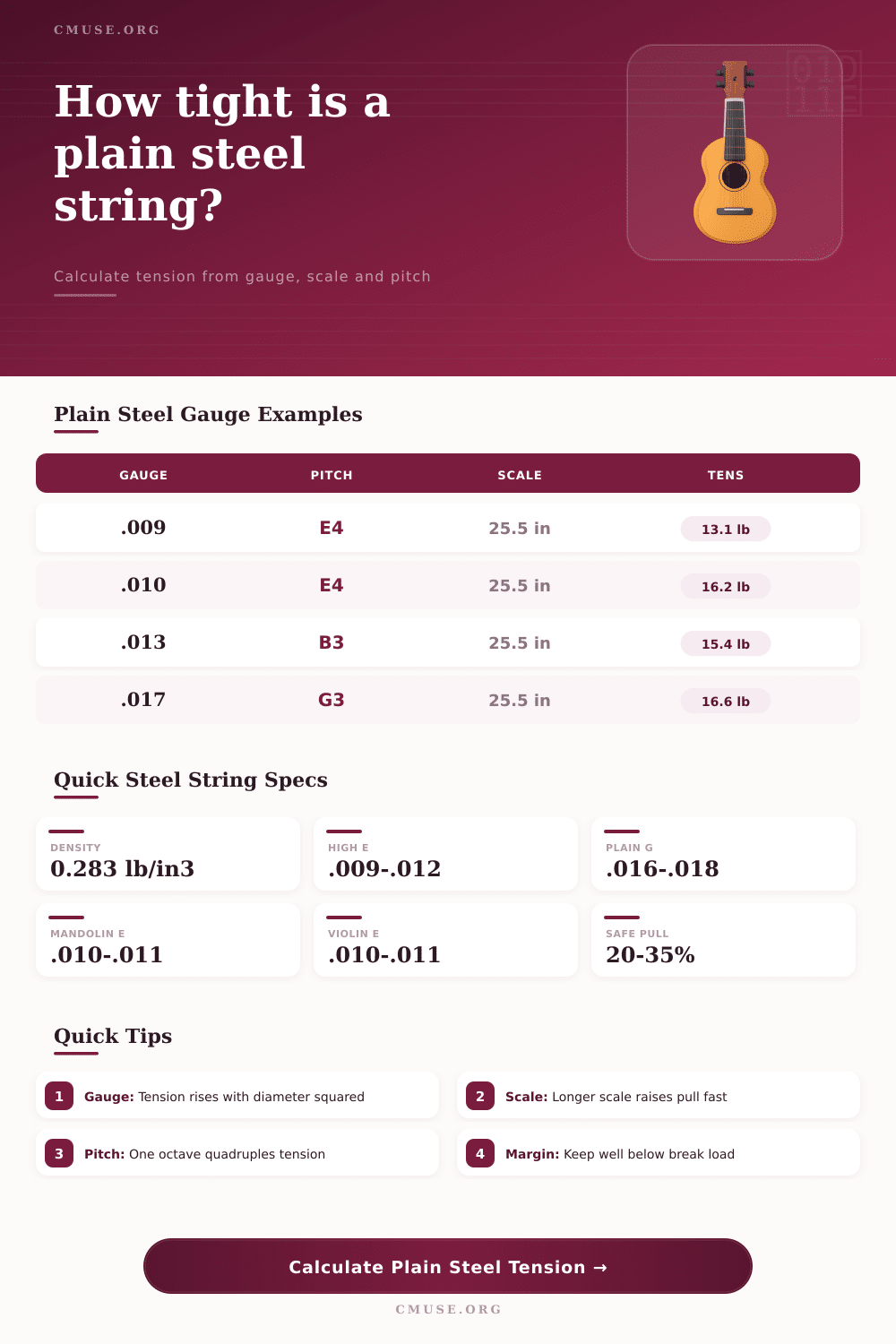
| .008 | 10.4 lb / 46 N | 5.8 lb / 26 N | 3.7 lb / 16 N | Extra light high E |
| .009 | 13.1 lb / 58 N | 7.3 lb / 32 N | 4.7 lb / 21 N | Light electric high E |
| .010 | 16.2 lb / 72 N | 9.0 lb / 40 N | 5.8 lb / 26 N | Regular electric high E |
| .011 | 19.6 lb / 87 N | 10.9 lb / 49 N | 7.0 lb / 31 N | Medium high E |
| .013 | 27.4 lb / 122 N | 15.3 lb / 68 N | 9.8 lb / 44 N | Common B string |
| .016 | 41.5 lb / 185 N | 23.1 lb / 103 N | 14.8 lb / 66 N | Light plain G |
| .017 | 46.8 lb / 208 N | 26.0 lb / 116 N | 16.7 lb / 74 N | Regular plain G |
| Note | Frequency | Common String | Gauge Range |
|---|---|---|---|
| G3 | 196.00 Hz | Electric plain G | .016 to .018 |
| B3 | 246.94 Hz | Electric B | .011 to .014 |
| D4 | 293.66 Hz | Banjo first D | .009 to .011 |
| E4 | 329.63 Hz | Guitar high E | .008 to .012 |
| G4 | 392.00 Hz | Lap steel high G | .012 to .016 |
| E5 | 659.26 Hz | Mandolin or violin E | .010 to .0115 |
| Steel Type | Density Used | Strength Used | Best Calculation Use |
|---|---|---|---|
| Music wire / plain steel | 0.283 lb/in³ | 350 ksi | Most guitar plain strings |
| High tensile piano wire | 0.283 lb/in³ | 380 ksi | Piano and zither wire estimates |
| High carbon plain steel | 0.284 lb/in³ | 360 ksi | Bright plain string estimates |
| Tinned plain steel | 0.283 lb/in³ | 330 ksi | Tin-plated acoustic strings |
| Plain stainless steel | 0.286 lb/in³ | 300 ksi | Corrosion-resistant plain steel |
| Tempered plain steel | 0.283 lb/in³ | 320 ksi | Conservative break margin |
| Preset | Scale | Gauge | Pitch | Expected Pull |
|---|---|---|---|---|
| Electric high E light | 25.5 in | .009 | E4 | About 13 lb |
| Electric high E regular | 25.5 in | .010 | E4 | About 16 lb |
| Electric plain G | 25.5 in | .017 | G3 | About 17 lb |
| Mandolin E | 13.875 in | .011 | E5 | About 26 lb |
| Violin E | 12.875 in | .0105 | E5 | About 21 lb |
| Banjo first D | 26.25 in | .010 | D4 | About 13 lb |
A plain steel string tension calculator allow you to calculate force applied to your strings. Simply input pitch, scale length and gauge and let it do the maths for you. It saves time as there is no converting or coefficients to work out yourself.
What are the numbers? Why would that be helpful? Firstly, knowing how to use a calculator on your instrument are helpful. Secondly, you must understand what those numbers represent in terms of tension and how they affect your comfort when performing. They also affects the structure of your instrument.
Why Use a String Tension Calculator?
The relationship between diameter and tension doesn’t go up in a straight line. Tension rise at a squared rate compared to diameter. That means doubling the size of string quadruples the tension. Until you experience the issue, many people overlook this occurrence. Perhaps you replace a.010 string with a.012 one. “It’s only two sizes,” you reason. Wrong. The tension on your bridge and nut change a lot. How much? The calculator show results in newtons or pounds. That helps you in making an educated decision. You will no longer break strings by mistake.
Keeping the neck relief intact on your guitar is important. This tool can help you do that.
Another source of confusion lie in the length of scale. For an equal pitch, the same gauge will be under more tension on a longer scale length. It’s simply because there is more mass vibrating over a larger area. That is why baritone guitars requires strings of heavier gauge different than regular electrics. Mandolins use much thinner wires despite playing in similar registers to violins. Using presets like violin E or electric high E on the tool shows how scale length change the balance. There is no need to learn the equation. If you have strings of equal gauge on a 25.5-inch scale it will always feel ‘heavier’ then a 24.75-inch one.
This is material science. Steel is not all the same, and material science counts. Stainless steel, piano wire and music wire has different tensile strengths and densities. These options can be selected in the calculator. A.010 inch of tinned steel differs from a.010 inch of high carbon steel. Mass per unit length is affected by density. How bright it sounds and how long it sustain. Break margin is dependent on the tensile strength. It represents your proximity to breaking the string under typical playing conditions. Most players work with tension that is typically between twenty and thirty-five percent of the string’s maximum tensile strength. That cushion prevents breakage from an unexpected bend or change in temperature.
For example, knowing your tension helps if you’re experimenting with different tunings. Or, you might be building your own guitar. Or, you might be trying to emulate one of your favorite vintage setups. In those instances, it’s best not to guess. That’s when tension matters.
If we use the standard tuning of E4 to B3 as our guide, that means there’s quite a bit less tension at the top end of the set. Many sets will actualy have a fairly steep drop-off as they climb higher up the fretboard. Balance means tension is a compromise. The strings are loose and mushy, the intonation is off. The strings are buzzing. It is tight and fights you. This cause finger fatigue and potential long-term structure damage.
Maximum tension isn’t the goal. Balanced tension provide expression without sacrificing stability. Be aware of the stress readings in the results. High numbers indicates that the metal is working harder. It can impact the tonal warmth and shorten life of your strings.
There’s a rhythm to finding the right combination. You dial in and you hear the change. Then the calculator kicks in with its base information. And then your hands and ears close the sale. It translates that abstract sensation into numbers. It allows you to quit hunting down what feels like mystery. Gauge, scale, and pitch works together. Once that becomes clear you begin making informed choices instead of guesses. String selection becomes a moddern mechanical exercise rather than a matter of taste. Management gets easy when you have the right tool for the job.
A point arrives at which the instrument just hums along happily without complaining. Each note feels conscious.