Pivot Chord Calculator
Find real common chords between two keys, rank the strongest bridge, and see how the same chord is reinterpreted as Roman numerals in both tonal centers.
🎹 Pivot Modulation Presets
🎼 Key and Pivot Inputs
| Rank | Chord | Source Roman | Destination Roman | Score |
|---|
📊 Pivot Modulation Spec Grid
🔁 Common Key Relationship Table
| Relationship | Typical Shared Triads | Pivot Character | Useful Cadence |
|---|---|---|---|
| Relative major or minor | Often 7 diatonic triads | Very smooth because both keys share a collection. | Confirm the new tonic with V or iv to V. |
| One step on circle of fifths | Usually 4 common triads | Bright and familiar, common in pop and classical phrases. | Use ii or IV in the new key before V. |
| Parallel major or minor | Few exact diatonic matches | Modal color may need borrowed-chord support. | Use a common tone plus a strong cadence. |
| Mediant or chromatic third | Usually 0 to 3 stable matches | Colorful and cinematic, but less invisible. | Give the pivot more preparation time. |
📐 Roman Function Comparison
| Destination Function | Typical Roman Numerals | Pivot Strength | Why It Works |
|---|---|---|---|
| Tonic area | I, iii, vi or i, III, VI | Stable | The new key is introduced gently before the cadence confirms it. |
| Predominant area | ii, IV or ii dim, iv | Strong | It can move directly toward V in the destination key. |
| Dominant area | V or vii dim | Direct | The old key releases quickly into the new dominant pull. |
| Color area | III, VI, VII or modal variants | Variable | The color can be expressive but may need a clearer cadence after it. |
🎚 Chord-Depth Comparison
| Compare Mode | Intersection Rule | Best Use | Tradeoff |
|---|---|---|---|
| Triads only | Root, third, and fifth must match. | Clear chorale, pop, and hymn-style modulation. | Can hide seventh-color possibilities. |
| Sevenths only | Four chord tones must match. | Jazz, late Romantic, and richer harmonic plans. | Fewer exact matches are available. |
| Triads and sevenths | Both chord families are searched. | Exploration when you want multiple pivot options. | Rankings may favor stable triads. |
| Diminished included | Diminished and leading-tone chords are kept. | Tense pivots and dominant-adjacent motion. | Often needs careful resolution. |
A pivot chord is any chord that exist in two different keys simultaneousy. This type of chord function as a normal chord within the first key. However, this same chord can also work as a useful chord in the second key.
Because pivot chords work in two different keys, it create a sense of smoothness in the transition between the two keys. Composers utilize pivot chords to create smooth transition between keys in their compositions. Songwriters use pivot chords to ensure that key changes dont seem sudden and unwarranted within a song.
How to Use Pivot Chords to Change Keys
The effectiveness of pivot chords depend on how well they work in the first and second key. Some pivot chords are nearly invisibly because they are close to the tonic for both keys. However, some pivot chords push the music forward toward a new dominant chord.
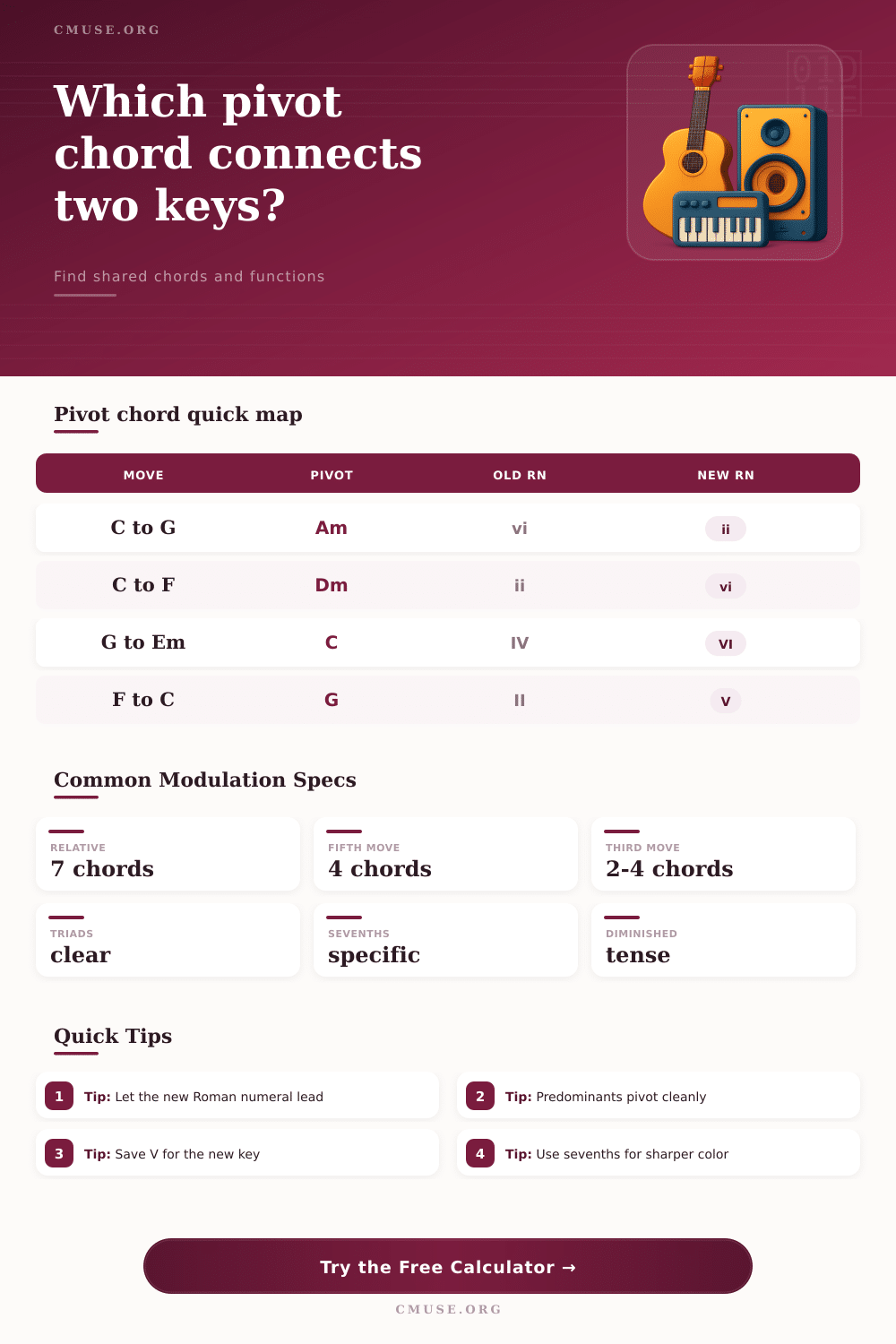
A chord calculator can help songwriters determine the pivot chords between two keys. To use a pivot chord calculator, a songwriter must choose the two keys, the chord depth, and the cadence goal for the song. One example of a pivot chord is using an A minor chord to move from C major to G major.
The A minor chord is the vi chord in C major. However, it is the ii chord in G major. The reinterpretation is small enough that it feels natural for the song.
However, it is strong enough to set up a cadence for the new key. When you use a chord calculator to determine a pivot chord between C major and G major, if you choose an authentic cadence goal, the calculator will highly rank the A minor chord if you select predominant function for the new key. However, if you select a plagal cadence for the new key, the calculator will highly rank a different chord.
The distance between the two keys determine the number of pivot chords available to a songwriter. For keys that share many of the same triads because they are close on the circle of fifths, there will be a long list of pivot chords that can be used. When the keys are close on the circle of fifths, the song will have a sense of gentle modulation between the two keys.
For keys that are farther apart on the circle of fifths, there are fewer triad in common between the two keys. For these instances, a seventh chord or a diminished chord will have to be used. The chord calculator can show the songwriter these difference in the available pivot chords when the songwriter manipulates the depth of the chords and the diminished chord toggle.
The calculator will return fewer results if you use the strict triad-only search instead of the “both” setting. While the calculator will suggest the candidates with the best stability in either case, there will be more candidates returned using the “both” setting. The length of the phrase that is to be used in the pivot will also impact the results of the calculator.
For instance, a four-bar preparation that uses one chord per bar will allow the listener to process the reinterpretation of the pivot chord before it reach the cadence. A preparation that is too short may make the placement of the pivot chord seem rushed. A preparation that is too long may make the pivot chord lose momentum as the listener approaches the cadence.
The calculator will account for these timing decision when it suggests the best pivot chord for that phrase length. Even with several good option for pivot chords from the calculator, the context of the piece will influence the decision on which chord to use. For instance, if the melody include one or more emphasized notes, that will influence the type of pivot chord that is used.
The same is true of the arrangement of the chord in the piece; if more color is needed, a seventh chord pivot may be better than a triad pivot chord. These considerations can use the reference table on the page to determine what type of chords will work within those contexts. A common mistake in determining the pivot chord is to use the new dominant chord as the pivot chord.
If the pivot chord is the dominant of the new key, then the listener’s ear will experience an abrupt change in key. A better approach is to leave the pivot chord within the predominant area of the key, and instead use the new dominant chord later in the phrase. Another common mistake is to ignore the function that a chord have within the old key; a chord that is functional within the new key may work jarringly within the old key.
The dual Roman numeral notation will help a composer to catch this issue. The last recommendation is for the composer to test the determined pivot chord by playing the progression. Source key chord(s) should be played, followed by the pivot chord, followed by the destination key cadence.
If the ear accept the reinterpretation of the pivot chord, it is successful. However, if it seems like two separate section of the song, then a different pivot chord should be used, or the preparation length for the pivot chord should be adjusted. While the calculator has narrowed the options for pivot chords, the composer should of make the final decision regarding the sound in the room when the chord is played.