Pitch To Tension Conversion Calculator
Convert a target note into string tension using scale length, gauge, material density, construction factor, cents offset, and A4 reference pitch.
🎯 Pitch And Instrument Presets
⚙ Pitch To Tension Inputs
Calculation Breakdown
📊 Live Conversion Cards
🎼 Instrument Comparison Grid
📈 Pitch, Tension And Frequency Tables
| Pitch Step | Note | Frequency | Tension | Tension Ratio |
|---|---|---|---|---|
| Calculate to fill the pitch table. | ||||
| Gauge | Material Basis | Frequency | Estimated Tension | Feel Reading |
|---|---|---|---|---|
| Calculate to fill the gauge table. | ||||
| Scale Example | Scale Length | Same Pitch | Tension | Vs Current |
|---|---|---|---|---|
| Calculate to compare scale lengths. | ||||
| Reference String | Pitch | Frequency | Typical Gauge | Typical Tension |
|---|---|---|---|---|
| Calculate to fill reference strings. | ||||
💡 Practical Tension Tips
That’s what happens when you pick up a new set of strings and notice that the guitar is different. The action has changed, the neck bow more. What was that crisp intonation you set up? It is gone. It is not magic. It is physics. Something have changed with the tension pulling on the instrument and your ears have noticed.
Most players will tune down or change gauges without thinking, which changes the structural load. Or you can calculate, or guess. After entering the gauge and scale length into the calculator above, it do the rest for you. No need to do the math and figure out the conversions or coefficients yourself.
How String Tension Works
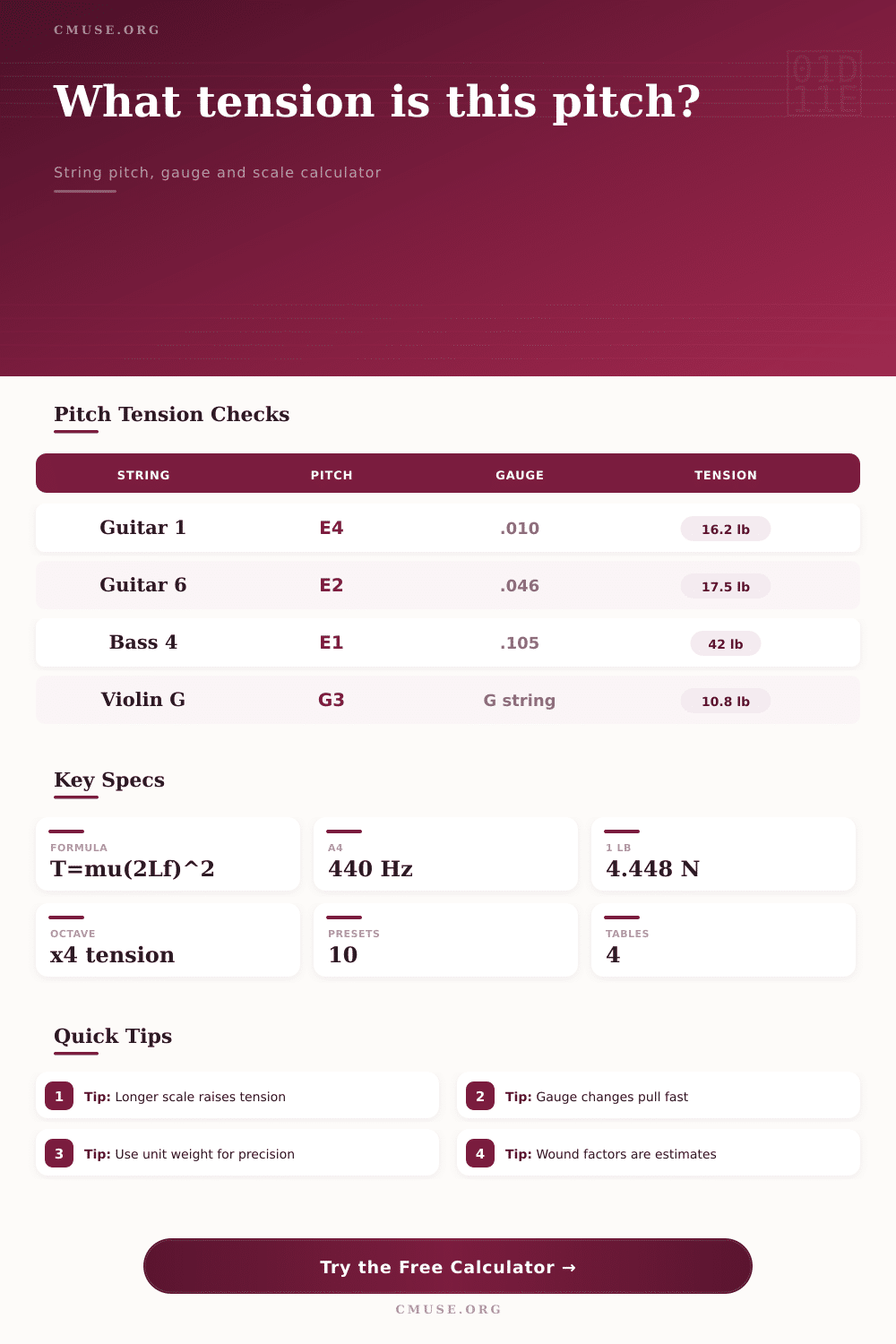
The basic formula is this: Tension = Linear Mass Density * (Frequency^2) * (Scale Length)^2. That second part is what makes it tricky. The squaring of the terms mean that a small adjustment in length or pitch result in a big swing in tension.
For example, when you go down a whole step, you might naturaly reason that the string becomes somewhat loose. It actualy goes way down. Going up an octave, however, requires four times the tension. While people considers tension as a linear slider, it’s actually an exponential curve.
Strings are not all alike, the type of material make a difference. A nickel-wound string is not the same than a plain steel string of equal diameter. Effective mass per inch change based off wrap construction. You can change this shape’s build factor in the tool.
Strings used in wound form aren’t solid cylinders. It has a core wire, air gaps, and an outer wrap. Your estimate of their density will be a ballpark figure. Getting precise is getting the manufacturer’s unit weight. That distinction are the difference between a setup that holds and one that drifts.
With diameter, you estimate, with weight, you verify.
The focus is on scale length. Electric guitars has a relatively short scale compared to a baritone guitar. Even with similar gauges, the strings is stretched over a much greater distance on a baritone, which increases tension significantly. Switching between a standard and short-scale bass without changing strings will result in sky-high string tension. Neck-snapping time.
Fortunately, the reference tables does this well. They illustrate how a single parameter can affects tension ratio when other factors remain unchanged. This is powerful stuff for seeing trade-offs before buying new strings.
The offset is in cents. A lot of folks don’t notice this one. By using a capo or by tuning to another key, you change the pitch slightly. Those cents do add up. Positive offset mean higher tension and higher frequency. Negative offset is just the opposite. You can enter those fine adjustments into the calculator.
You have an idea of exactly how much pull you’re putting on those bridge pins. They are small, yes but important when considering neck relief consistency and accurate intonation. You can’t rely on your feelings alone either: You know a note is sharp because you hear it. You don’t know if the bridge just lifted off the body. It would of been smart to check the tension values.
You want a balanced set of strings. Uneven string tensions are going to make it feel weird to play, this might even cause uneven wear on the frets. What you’re looking for is a cohesive pull across all six string. And the tool will help you get there.
Tweak the material or gauge until the tension numbers match up with what you want the instrument to feel like. It is a balancing act between a brighter sounding string and the practicality of what a guitar can handle. Make it too tight and the neck bows out; make it too slack and the note buzzes.
What you want doesn’t matter to mathematics, but math have limits. With some knowledge of length, mass, and frequency, you won’t be guessing anymore. You’ll begin to build. The next time you change strings, you’ll know what happened and how to correct it.