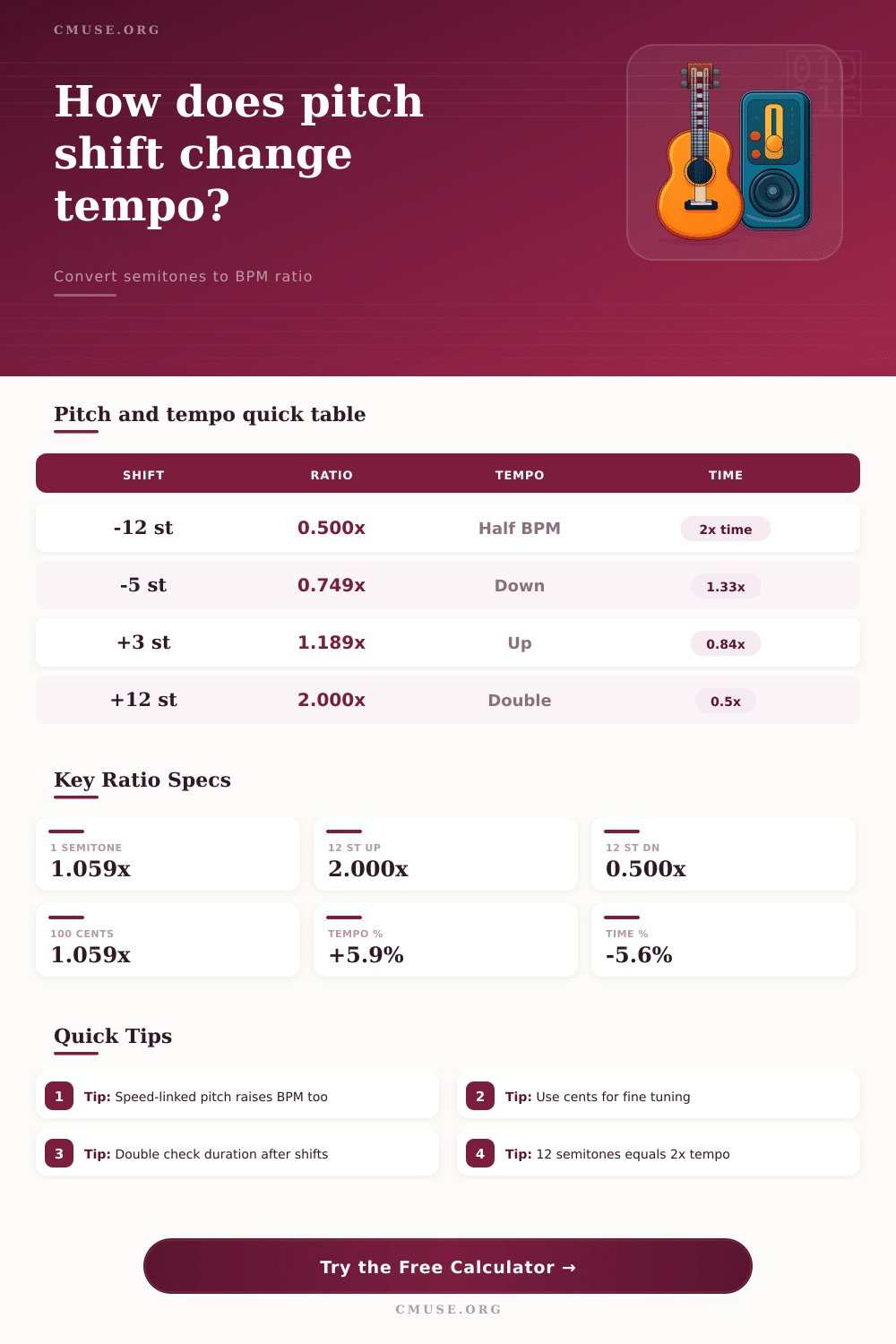
Pitch to Tempo Calculator
Convert pitch shifts into BPM, speed ratio, and duration changes when playback speed and key move together.
🎵 Quick Presets
📈 Inputs
📊 Ratio Grid
📐 Reference Tables
| Shift | Ratio | Tempo | Time |
|---|---|---|---|
| -12 st | 0.500x | Half BPM | 2x time |
| -5 st | 0.749x | Down | 1.33x |
| +3 st | 1.189x | Up | 0.84x |
| +12 st | 2.000x | Double | 0.5x |
| Source BPM | Shift | New BPM | Use |
|---|---|---|---|
| 90 | +3 st | 107.0 | Lift chorus |
| 100 | +1 st | 105.9 | Small rise |
| 120 | -3 st | 100.8 | Loose groove |
| 140 | -12 st | 70.0 | Half speed |
Pitch and tempo maybe sound like the same thing but in music they are actually two different ideas. Tempo simply points the speed at which you play the bit, while pitch relates to the height of the sounds, whether they are high or low. Those vibrations travel through the air, reach our ears, and we hear them as pitch.
The ear of people perceives frequency of around 20 until 20,000 cycles each second (measured in Hertz).
Pitch and Tempo: What Is the Difference
Here the key difference: those two elements operate separate from each other. Pitch measures the frequency of note in Hertz, on the other hand tempo estimates in beats per minute, or BPM. Slow song in half, and the pitch stays unchanged.
Alter the pitch upward or down, and the tempo does not move (unless you use effects for pitch-shifting). They do not depend on each other. Think like this: pitch points whether sound is high or low, while tempo says if the game is fast or slow.
Technology simplifies the game with pitch and tempo meastre. Musicians commonly slow bit to learn song, copy parts or simply follow what happens. There are many free websites with tools that allow you to move the pitch of song up or down for practice.
Many apps have sliders to set the key and BPM easily.
Lot of that magic happens by means of granular synthesis. The sound digs in little bits that repeat (for slowdown) or jump (for boost). Like this you strain or compact time without altering pitch.
Hence time stretching commonly sounds weird and wrong, because of those repeated fragments. Most of programs for audio address tempo without touching pitch.
In Audacity under Effect you find Pitch and Tempo with several options: Change Pitch, Change Speed and Pitch, Change Tempo, Paulstretch and Sliding Stretch. For copy use Change Tempo. Note: if you introduce 44.1 kHz file in a session in 96 kHz, it will sound faster and higher, simply because of sample rate conversion.
Classical bits mark tempo by means of words as Largo (very slowly, 42 (66 BPM) or Andante (walking), 56, 88 BPM). Allegro go more quickly in 84… 144 BPM, Presto even more in 100, 152 BPM.
Modern writers commonly simply write BPM, omitting Italian terms. Electronic dance music almost always uses BPM. Interesting fact: semitone upward in DAW match around +7 BPM, and vice versa for pitchdrops.