Pickup Output Ratio Calculator
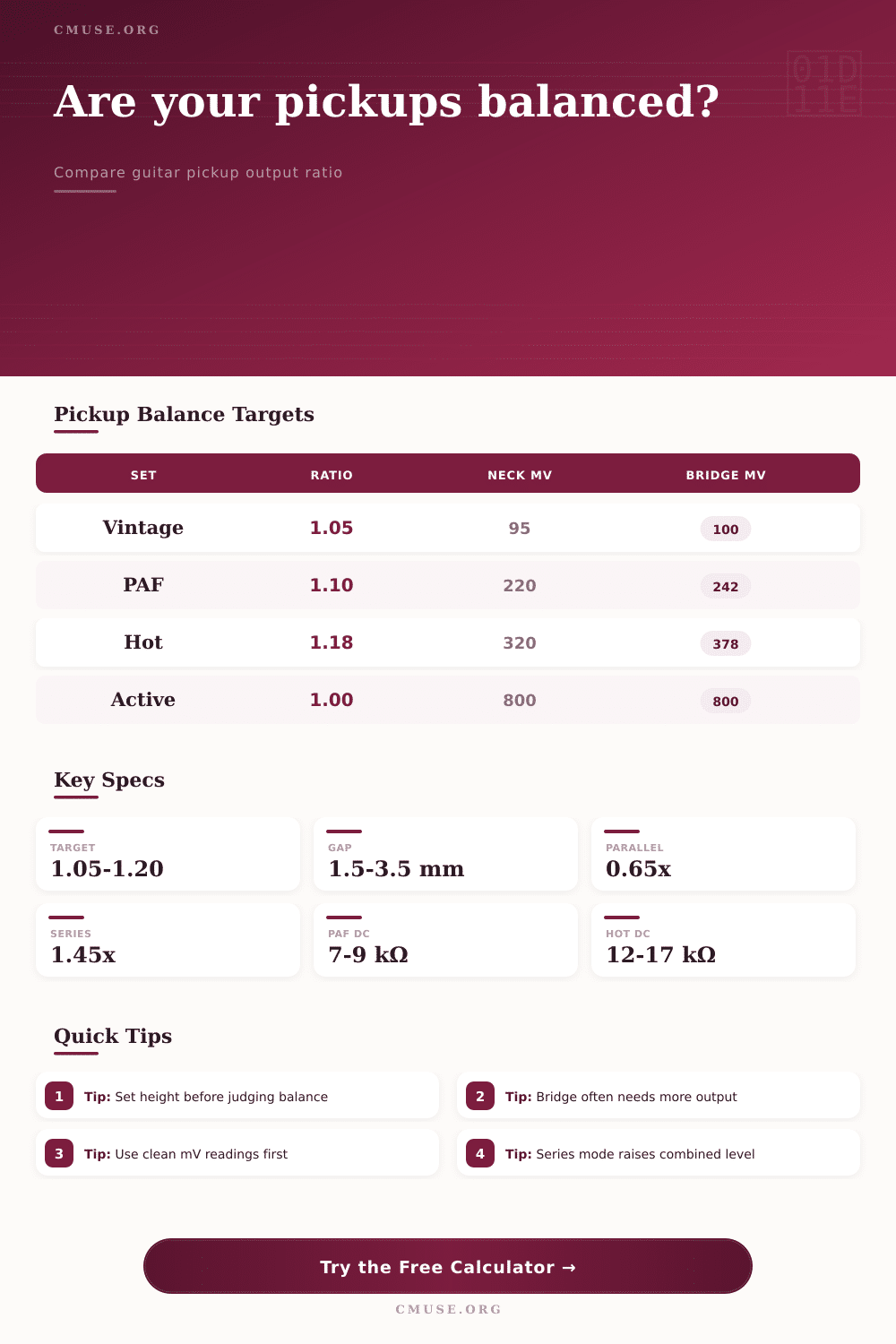
Compare neck and bridge pickup output after mV rating, DC resistance, magnet type, height gap, and series or parallel wiring are considered.
Pickup Balance Results
| Magnet | Relative Strength | Typical Feel | Balance Note |
|---|---|---|---|
| Alnico 2 | 0.94 | Soft attack, sweet mids | Often lets bridge sit closer without harshness |
| Alnico 3 | 0.90 | Low pull, airy highs | Useful for loud neck positions |
| Alnico 4 | 0.98 | Even response, clear mids | Good neutral pair reference |
| Alnico 5 | 1.00 | Firm lows, bright top | Common baseline for output comparisons |
| Alnico 8 | 1.08 | Strong mids, high push | Can make bridge dominate quickly |
| Ceramic | 1.12 | Tight attack, high output | Usually needs careful bridge height |
| Pickup Family | Common mV Range | Common DC Range | Ratio Starting Point |
|---|---|---|---|
| Vintage single coil | 80–140 mV | 5.5–6.8 kΩ | 1.05 bridge-to-neck |
| Tele bridge pair | 90–180 mV | 6.0–9.5 kΩ | 1.10 to keep bridge present |
| P90 pair | 150–260 mV | 7.0–10.5 kΩ | 1.08 for even switching |
| PAF humbuckers | 190–300 mV | 7.0–9.5 kΩ | 1.10 classic balance |
| Hot passive humbuckers | 320–550 mV | 12–17 kΩ | 1.15 for lead authority |
| Active pickups | 650–1000 mV | Low output impedance | 1.00 if preamps are matched |
| Target Ratio | Best For | Switching Result | Height Strategy |
|---|---|---|---|
| 1.00 | Active sets, studio clean levels | Neck and bridge stay level | Use similar final gaps |
| 1.05 | Vintage single coils | Bridge is slightly more present | Lower neck if it blooms too much |
| 1.10 | PAF and classic mixed sets | Bridge leads without a jump | Raise bridge or lower neck moderately |
| 1.15 | Rock humbuckers and HSS guitars | Bridge has a clear lead lift | Check clean tone before going closer |
| 1.20 | Hot bridge, high-gain rhythm | Bridge intentionally dominates | Watch magnetic pull below 1.5 mm |
| Mode | Output Estimate | Resistance Estimate | Use Case |
|---|---|---|---|
| Individual comparison | Reads each pickup alone | Neck and bridge separate | Best for pickup height balancing |
| Parallel blend | About 65% of summed mV | Product over sum | Standard middle position clarity |
| Series blend | About 145% of average mV | Neck plus bridge DC | Louder, thicker combined tone |
| Split coils parallel | About 48% of summed mV | Lower apparent combined DC | Humbucker split balance checks |
| Preset | Neck / Bridge mV | DC Pair | Typical Goal |
|---|---|---|---|
| Vintage Strat Set | 100 / 112 mV | 5.9 / 6.3 kΩ | Mild bridge lift with Alnico 5 |
| PAF Humbuckers | 220 / 250 mV | 7.6 / 8.4 kΩ | Classic 1.10 bridge-to-neck balance |
| HSS Balance Check | 120 / 360 mV | 6.1 / 14.2 kΩ | Keep bridge useful without a harsh jump |
| Active Modern Set | 780 / 800 mV | Preamp / Preamp | Nearly even switching level |
If you have decent equipment but still notice that volume decreases significantly upon moving from the bridge pickup to the neck pickup, it’s likely just a result of those strings vibrating over a wider surface area closer to the neck. That’s not necessarily bad. Just know that there will be a mismatch in sound between the bridge and neck pickups as a result off that naturaly occurrence.
Once you measure something and enter it into the calculator (above), it do all the math for you. You don’t have to guess anymore: Is this normal? Or is my guitar set up wrong? The base number is raw output voltage but that may not tell whole story. When you plug in and strum clean, you’ll have a number, which is raw power per coil. But just voltage doesn’t takes into consideration how the pickups will interact with other components in your guitar’s electronics system. It doesn’t consider DC resistance either, which tend to correspond to amount of wire wrapped around magnet. More wire equals greater output with a loss of high sounds. So those two figures together show better picture.
How to Fix Volume Problems with Guitar Pickups
Maybe your bridge humbucker registers 20mV higher than the neck but it’s much more resistive. That could still result in a tonal imbalance toward the bass side of things even if the voltage figure is higher. That helps distinguish that so you’re not running down rabbit holes following numbers that aren’t translating to what you hear in your ears.
The other part of this equation that’s quieter but always present is magnet type. Ceramic versions has more output potential and tighter attack while Alnico five produces a firmer midrange punch. These materials change basic expectation for balance as can be seen in the reference table on the page. Combining a classic style neck pickup with say, an Alnico two magnet alongside a newer bridge pick up with ceramic bars will result in a tricky balancing act no matter what height you use.
The strength of magnetic field changes amount of pull on the strings and sustain, which indirectly affects the consistency of output. To further complicate things if the hotter pickup is too low, it may choke the strings, particularly on lighter gauge string where you’ll notice some magnetic drag as you bend the strings. But the most useful lever to address imbalance is height.
By simply bringing a pickup nearer to the strings, the output will increase much faster: tiny increments towards the lower end result in huge differences. In the most extreme examples, half a millimeter can make it sound like a completly different pickup. If you’re after a slightly more rock tone from the bridge or vintage evenness across, the tool provides recommended gap adjustments to match.
For most players, a modest lifting of the bridge addresses how naturaly strings lose amplitude toward the end of the neck. Without a boost, the bridge often sound quieter and thinner then the warm sound of the neck. But what about when you hit middle spots? Those are where wiring types matter. Series wiring thickens the tone and increases headroom; parallel wiring cleans up signals nicely but reduces total volume. This calculator shows you how those combinations impact overall output level, so you can anticipate a smooth transition or a jarring dip in volume depending on your switch position.
Also, many new guitars comes equipped with coil splitting capabilities which halves the effective resistance and will also change frequency response. If you know the impact this has on the ratio, you can determine if it’s worth of to mod your gear for this option or just tweak the height accordingly to remedy the issue.
Getting pickups balanced takes accurate measuring and some patience, but the instant gratification is the comfort of playing. It’s less about control knobs and more about tone. Test at clean settings so you don’t have levels covered up by drive pedals. Adjust incrementally in small amounts; then listen again for changes before moving on. The day you find neck and bridge talking in equal voice, you’re not trying to figure out your guitar anymore, it just works. That’s the difference between good and great setups; technical information turns into musical flow.