Pickup Measure Beat Calculator
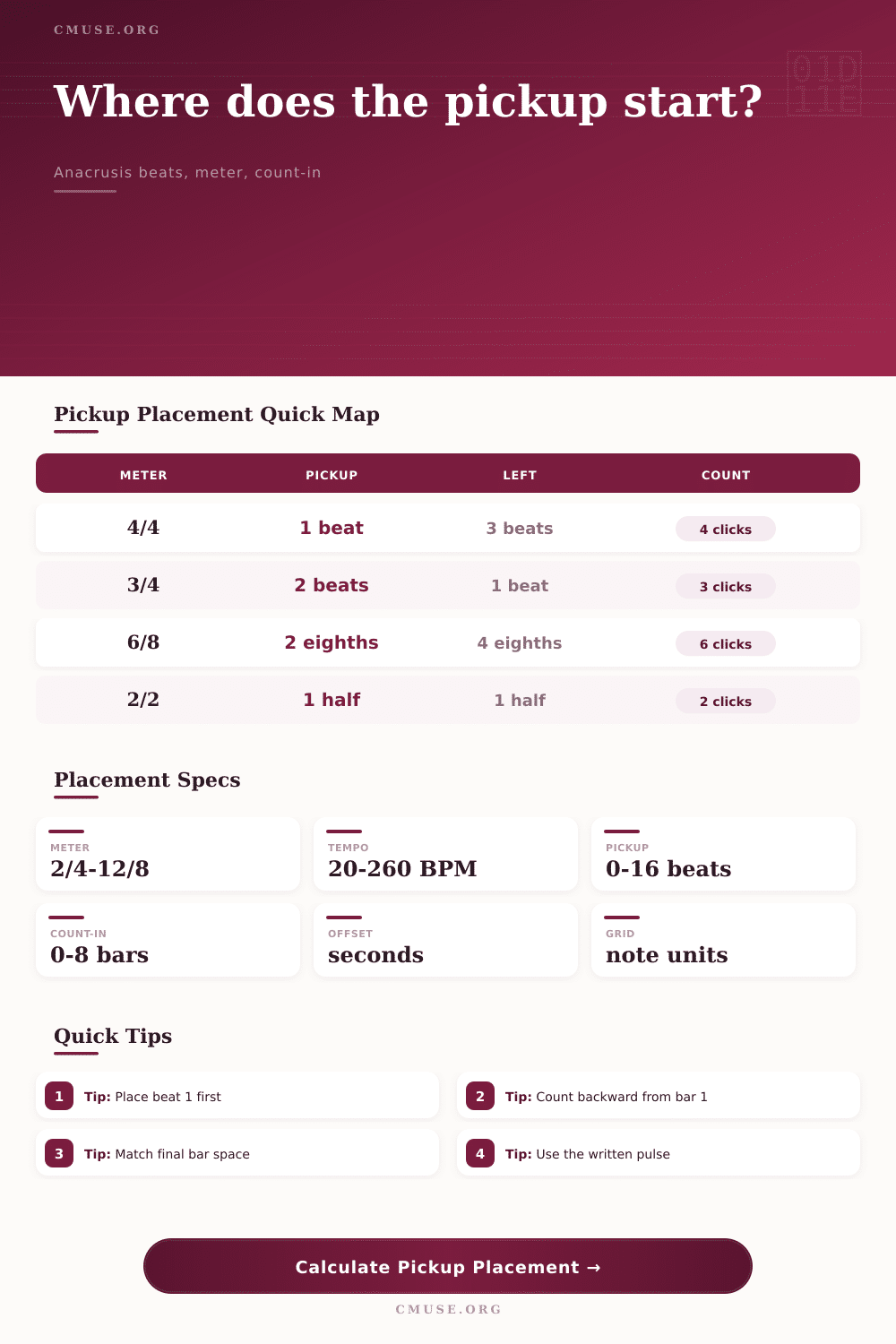
Place an anacrusis exactly before the first full downbeat, convert it into written beats and seconds, and check the matching remainder of the opening or closing bar.
Preset use: Load a common score situation, then adjust the pickup note value, meter, BPM pulse, count-in and rehearsal-start setting for your chart.
Placement Breakdown
4/4
Meter
625 ms
Written beat
25%
Pickup of bar
75%
Remainder
| Meter | Common pickup | Remaining beats | Placement idea |
|---|---|---|---|
| 4/4 | 1 quarter note | 3 quarter beats | Start on beat 4, then land on the next downbeat. |
| 3/4 | 2 quarter notes | 1 quarter beat | Start on beat 2 when the melody lifts into a waltz downbeat. |
| 2/4 | 1 eighth note | 3 eighth notes | Often a short folk or reel lift just before the first bar. |
| 2/2 | 1 half note | 1 half beat | March and hymn notation often balance as half-bar plus half-bar. |
| 5/4 | 1 quarter note | 4 quarter beats | Place the pickup before the grouped accent pattern, not inside it. |
| Meter | Felt pulse | Pickup notation | Count-in choice |
|---|---|---|---|
| 6/8 | 2 dotted-quarter pulses | 1 or 2 eighth notes | Use six written clicks for precision or two dotted clicks for feel. |
| 9/8 | 3 dotted-quarter pulses | 3 eighth notes | A full dotted pulse pickup leaves six written eighths. |
| 12/8 | 4 dotted-quarter pulses | 3 eighth notes | Often feels like a one-pulse vocal lead into the bar. |
| 3/8 | 3 eighth pulses | 1 eighth note | Short entries usually need every written click counted. |
| 7/8 | Grouped eighths | 2 or 3 eighth notes | Count the pickup against the chosen 2+2+3 or 3+2+2 grouping. |
| Situation | Suggested count | Pickup handling | Best use |
|---|---|---|---|
| Solo vocal pickup | 1 full bar plus breath | Let the singer hear the pickup beat internally. | Studio tracking and rehearsal starts. |
| Large ensemble | 2 full bars | Count through the pickup so the first full bar locks. | Choir, band and orchestra reading. |
| Click track intro | Exact pre-roll bars | Place the pickup before the first arranged downbeat. | DAW sessions and live playback rigs. |
| Fast compound meter | Dotted pulse plus subdivision | Give the big beat, then the written pickup ticks. | 6/8, 9/8 and 12/8 starts. |
| Theater cue | Prep beat plus count | Keep the cue word before the pickup attack. | Entrances under dialogue or movement. |
| Notation method | What it shows | How to calculate | When to choose it |
|---|---|---|---|
| Pickup before bar 1 | Anacrusis is unnumbered | Pickup beats sit before the first numbered downbeat. | Lead sheets, hymns and most classroom notation. |
| Bar 0 pickup | Pickup has its own label | Bar 0 length equals pickup beats; bar 1 starts after it. | DAW markers, rehearsal letters and click programming. |
| Partial bar 1 | First bar is incomplete | Remaining beats complete the notated bar total. | Some engraving workflows and imported MIDI grids. |
| Balanced final bar | Last bar fills the missing space | Final bar beats equal meter beats minus pickup beats. | Traditional notation when repeats return to the pickup. |
| Counted pre-roll | Clicks precede the pickup | Count-in beats plus pickup duration define entry offset. | Recording, live playback and ensemble count-offs. |
That’s the particular panic moment as conductor lifts their baton and we’re all looking at the page waiting for them to signal us into action but nobody moves…yet. Yes you know what I’m talking about. With those incomplete bars leading up to the first proper downbeat. The pickup measure that starts the music…
The math become blurry. What is actual count in? How many more beats do we need in last bar to make it even? Most musicians naturaly know how to feel it. But if you are attempting to cue a large group of player or programme a click track, that natural feeling require a grid. That’s why this tool can be very helpful for making sure the timings matches. What we’re doing here is letting the calculator do all of the work for us and translate those abstract note values into actual beat counts and seconds.
Understanding Pickups and Timing
Given your chosen meter and tempo, it will tell you precisely how many seconds that upbeat last. More importantly, it can calculates the remaining parts of opening and closing bars. Why is this important? Because there’s a rule about notation. If you begin a piece on a partial bar then you need to end on one as well. The total length of the pickup plus the concluding partial bar has to be equal to a complete measure. In other words, if you’ve got a two-beat pickup at the beginning of a 4/4 phrase, then closing needs to be three beats to complete the loop. Mess up on this and not only will the phrase shape be ruined but the feeling of repeat section will seem lopsided.
To read it, you must understand its input. What is your pulse? When your metronome displays a 120 BPM, does that mean one hundred twenty eighth-notes per minute or sixty quarter notes? Or maybe it’s a dotted quarter note pulse in 6/8 or 12/8 time? It may sound silly, but that’s why there is such an emphasis on understanding how a pulse can differ from a written measure of music. That’s also where most timing discrepancy arise when people try to record together.
The tool allow you to state specifically which note value receives the pulse so that the number of seconds the metronome shows corresponds with what performers are hearing. Let’s think about a more practical use: tracking a song in a digital audio workstation. You can’t just hit “record” and then press play and expect everybody to hear the same imaginary starting place. You need a count-in that syncs with your grid. This is where the entry offset come into play. The calculator provides an entry offset, telling you exactly how many seconds to back off from first downbeat. It will help you plan the click track as well. Will there be a click for each written subdivision or only on main pulses? In an intricate odd meter such as 7/8 or 5/4, this can make difference between a tight performance and a confused one.
The page includes a reference table laying out some of these common scenarios so you have an idea of what to expect from the standard presets before customizing them. Knowing exactly when each second has begun is important because human beings rarely have machine-perfect timing. That’s where this tool come into play. If you’re rehearsing with a live band, the bandleader or conductor will use their calculation to provide visual cues; they might tap three beats of silence before the pickup begins. But if they’ve miscalculated the amount of prep time then it land too soon, or too late on the downbeat. The tool accounts for these additional prep beats by adding them to the timeline so you can correctly calculate your rehearsal count.
It fills the space between static sheet music and the dynamic world of performance reality. Pickups has a psychological element too. You can anticipate something if the pickup is long; it may be abrupt if the pickup is short. Try changing length of the pickup in the tool and observe the change in percentage of bar. Half way through a measure feels very different than a pickup on just a quarter note. The visual feedback guides the arranger or composer on what is best for the song. This turns a theoretical idea into a real decision about tension and release in music.
Basically, it is about the time we share as musicians. If you’re a section leader in an orchestra, or perhaps singing a solo part and need to record just the vocal line, then everyone must be in agreement about where beat one occur. And thanks to some math, they can. Clearing up the balance of the final bar and its offset removes any ambiguity during the performance. Next time you encounter a challenging anacrustus, listen with the numbers in mind as they will lead you back into the grid. It’s the part most of us miss but which holds the ensemble together.