🎹 Piano Transpose Calculator
Instantly find any transposed note, chord, or key — shift up or down by semitones
| Interval Name | Semitones | Example (from C) | Musical Use |
|---|---|---|---|
| Unison | 0 | C → C | Same note |
| Minor 2nd | 1 | C → C# | Half step, tension |
| Major 2nd | 2 | C → D | Whole step |
| Minor 3rd | 3 | C → Eb | Minor chord root |
| Major 3rd | 4 | C → E | Major chord root |
| Perfect 4th | 5 | C → F | Subdominant |
| Tritone | 6 | C → F# | Dissonance |
| Perfect 5th | 7 | C → G | Dominant, power chords |
| Minor 6th | 8 | C → Ab | Chromatic color |
| Major 6th | 9 | C → A | La in solfege |
| Minor 7th | 10 | C → Bb | Dominant 7th |
| Major 7th | 11 | C → B | Leading tone |
| Octave | 12 | C → C | Same note, higher |
| Key | Sharps / Flats | Relative Minor | Enharmonic |
|---|---|---|---|
| C Major | 0 | A Minor | — |
| G Major | 1# (F#) | E Minor | — |
| D Major | 2# (F#,C#) | B Minor | — |
| A Major | 3# | F# Minor | — |
| E Major | 4# | C# Minor | — |
| B Major | 5# | G# Minor | Cb Major |
| F# Major | 6# | D# Minor | Gb Major |
| F Major | 1b (Bb) | D Minor | — |
| Bb Major | 2b | G Minor | — |
| Eb Major | 3b | C Minor | — |
| Ab Major | 4b | F Minor | — |
| Db Major | 5b | Bb Minor | C# Major |
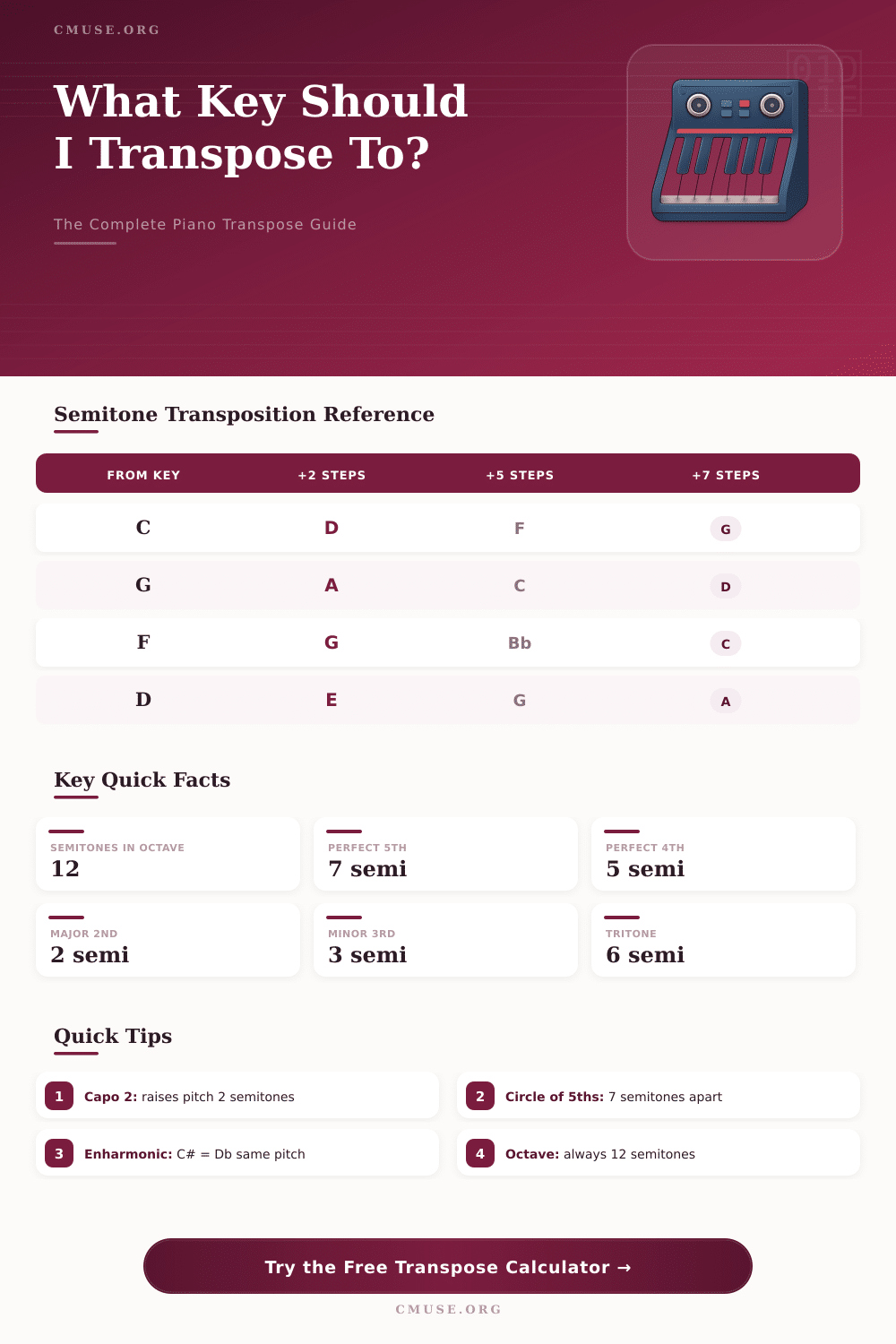
| From Key | +2 (Major 2nd) | +5 (Perfect 4th) | +7 (Perfect 5th) | -2 (Down 2nd) |
|---|---|---|---|---|
| C | D | F | G | Bb |
| D | E | G | A | C |
| E | F# | A | B | D |
| F | G | Bb | C | Eb |
| G | A | C | D | F |
| A | B | D | E | G |
| B | C# | E | F# | A |
| Bb | C | Eb | F | Ab |
| F# | G# | B | C# | E |
| Instrument | Key | Written vs Sounding | Semitones to Add |
|---|---|---|---|
| Piano / Guitar | C (Concert) | Same pitch | 0 |
| Trumpet | Bb | Sounds Major 2nd lower | +2 |
| Clarinet (Bb) | Bb | Sounds Major 2nd lower | +2 |
| Tenor Saxophone | Bb | Sounds Major 9th lower | +2 (+octave) |
| Alto Saxophone | Eb | Sounds Major 6th lower | +9 |
| Baritone Saxophone | Eb | Sounds Major 13th lower | +9 (+octave) |
| French Horn | F | Sounds Perfect 5th lower | +7 |
| Soprano Saxophone | Bb | Sounds Major 2nd lower | +2 |
| English Horn | F | Sounds Perfect 5th lower | +7 |
| Clarinet (Eb) | Eb | Sounds Minor 3rd higher | -3 |
Piano Transpose is a useful tool that allows a musician to take a piece and move it to another tone. In a piano set to equal tuning the piece usually needs only some steps up or down to fix the pitch. It seems easy but there are much more than only some signs for emotional notes.
Modern pianos commonly Piano Transpose the tone automatically by means of simple pressure on a key. Some musicians prefer a keyboard with a separate button for transposition instead of a complex internal system. Going up five half steps and going down six can reach all versions of the original tone.
How to Change a Song’s Key on the Piano
For instance, if the piece is in C middle, up five half steps bring C#, D, D#, E and F, while down six half steps cover B, Bb, A, G and G#.
Also files can be changed by means of any number of half steps up or below, or made more slow or faster according to wanted amount. Online there are programs that allow a user to choose the number of half setps for the motion, later enter names of chords to receive all of them entered according to the chosen distance. Such a tool fits to also transpose directly to a certain tone, and itself counts the original tone.
Thinking about scale degrees is a fast way to Piano Transpose. When one knows a progression of chords as one, six, two, five, and those scale degrees count in every tone, the next chord never needs to bee guessed. That practice does not even need a piano.
One can do it anywhere.
In jazz, Piano Transpose moments are quite a lot used skill and a good method for work with mapping of chords. For classical music, on the other hand, it will be much more extra. Some classical piano players do practice transposition of simple pieces to understand the structure of pieces.
Professional players must Piano Transpose from sight, because they maybe will have to change tone right away to fit different singers. Transposing pieces up or below by means of some half steps can give them fresh character and interesting effects in various sounds and intervals between notes.
Chromatic transposition is more hard on piano than on guitar. The piano is a non-transposing instrument, which means that a written C sounds truly as C. Guitar notes usually are written an octave higher than they truly sound in concert, compared to piano. Because of that, when the same chords play on both instruments, you do not need to Piano Transpose guitar chords for piano.
Some piano players strengthen them by doubling notes, so that theysound more like guitar.
Programs like MuseScore Piano Transpose automatically by means of a menu. Notation editors can transpose uploaded pages of music to any tone and export as MusicXML. When a program transposes according to a circle of fifths automatically, it sometimes adds many natural signs.
Mechanical transposition of piano that moves down a fixed distance sometimes causes a dirty sound, so rearranging such parts to preserve the chord but play more highly on the keyboard can help avoid confused hearing impressions.