🎹 Piano String Tension Calculator
Calculate exact string tension for any piano string — treble, mid, or bass
| Note | Freq (Hz) | Gauge (mm) | Tension (lbs) | Tension (N) |
|---|---|---|---|---|
| A4 | 440.00 | 0.90 | 128.5 | 571.7 |
| C4 (Mid C) | 261.63 | 1.05 | 138.2 | 614.9 |
| G3 | 196.00 | 1.20 | 144.6 | 643.4 |
| C3 | 130.81 | 1.40 | 149.3 | 664.2 |
| F2 | 87.31 | 1.70 | 155.8 | 693.1 |
| A1 | 55.00 | Wound 2.2 | 162.4 | 722.4 |
| E1 | 41.20 | Wound 3.0 | 170.1 | 756.7 |
| A0 | 27.50 | Wound 4.5 | 178.6 | 794.5 |
| Piano Type | Scale Length (in) | Scale Length (cm) | Typical Treble Tension | Total Load (tons) |
|---|---|---|---|---|
| Concert Grand (9 ft) | 66–68 | 168–173 | 140–180 lbs | ~20 |
| Semi-Concert Grand (7 ft) | 62–66 | 157–168 | 130–170 lbs | ~18 |
| Baby Grand (5 ft) | 56–62 | 142–157 | 120–160 lbs | ~16 |
| Upright (48–52 in) | 50–58 | 127–147 | 115–155 lbs | ~14 |
| Console / Studio (42 in) | 46–54 | 117–137 | 110–150 lbs | ~12 |
| Spinet (36–40 in) | 42–50 | 107–127 | 100–140 lbs | ~10 |
| Gauge (mm) | Gauge (in) | Linear Density (kg/m) | Typical Range | String Section |
|---|---|---|---|---|
| 0.70 | 0.0276 | 0.00300 | High Treble | C7–C8 |
| 0.80 | 0.0315 | 0.00392 | Treble | C5–C7 |
| 0.90 | 0.0354 | 0.00496 | Treble | C4–C5 |
| 1.05 | 0.0413 | 0.00675 | Mid Treble | F3–C4 |
| 1.20 | 0.0472 | 0.00882 | Mid | C3–F3 |
| 1.40 | 0.0551 | 0.01200 | Mid Bass | F2–C3 |
| 1.70 | 0.0669 | 0.01768 | Low Mid | C2–F2 |
| 2.00 | 0.0787 | 0.02450 | Bass (wound) | F1–C2 |
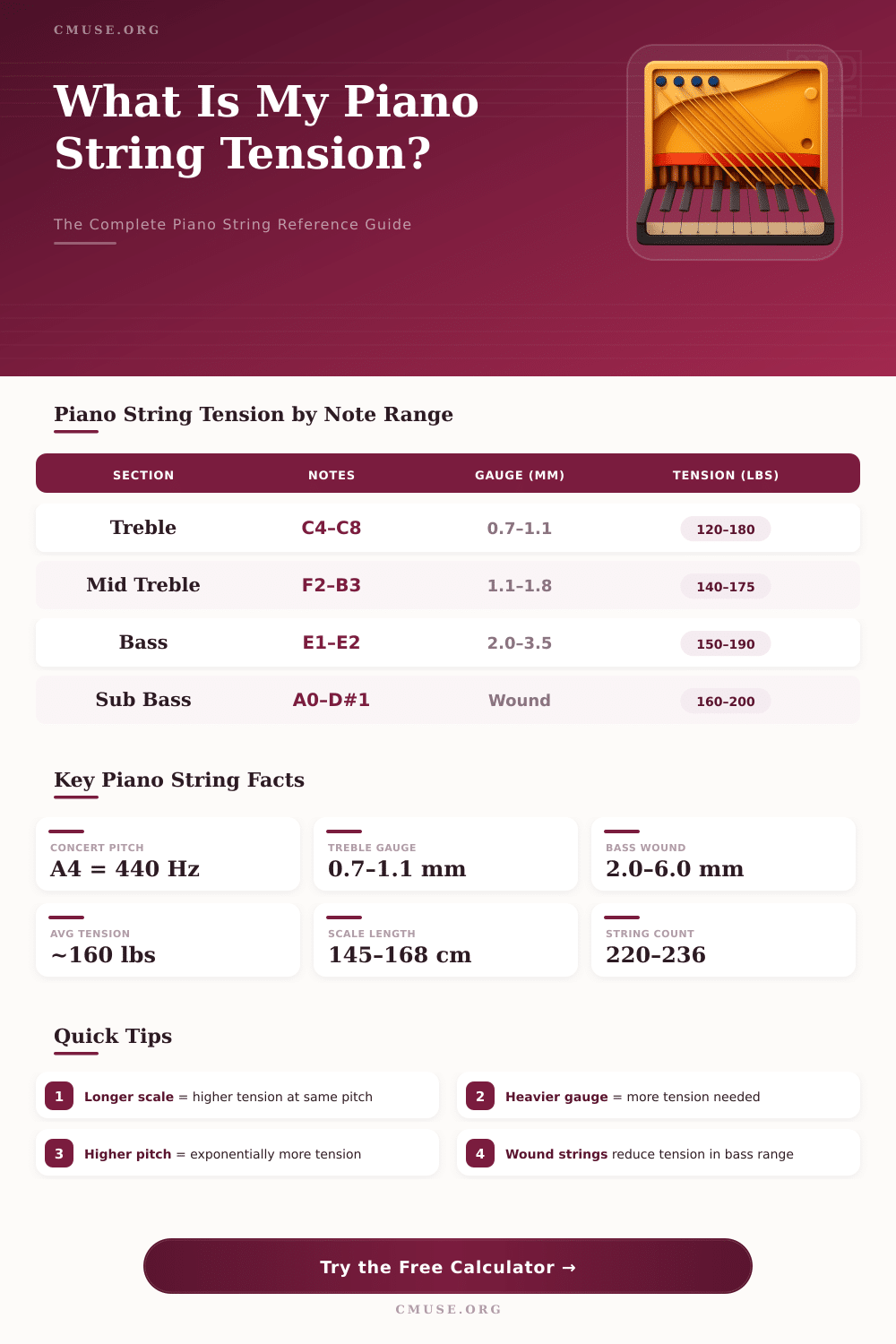
The strings of a piano carry a huge amount of pressure. Each one in a modern instrument matches a piano string tension of around 75 kilos, although this ranges a bit. According to some sources the piano string tension for one string reaches between 160 and 200 pounds.
That shows big piano string tension in one single device.
How Much Tension Is in a Piano?
When one adds all strings, the whole piano string tension becomes huge. In a big piano there are around 230 of them, that together applies almost 20 tons of pressure on the frame. Some models have even up to 236 strings, because the high notes require three for one sound, the middle ones two per note, and the deep use only one each.
Like this builds total tension, that can pass 35 000 pounds.
Especially because of that pianos weigh so much. The heavy metal inside serves only to hold the whole string pull. They lay the frame in pressing, while they stay under high piano string tension.
Those opposite pressures work against one to the others in the whole instrument.
Different patterns exist for piano string tension. Some devices apply low tension ideas, while others choose high. Big tension allows more complete dynamics.
The softest sound from a high-tension piano sounds more strongly then that of low. Both kinds should act the same after good setup, even though they truly sound different during quiet play.
The strings in pianos are surprisingly near to their limit. Wires of a standard big model involves only 50 percent of their maximum piano string tension, when one sets them correctly. That leaves little margin for extra pressure.
If one tries to raise the deepest string to a much higher sound, it almost certainly willbreak before reaching the target. The middle C has almost ten times the frequency of the most low note, so to reach it the piano string tension should grow around 100 times.
The piano string tension does not range a lot between high and deep notes. Short ones give the highest tones, while long ones care about the lowest. But only the length does not work to cover everything.
Piano string tension is the pull, that one must apply to reach the right pitch. In a concert piano, the average for one of them is around 200 pounds of force.