🎹 Piano Key Border Calculator
Calculate exact key counts, total border width, spacing, and octave layout for any piano keyboard design
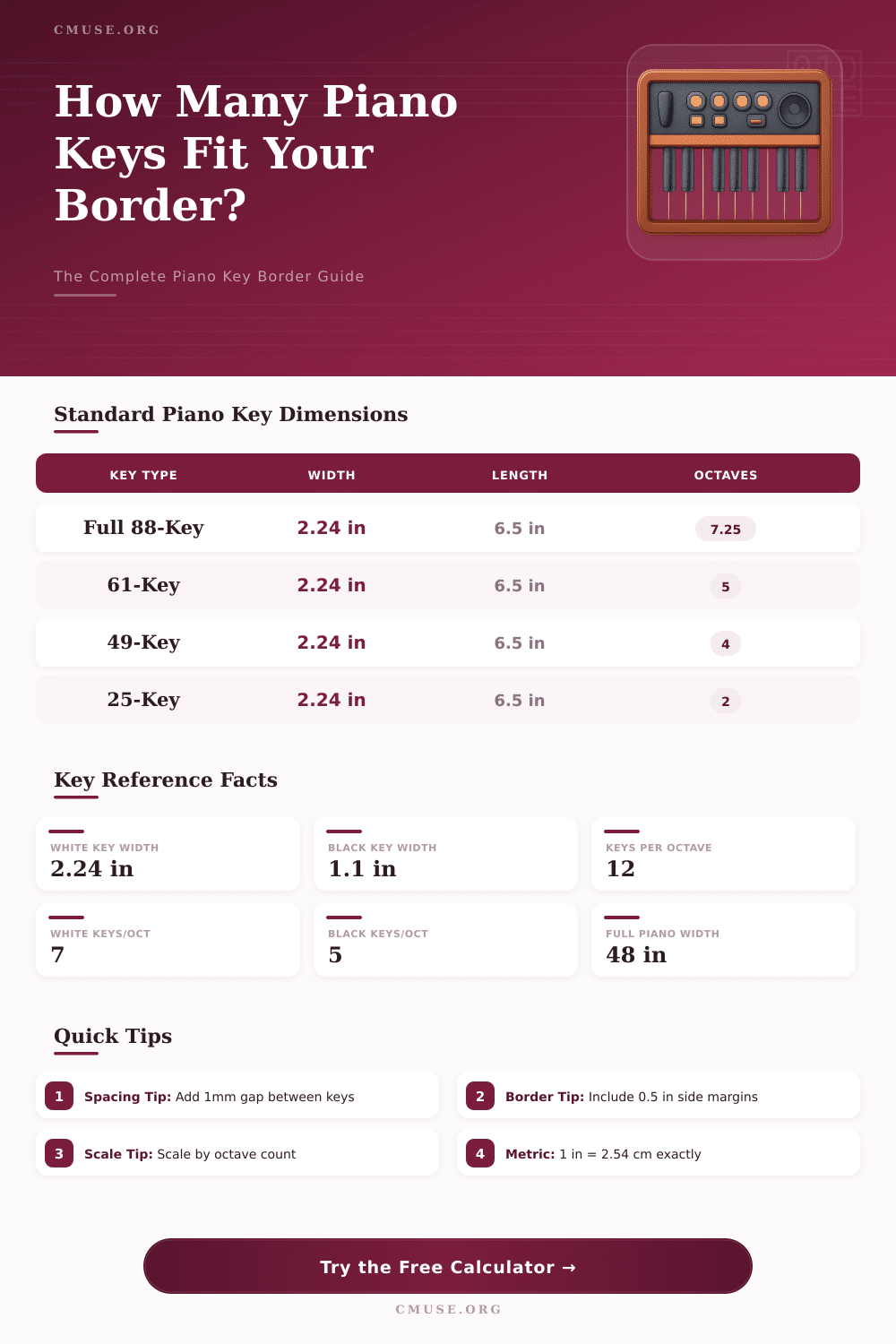
| Keyboard Type | Total Keys | White Keys | Black Keys | Octaves | Total Width (in) | Total Width (cm) |
|---|---|---|---|---|---|---|
| Grand Piano (Full) | 88 | 52 | 36 | 7.25 | 48.0" | 121.9 cm |
| 76-Key Stage Piano | 76 | 45 | 31 | 6.33 | 41.5" | 105.4 cm |
| 61-Key Keyboard | 61 | 36 | 25 | 5.08 | 33.5" | 85.1 cm |
| 49-Key Controller | 49 | 29 | 20 | 4.08 | 26.9" | 68.3 cm |
| 37-Key Keyboard | 37 | 22 | 15 | 3.08 | 20.3" | 51.6 cm |
| 32-Key Keyboard | 32 | 19 | 13 | 2.67 | 17.6" | 44.7 cm |
| 25-Key Mini | 25 | 15 | 10 | 2.08 | 13.8" | 35.1 cm |
| Single Octave | 12 | 7 | 5 | 1.0 | 6.5" | 16.5 cm |
| Octaves | White Keys | Width at 2.24" (in) | Width at 2.24" (cm) | Width at 2.00" (in) | Border Area (sq in) |
|---|---|---|---|---|---|
| 1 | 7 | 15.68" | 39.83 cm | 14.00" | 102.0 |
| 2 | 14 | 31.36" | 79.65 cm | 28.00" | 204.0 |
| 3 | 21 | 47.04" | 119.48 cm | 42.00" | 306.0 |
| 4 | 28 | 62.72" | 159.31 cm | 56.00" | 407.7 |
| 5 | 35 | 78.40" | 199.14 cm | 70.00" | 509.6 |
| 6 | 42 | 94.08" | 238.96 cm | 84.00" | 611.5 |
| 7 | 49 | 109.76" | 278.79 cm | 98.00" | 713.4 |
| 7.25 (88-key) | 52 | 116.48" | 295.86 cm | 104.00" | 757.1 |
| Measurement | Imperial (inches) | Metric (mm) | Ratio to White Key |
|---|---|---|---|
| White Key Width (Grand) | 2.240" | 56.90 mm | 1.00 |
| Black Key Width (Grand) | 1.100" | 27.94 mm | 0.49 |
| White Key Length | 6.500" | 165.10 mm | 2.90 |
| Black Key Length | 3.750" | 95.25 mm | 1.67 |
| White Key Width (61-key) | 2.180" | 55.37 mm | 0.97 |
| Key Gap (standard) | 0.040" | 1.02 mm | 0.018 |
| Border Margin (typical) | 0.500" | 12.70 mm | 0.22 |
| Octave Span (7 whites) | 15.68" | 398.27 mm | 7.00 |
As far as the play of piano depends on the gap between keys, much more than one could imagine. The space between the keys shapes the feeling under your fingers and affects where you play with full trust. If the keys are well spaced and lined up, one gets a more stable and controlled touch.
That results in a richer and more expressive playing style entirely.
Why the Space Between Piano Keys Is Important
Here the key spot: there is no one same rule that all makers follow. However the most many brands ultimately arrive to a bit alike range. When one measures the whole width of an 88-key keyboard, one finds that it ranges between around 48 inches and 48 inches and half.
In metric system that matches to about 122 to 123 centimetres. Sharing the space of the 52 white keys, one can estimate about the width of every white key.
Modern keyboards have an octave span that runs between 164 and 165 millimeters, or around 6 inches and half. Interesting is, that even one millimeter of difference can equal to around 7 millimeters on the whole keyboard width; hear those little differences. The black keys have width of about 13.7 millimeters, give or take.
White keys measure around 23.5 millimeters at the base, without counting the spaces between them. I stripped a vintage Kawai studio model from 1980, where the white keys measured exactly seven-eighths of inch.
The relation in design between black and white keys follows a pattern of 7 against 12. In the back half of the keyboard, the 12 notes spread equally according to widths and spacing. In the front part only the 7 white keys appear, and they also are spaced likewise.
Here where it becomes tricky: C, D and E are a bit broader in the back than F, G and B. If one gives twenty-two units of width to every note, the white keys of C, D and E use 20 units, while F, G and B need 21 units. That is a small change, but it matters for the makers of keyboards and certainly for musicians with big hands.
Over time, the keyboards wear out. The keys become uneven in height, create wrong spacing and lean to various sides. That causes problems while one tries to reach even sound.
Your touch becomes unpredictable. Also, it simply looks messy. For care of piano, one must square and respace the keys in line, and the technicians use special tools for that task.
Wrong spacing of keys happens also on electronic pianos. Some models show bigger gaps between certain white keys, especially around the transition of B to C. On some Kawai electronic models, that tiny unevenness is part of the internal mechanism itself and does not really hurt the playing. Problems start only when the keys stick or rub, then onehas actual trouble.