Piano Interval Calculator
Compare two notes by semitones, cents, frequency ratio, and 88-key span with a piano-focused theory workflow.
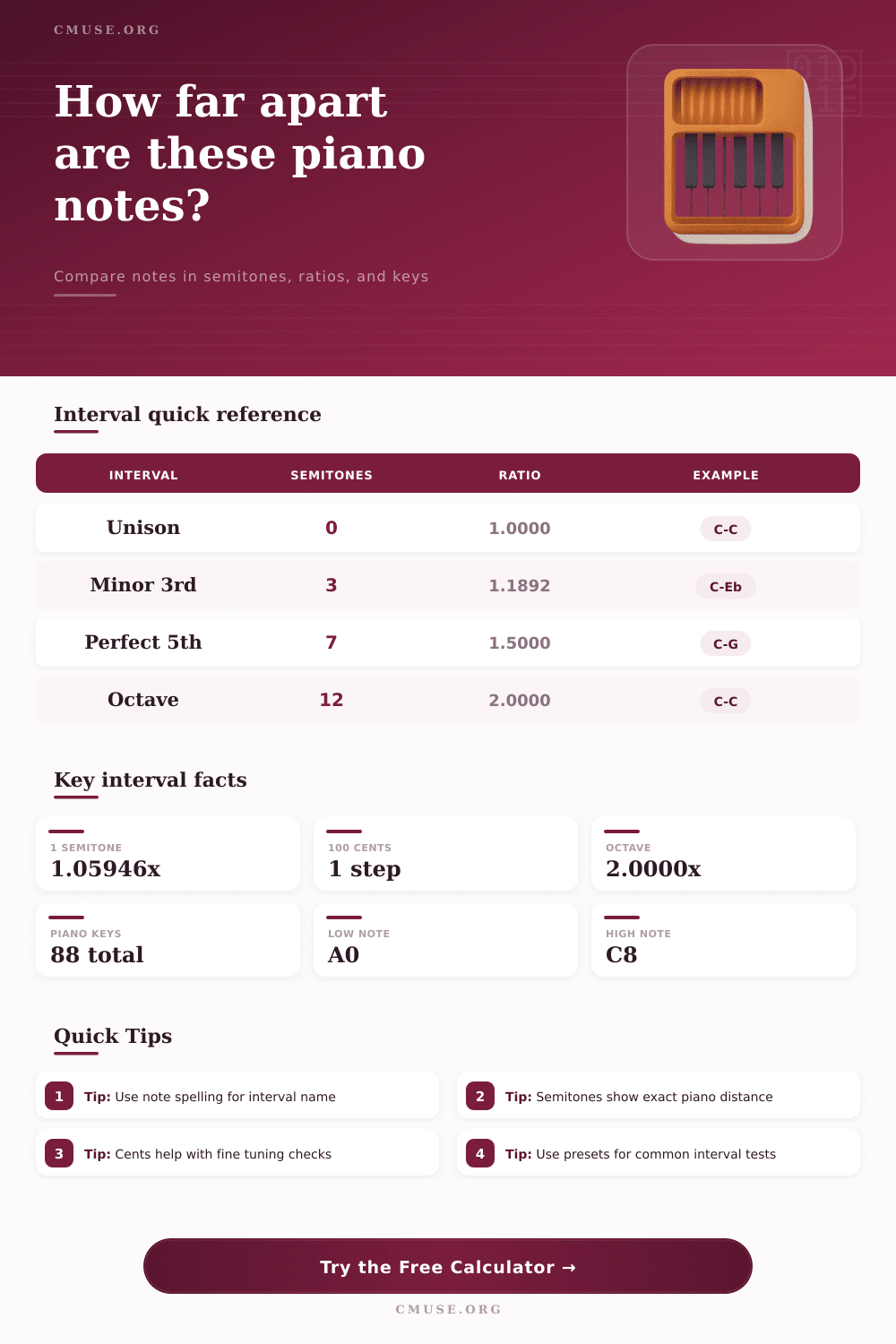
Semitone step
Equal temperament ratio
Octave
Twelve semitones
Cents
Per semitone
Piano range
A0 to C8
| Interval | Semitones | Ratio | Example |
|---|---|---|---|
| Unison | 0 | 1.0000 | C-C |
| Minor third | 3 | 1.1892 | C-Eb |
| Perfect fifth | 7 | 1.5000 | C-G |
| Octave | 12 | 2.0000 | C-C |
| Note | MIDI | Key no. | A4=440 Hz |
|---|---|---|---|
| A0 | 21 | 1 | 27.50 Hz |
| C4 | 60 | 40 | 261.63 Hz |
| A4 | 69 | 49 | 440.00 Hz |
| C8 | 108 | 88 | 4186.01 Hz |
Piano intervals are the distance between two notes on the keyboards. Intervals are for every pair of notes in a chord or scale. That forms one of the main bases of music and its theory
In the C Major scale the space between C and D is a second. D is the second note here. A second interval goes from any white key to the next white key, up or down.
What Are Piano Intervals
Third intervals jump past one white key. From C to F are four notes in the scale, so it is a fourth.
When two white keys stand without a black between them, it is a semitone, half-tone or half-step. It is the smallest distance usually used in Western music. Between white keys happen only two such seconds: E to F and B to C, because there are no black keys between them.
A minor second is a semitone above the base. A major second is a whole tone above it. Minor seconds and thirds are a half step lower than majors.
This defines the quality of intervals.
There are five main interval kinds: minor, major, augmented, diminished and perfect. You build most chords using perfect, major and minor piano intervals. The mark “m7” shows a minor seventh interval.
It is the space of the root in a major scale until the seventh note, but lowered by one semitono.
In piano music intervals can be melodic, notes played one after the other… Or harmonic, so simultaneously. Finding them by ear, melodic and harmonic, is among the most useful music steps.
A good start is to recognize unison, major third and perfect fifth.
Choose an easy interval, as a minor third or perfect fifth, and play it everywhere on the instrument to help build the feeling. The sound of the two notes together stays alike no matter where. Flash cards with various intervals from different notes written also work well.
One way for ear training is to bind interval names to steps in known songs. Intervals really are usefull in many areas, depending on how you practice and use them. First learn them on piano really helps, thanks to the finger positions.
You play intervals in music on every instrument, not only piano. They form a basic, great musical element, simple and practical for understanding scales, chords and how musicworks.