🔧 Piano Hinge Weight Calculator
Calculate load capacity, required hinge length, and number of hinges for any panel or door
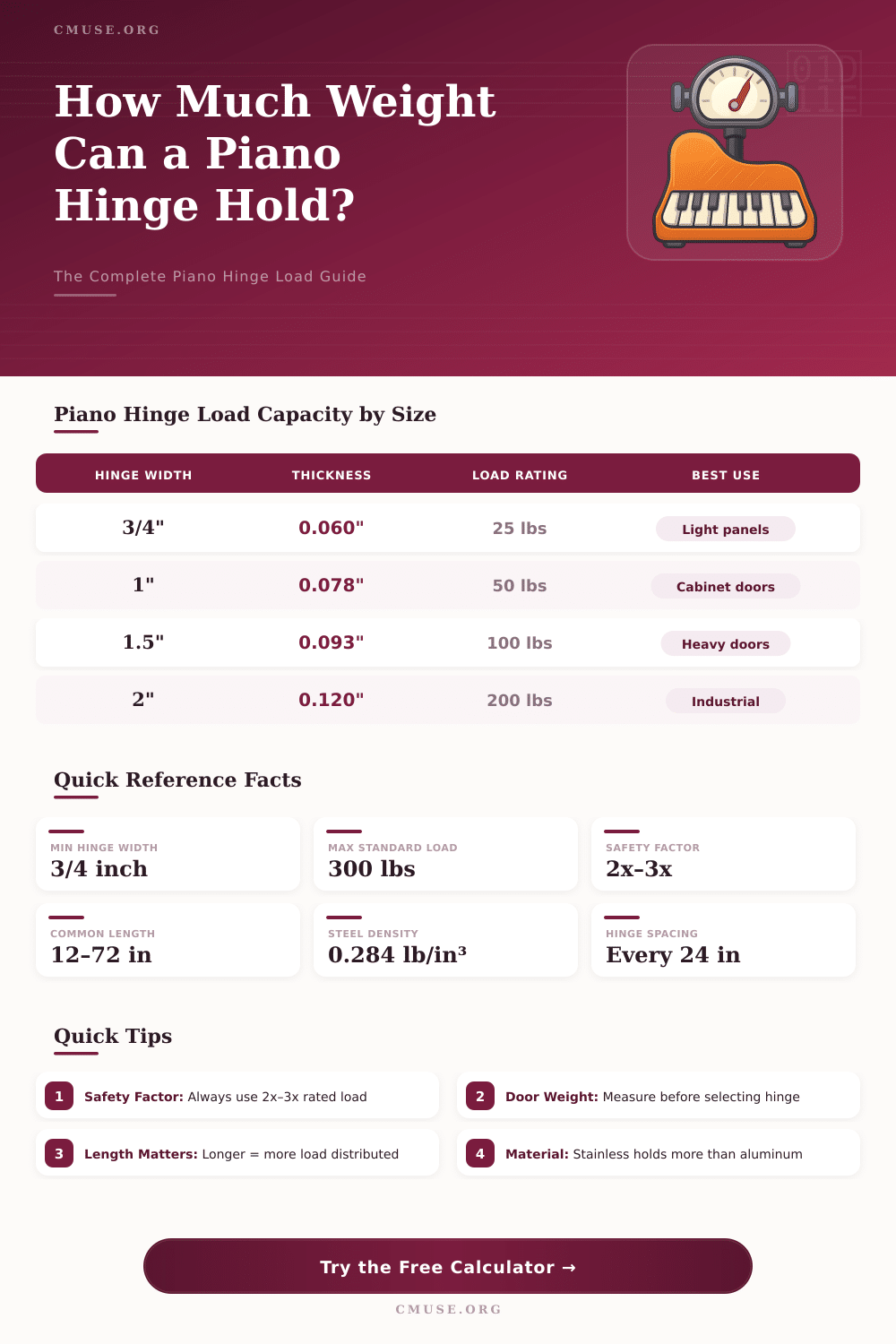
| Hinge Width | Gauge / Thickness | Typical Load (lbs) | Max Load (lbs) | Best Application |
|---|---|---|---|---|
| 3/4 inch | 0.045" (18 ga) | 15 | 25 | Light panels, hobby boxes |
| 1 inch | 0.060" (16 ga) | 30 | 50 | Cabinet doors, small lids |
| 1.5 inch | 0.078" (14 ga) | 60 | 100 | Piano lids, toolboxes |
| 2 inch | 0.093" (13 ga) | 100 | 175 | Heavy doors, access panels |
| 2.5 inch | 0.120" (11 ga) | 175 | 300 | Industrial panels, ramps |
| 3 inch | 0.150" (10 ga) | 300 | 500 | Heavy-duty, stage equipment |
| Hinge Length | Load per Inch (lbs) | Max Panel Weight Supported | Metric Equivalent |
|---|---|---|---|
| 12 inches (1 ft) | ~8 lbs/in | ~96 lbs | 30 cm / 43.5 kg |
| 24 inches (2 ft) | ~8 lbs/in | ~192 lbs | 61 cm / 87 kg |
| 36 inches (3 ft) | ~8 lbs/in | ~288 lbs | 91 cm / 130.6 kg |
| 48 inches (4 ft) | ~8 lbs/in | ~384 lbs | 122 cm / 174.2 kg |
| 60 inches (5 ft) | ~8 lbs/in | ~480 lbs | 152 cm / 217.7 kg |
| 72 inches (6 ft) | ~8 lbs/in | ~576 lbs | 183 cm / 261.2 kg |
| Material | Yield Strength | Corrosion Resistance | Relative Load Capacity | Best For |
|---|---|---|---|---|
| Cold-rolled Steel | ~36,000 psi | Low (needs coating) | 100% (baseline) | General indoor use |
| Stainless Steel 304 | ~30,000 psi | Excellent | 90% | Marine, food, outdoor |
| Stainless Steel 316 | ~28,000 psi | Superior | 85% | Harsh environments |
| Aluminum 6063 | ~11,000 psi | Good | 35% | Lightweight, aircraft |
| Brass | ~15,000 psi | Good | 45% | Decorative, instruments |
| Project | Panel Size | Est. Panel Weight | Recommended Hinge |
|---|---|---|---|
| Piano Lid | 48" x 14" | 12–18 lbs | 48" x 1.5" steel |
| Keyboard Cover | 54" x 10" | 8–12 lbs | 54" x 1" aluminum |
| Cabinet Door (wood) | 24" x 30" | 15–22 lbs | 24" x 1.5" steel |
| Toolbox Lid (steel) | 36" x 14" | 20–35 lbs | 36" x 2" steel |
| Access Panel | 24" x 24" | 18–28 lbs | 24" x 2" steel |
| Stage Riser Lid | 48" x 48" | 55–80 lbs | 48" x 3" heavy duty |
| DJ Booth Panel | 36" x 24" | 20–30 lbs | 36" x 2" stainless |
| Recording Booth Door | 30" x 80" | 60–100 lbs | 80" x 3" heavy duty |
Piano Hinge Weight, also known as continuous hinge, extend through the whole length of door, panel, lid or cover. That type spreads the burden and the tension all along every part of the hinge itself. Rather than shorter hinges, that focus the pressure in just some places, this helps to escape local weaknesses.
Because of the spreading of the weight above many knots and closures, such hinges carry much more than two or three short button hinges from same material.
How Much Weight Can a Piano Hinge Hold
A standard 24-inch piano hinge usually lasts around 60 pounds as maximum burden. So every inch spreads the weight in around 2.5 pounds. Plastic 2-inch piano hinge fits to bear even 100 pounds each straight inch.
For heavy use, such hinges back of 200 until 600 pounds, and special types from aluminium adapt to exact dmeand.
Piano hinges come in various sizes. For draft, one choose the right size. Main thought is the mass of the thing, that one will set.
From store for projects, standard piano hinge probably works for 25-30-pound door. On the other hand, heavy 16.5-inch model with 2-inch open beam and 0.060-inch thickness handles until 70 pounds maximum. The most common 16-inch hinges only carry 20 until 40 pounds, so more sturdy version answers four massive doors, windows or folding furniture.
Brass piano hinge well served for projects. It, with its full-length structure and many fixing points, carries so much weight, how the frame itself fits. When one wants lightweight, but strong and continuous hinge, aluminum types are ideal.
Aluminium does not corrode or rust, and it costs less than other metals. And beyond that, aluminum hinges weigh only half compared to brass or carbonsteel options.
Heavy stainless steel piano hinge lasts changes of temperature very well. Materials of high quality, as 304, 316 or maritime grade 316L, do not bend in high heats and stay stable even in very low cold.
Good information one must know about the effect of sudden braking. The turning force on the most upper hinge or the upper section of piano hinge reaches its biggest size. This upper part suffers the main pull of the force.
One consider that during work with heavy lids or panels. For escape bending, install piano hinges perfectly straight. If screws enter almost all holes, the hinge becomes very solid.
Even so, weight can cause shifting of screws. Use very rugged wooden parts, because the pressure on the hinge screws can be huge. Supports between legs and upper part oflids also helps to remove part of the weight of the hinge.