🎹 Piano Depreciation Calculator
Estimate your piano's current value based on type, age, condition, and brand tier
Per Year
Per Year
Per Year
Per Year
Per Year
Grand
Piano
Floor
| Condition | Description | Value Multiplier | Maintenance Typical |
|---|---|---|---|
| Excellent | Like new, no visible wear | 1.10–1.15x | Annual tuning |
| Good | Minor cosmetic wear, plays well | 0.90–1.00x | Bi-annual tuning |
| Fair | Visible wear, may need minor repair | 0.65–0.80x | Rarely serviced |
| Poor | Significant wear, needs work | 0.35–0.55x | Never / unknown |
| Restoration | Non-playable, parts missing | 0.10–0.25x | Never |
| Age (Years) | Depreciation % | Remaining Value | Approx. Resale |
|---|---|---|---|
| 1 Year | 5% | 95% | ~$2,850 |
| 5 Years | 20% | 80% | ~$2,400 |
| 10 Years | 38% | 62% | ~$1,860 |
| 15 Years | 51% | 49% | ~$1,470 |
| 20 Years | 62% | 38% | ~$1,140 |
| 30 Years | 75% | 25% | ~$750 |
| 50+ Years | 80% | 20% (floor) | ~$600 |
| Piano Type | Length / Height | Weight (lbs) | Weight (kg) |
|---|---|---|---|
| Upright (Spinet) | 36–40 in tall | 200–300 lbs | 90–136 kg |
| Upright (Console) | 40–44 in tall | 350–450 lbs | 159–204 kg |
| Upright (Studio) | 45–48 in tall | 400–500 lbs | 181–227 kg |
| Baby Grand | 4'6–5'1 long | 450–600 lbs | 204–272 kg |
| Medium Grand | 5'1–5'8 long | 600–700 lbs | 272–318 kg |
| Full Grand | 6'2–7' long | 700–900 lbs | 318–408 kg |
| Concert Grand | 7'4–9' long | 900–1,200 lbs | 408–544 kg |
| Digital Piano | 48–54 in wide | 25–60 lbs | 11–27 kg |
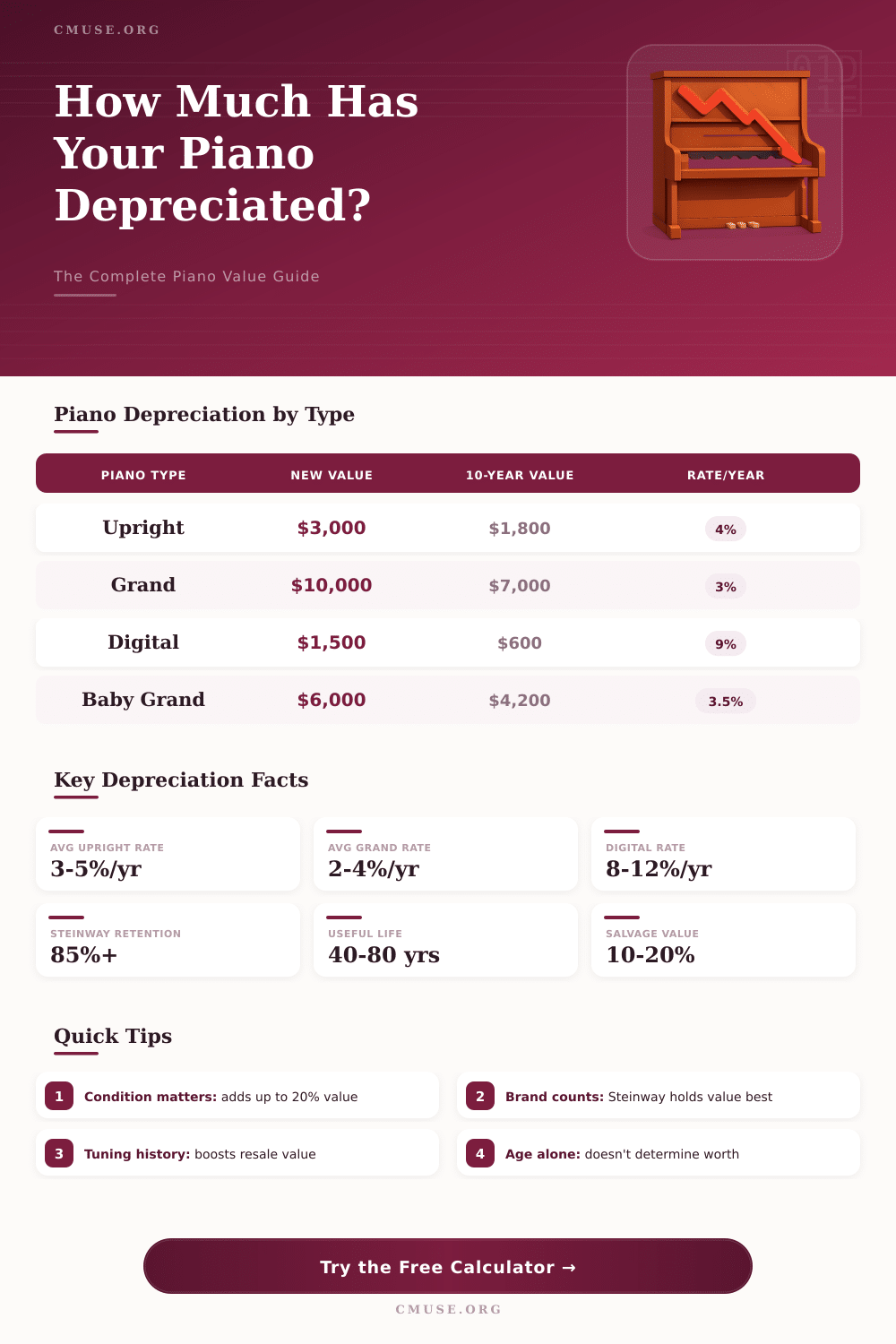
Pianos quickly lose value like cars, when they walk out through the door. The first blow is truly cruel: fresh from the plant piano loses 20 percent of value as soon as it becomes “used”. After that big shock, the losses go more slowly in a steady rhythm.
It drops around 5 percent yearly for the next few years. When a piano reaches the 10-year limit, that yearly sliding finally stops.
How Pianos Lose Value
This pattern counts across the whole world of pianos, regardless of the brand. Whether talking about Yamaha, Steinway, Bösendorfer or some other famous name, new pianos lose value quickly during the first four to five years. One exception happens here, the 20-percent drop comes the immediate moment, when it leaves the store.
That is simply the ways of the market.
Here the ugly truth: pianos do not work as investments. They are only losing-value objects, clearly and without trouble. As they exit from the store, they already lost at least a third of their value.
Even if you care about a well taken care high class instrument, an old piano will not sudenly become collectible because of careful care, that gives precious extra profit.
To estimate the real value of a piano, one uses the method of Piano Depreciation. It works well for fairly new pianos, especially those that are in good shape and recently from production. There is no magic calculator, where you enter the brand, model and year to receive a precise pattern, that does not exist.
Charts of Piano Depreciation help guide you for ratings. What makes everything hard is, that touch, sound, style and size affects the overall quality in very personal ways. Every producer adds his own traits and precious details.
Unlike a violin, acoustic piano truly fails threw use and time. Those instruments permanently decline. Expert technicians with regular attention can slow that decline and keep everything well for decades, but it requires real effort.
The older the piano, the more care it requires. Until finally you must do a full repair. Funny enough, the nicest pianos commonly sit in rooms instead of being played daily.
Choosing a used piano, you can make a wise money decision. A well repaired high class instrument gives 70 to 80 percent of the skill of new, but for only 40 to 50 percent of the price. Someone else already suffered the big Piano Depreciation fall.
So good stores commonly offer used pianos with a 10-year full guarantee. You escape the big Piano Depreciation toll, that you would have buying new. Badly maintained pianos entirely flip the pattern, they are less expensive originally and reselling them is not worth the effort.
Their Piano Depreciation does notfollow a fixed pattern.
For tax purposes, piano belongs to one of two groups: office furniture with a seven-year life or musical gear with a five-year life. If you sell it, you must remove all Piano Depreciation, that you claimed from the original cost, to count your new base.